
The Rise from Chaos #
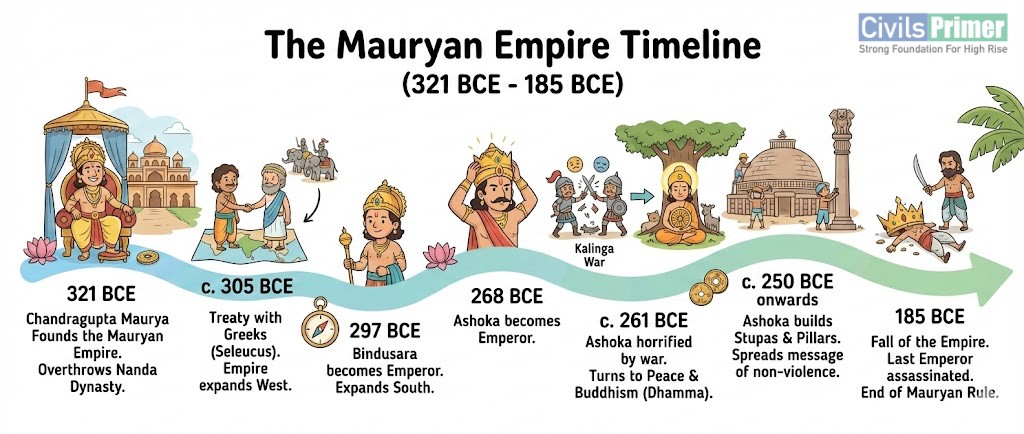
Imagine India around 326 BCE. The northwest is in turmoil because Alexander the Great has just invaded. At this precise moment, deep in the Gangetic plains, a different kind of power struggle is brewing. At the time of Alexander’s invasion (326 BC), the Nanda dynasty was ruling North India, preceding the Mauryas. The Nandas were powerful but unpopular. Enter a young, ambitious man named Chandragupta Maurya, guided by the sharp intellect of his mentor, Chanakya (Kautilya). Together, they orchestrated a revolution. We know the details of this dramatic political takeover not just from history books, but from theatre. The ancient Indian play Mudrarakshasaby Vishakhadatta narrates the court intrigues and the ascent of Chandragupta Maurya to power with Chanakya’s help.
Once Chandragupta secured the throne, he didn’t just sit back. He pushed west to reclaim land from the Greeks. He defeated Seleucus Nicator, Alexander’s general. But instead of eternal war, they made a treaty. Seleucus even sent an ambassador, Megasthenes, to live in the Mauryan capital, Pataliputra. Megasthenes wrote Indica, giving us a window into the Mauryan military and society. Simultaneously, Chanakya wrote the Arthashastra, a masterclass in statecraft. It wasn’t just about war; it was about social law. For instance, contrary to rigid later norms, the Arthashastraallows for divorce (Moksha) to a wife deserted by her husband.
The Height of Power – Ashoka the Great #

Chandragupta’s son, Bindusara, expanded the empire southwards, but the story truly transforms with his son, Ashoka. When we look at history through stone inscriptions, Ashoka is a mysterious figure. For a long time, we didn’t even see his name. In his inscriptions, Ashoka is generally referred to by the titles Devanampriya (Beloved of the Gods) and Priyadarsi (He who regards others with kindness). It wasn’t until much later discoveries that we confirmed his identity. The personal name “Ashoka” is explicitly mentioned in the Maski, Gurjara, Nittur, and Udegolam Minor Rock Edicts, rather than his usual titles.
The Turning Point: Kalinga – Ashoka began as a conqueror. His most famous campaign was against Kalinga (modern-day Odisha). Why was this region so critical? Ashoka annexed Kalinga to the Mauryan Empire primarily because Kalinga controlled the important land and sea routes to South India and Southeast Asia. But the war was a bloodbath. In Major Rock Edict XIII, Ashoka confesses his remorse. This horror drove him toward Buddhism and a new philosophy called Dhamma.
The Policy of Dhamma #
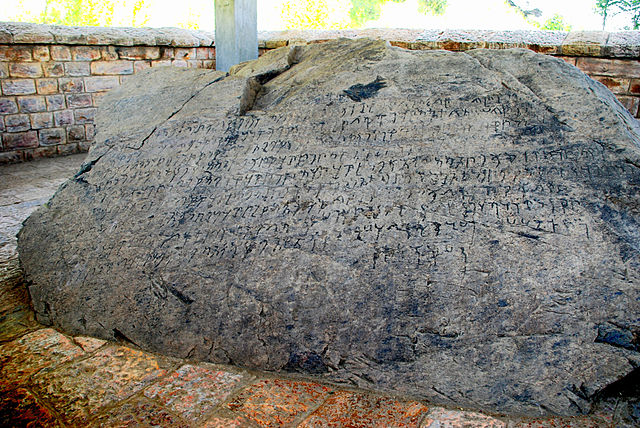
Ashoka’s Dhamma was not a new religion, nor was it strictly Buddhism. It was a code of conduct for being a good human. Ashoka’s edicts emphasized social harmony and equity among the people, considering these more important than religious devotion. He preached tolerance above all else. In a world of conflicting sects, he set a golden rule: It was Ashoka (in Major Rock Edict XII) who inscribed that whosoever praises their own sect or blames others out of excessive devotion injures their own sect severely.
He wanted this message to reach everyone, so he inscribed it across his vast empire. But he didn’t use just one language. He adapted to the local literacy. While most inscriptions are in Brahmi, the inscriptions at Mansehra and Shahbazgarhi are in Kharosthi (written right to left), and Kandahar inscriptions use Greek and Aramaic. His influence reached the deep south, beyond his borders. The Major Rock Edicts II and XIII of Ashoka mention the southern kingdoms of the Cholas, Pandyas, Satyaputras, and Keralaputras.
Administration and Economy #
The Mauryan state was a well-oiled machine. They had to be, to manage such a vast territory and handle crises like famines. In fact, we have physical proof of their disaster management. The Sohgaura Copper-plate inscription is the earliest known royal order (from the Mauryan period) to preserve food grains for use during crises/famines.
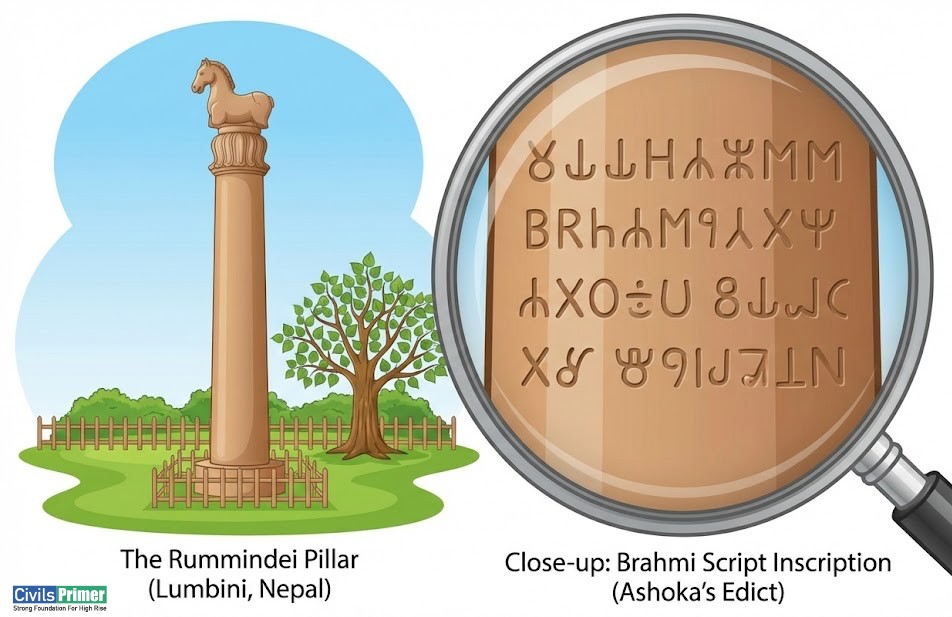
Ashoka also traveled to connect with his roots. He visited Lumbini, the birthplace of the Buddha. He didn’t just pray; he offered economic relief. The Rummindei Pillar inscription records Ashoka’s visit to Lumbini (Buddha’s birthplace), where he exempted the village from Bali and reduced the Bhaga (tax) to one-eighth.
Art in Stone #
The Mauryas were the first to use stone on a massive scale, leaving a legacy that defines Indian art today.
The Pillars: You might have seen Ashokan pillars in museums. It is crucial to understand their structure. Ashokan stone pillars are monolithic (carved from a single piece of stone), highly polished, and tapering; they are independent freestanding structures, not part of architectural buildings. They were not supporting roofs; they were the monument. The most famous of these is the one we see on official government documents today. The Lion Capital, which is the national emblem of India, is located at Sarnath and was built by Ashoka.
The Caves: The Mauryas also pioneered rock-cut architecture. However, there is a common misconception about the famous Barabar Caves. The Barabar rock-cut caves were originally made for the Ajivikas sect by Ashoka and his successor Dasaratha, not by Chandragupta Maurya. This shows the pluralistic nature of royal patronage—supporting sects other than their own.
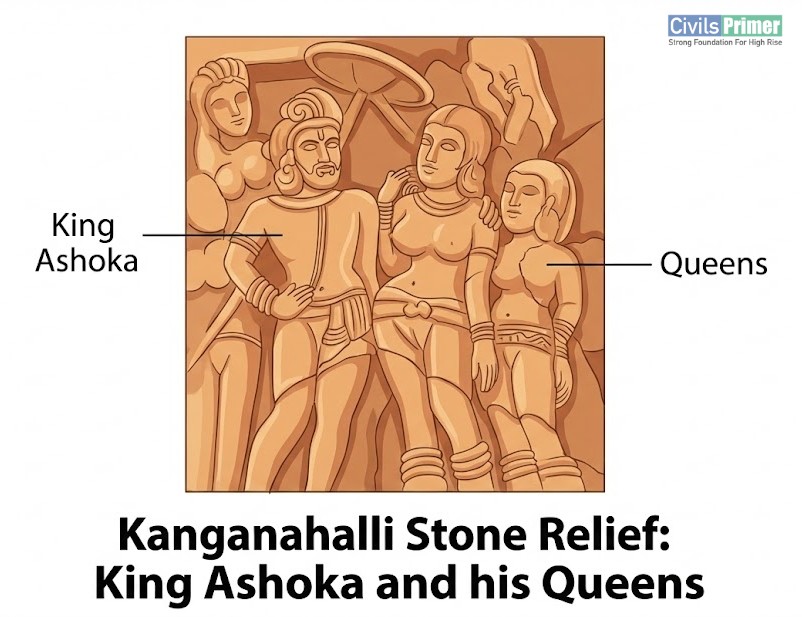
The Portrait: For centuries, we only had words describing Ashoka. We lacked a face to put to the name. That changed with a discovery at a stupa site in Karnataka. The relief sculpture inscription mentioning “Ranyo Ashoka” (King Ashoka) along with a stone portrait of the king was found at Kanganahalli (Karnataka).
The Decline #
Despite the grandeur, the empire could not last forever. After Ashoka, the grip of the center weakened. The end was violent and abrupt. The last Mauryan ruler, Brihadratha, was assassinated by his commander-in-chief, Pushyamitra Sunga, who then founded the Sunga dynasty. This marked the end of India’s first great empire (around 185 BC), paving the way for the Sunga dynasty and a resurgence of Brahmanical influence.
Facts to Note #
- Sarnath: Where the Lion Capital stands.
- Sohgaura: Where the famine relief copper plate was found.
- Lumbini: Where Ashoka reduced the tax (Bali and Bhaga).
- Kanganahalli: Where the portrait of Ashoka was found.
- Maski: Where the name “Ashoka” (not just the title) appears.
Mains PYQs #
- 2022: Discuss the significance of the lion and bull figures in Indian mythology, art, and architecture.
- 2020: The rock-cut architecture represents one of the most important sources of our knowledge of early Indian art and history. Discuss.
- 2016: Early Buddhist Stupa art, while depicting folk motifs and narratives, successfully expounds Buddhist ideals. Elucidate.
- 2015: Delineate the nature and impact of India’s contact with Western Asia and the Mediterranean world during the Mauryan period.
- 2014: Discuss different interpretations of historians about the nature of Ashoka’s dhamma. Did his principle of dhamma-vijaya render the Mauryan Empire militaristically weak?
- 2012: Examine the role of Adhyaksha in the Mauryan administration.
- 2010: Assess the role of guilds and trade organisations in the development of the early Indian economy.
Answer Writing Minors #
Regarding the Magadha and Mauryan Empire, here are a common introduction and conclusion suitable for All UPSC Mains subjective questions on Mauryan Empire Art, Administration and Modern Utility.
- Common Introduction The Magadha region, serving as the nucleus of India’s first pan-Indian empire under the Mauryas, established the foundational administrative, artistic, and ethical frameworks of early Indian civilization. The enduring relevance of this era is evident today, with significant sites like Sarnath—where Emperor Ashoka erected the famous Lion Capital—recently being officially nominated by India for the UNESCO World Heritage List for the 2025-26 cycle.
- Common Conclusion In conclusion, the architectural and intellectual heritage of the Mauryan era, epitomized by the global recognition of Sarnath and the revival of ancient learning centres like Nalanda, continues to anchor India’s cultural identity and soft power diplomacy,. Preserving these historical footprints is essential not only for understanding India’s imperial past but also for reinforcing its civilizational continuity in the modern geopolitical landscape.
Current Affairs Linkage #
The Mauryan Empire
- Nomination of Sarnath for UNESCO World Heritage List: India has officially nominated Sarnath for inclusion in the UNESCO World Heritage List for the 2025–26 cycle. The site holds immense historical and spiritual significance as the place where Lord Buddha delivered his first sermon (Dhammachakra Pravartana). It is also closely associated with Emperor Ashoka, who erected the iconic Lion Capital Pillar—now India’s national emblem—and commissioned several monastic structures, including the Dhamek Stupa. (October, 2025)
- Hockey Asia Cup Held in Rajgir (Ancient Capital of Magadha): The 12th Men’s Asia Cup Hockey Championship was hosted at the Rajgir International Stadium. Rajgir, historically known as Rajagriha, served as the first capital of the Magadha kingdom and remains a site of major historical and cultural significance in ancient Indian history. (October, 2025)
- Inauguration of New Nalanda University Campus: A new campus of Nalanda University was inaugurated near the ancient ruins in Rajgir, Bihar. The historic Nalanda Mahavihara was one of the world’s earliest residential universities and a renowned centre of learning in ancient and medieval Magadha, attracting scholars from across Asia for studies in philosophy, science, and Buddhist traditions. (July, 2025)