
Prehistory refers to the period of human history for which we have no written records. It is primarily reconstructed using archaeological sources like stone tools, pottery, artefacts, and bone remains.
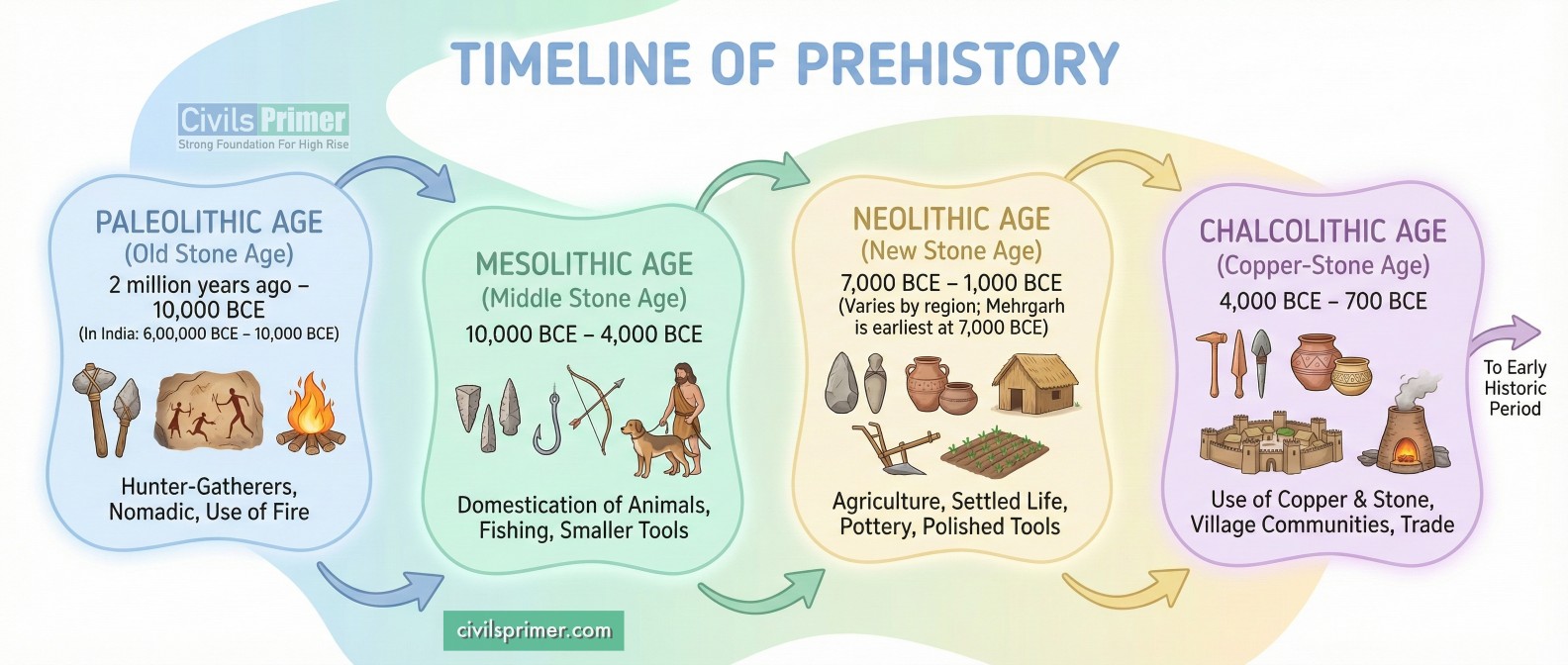
Geological Context: The Paleolithic Age developed during the Pleistocene period (Ice Age). The Mesolithic and Neolithic ages belong to the Holocene era (warmer climate), which began around 10,000 years ago.
Human Evolution in India: No early human fossils associated with Stone Age tools have been found in India, except for a Homo erectus fossil skull in Hathnora (Narmada Valley). Modern humans (Homo sapiens) arrived from Africa at least 74,000 years ago.
Palaeolithic Age (Hunters and Food Gatherers) #
This period covers 99% of human history and is characterised by the use of rough, unpolished stone tools.
Characteristics:
- Lifestyle: People were nomadic hunter-gatherers, living in caves and rock shelters. They lived in bands of 50-60 people.
- Tools: Made of hard rock called Quartzite (hence people are called ‘Quartzite men’). Tools included hand axes, cleavers, and choppers.
- Fire: Traces of ash found in Kurnool caves suggest familiarity with fire.
- Ostriches: Found in India during this period; eggshells were discovered at Patne, Maharashtra.
Three Phases of Paleolithic Age:
- Lower Paleolithic (6,00,000 – 1,50,000 BCE): Use of hand axes and cleavers. Sites: Soan Valley (Pakistan), Belan Valley (UP), Hunsgi (Karnataka).
- Middle Paleolithic (1,50,000 – 35,000 BCE): Flake tools like scrapers and borers. Sites: Nevasa, Narmada Valley.
- Upper Paleolithic (35,000 – 10,000 BCE): Blades and burins. Appearance of Homo sapiens. Sites: Kurnool, Bhimbetka.
Mesolithic Age (Hunters and Herders) #
This was a transitional phase coinciding with the shift to a warmer climate, leading to the development of grasslands and an increase in grass-eating animals.
- Technological Shift
- Microliths: The characteristic tools were tiny stone artifacts (less than 5 cm) called microliths. These were often hafted onto bone or wood handles to make saws and sickles.
- Subsistence
- Shifted from big animal hunting to small animal hunting and fishing.
- Domestication: Earliest evidence of animal domestication (sheep, goat) comes from Bagor (Rajasthan) and Adamgarh (MP) around 5000 BCE. The first animal to be tamed was the wild ancestor of the dog.
- Burial Practices: Grave goods indicate religious beliefs; burials in Langhnaj and Damdama show specific orientations.
- Key Sites: Bagor (largest site), Sarai Nahar Rai, Mahadaha (bone artifacts), Langhnaj (pottery present)
Neolithic Age (Food Producers) #
Termed the “Neolithic Revolution” by V. Gordon Childe, this age introduced food production.
- Major Innovations:
- Agriculture: People became farmers, cultivating wheat, barley, ragi, and horse gram. Mehrgarh (Pakistan) provides the earliest evidence of wheat and barley. Koldihwa (UP) shows the earliest evidence of rice.
- Settled Life: Emergence of self-sufficient villages. Houses were made of mud and reed; pit-houses (dug into the ground) are found in Burzahom.
- Tools: Polished stone tools, stone axes (Celts), mortars, and pestles for grinding grain.
- Pottery: Emergence of wheel-turned pottery (Black burnished ware, Grey ware) for storing surplus grains.
- Clothing: People began weaving cloth using cotton and wool.
- Regional Variations:
- North-Western: Rectangular axes (e.g., Kashmir).
- North-Eastern: Polished axes with rectangular butt; Daojali Hading (Assam) yielded Jadeite stone brought from China.
- Southern: Axes with oval sides
UPSC PYQs (Prelims + Mains) #
Prelims:
- 2021: “Acheulian culture” is associated with? Ans: Handaxes and cleavers
- 2020: Mesolithic sites are characterized by? Ans: Microliths
- 2018: Statements regarding Bhimbetka rock paintings. Ans: They depict hunting scenes and animal figures (Statement that they belong only to Paleolithic is incorrect).
- 2012: Earliest evidence of human occupation in India? Ans: Narmada Valley
- 2004: Which one is a Neolithic site? Ans: Chirand.
Mains PYQs #
- 2020: “The rock-cut architecture represents one of the most important sources of our knowledge of early Indian art and history. Discuss.”
- Key Point: Mention Mesolithic rock-cut designs at Bhimbetka and their evolution into complex structures like Ajanta/Ellora.
- 2015: “Mesolithic rock cut architecture of India not only reflects the cultural life of the times but also a fine aesthetic sense comparable to modern painting. Critically evaluate.
Current Affairs Linkage #
| July 2025 | Discovery of Neolithic Site at Daojali Hading (Assam): A Neolithic habitation site was unearthed in the Dima Hasao district of Assam. Key findings include polished double-shouldered celts, cord-marked pottery, mortars, pestles, and evidence of early metallurgy (furnace and iron slag). These findings date back over 2,700 years and link the site to the broader Eastern and Southeastern Asian Neolithic cultural complex,. |
| July 2025 | Inclusion of Erra Matti Dibbalu in UNESCO Tentative List: The rare red sand dunes (Erra Matti Dibbalu) near Visakhapatnam, Andhra Pradesh, have been included in the UNESCO Tentative List of World Heritage Sites. These formations, belonging to the late Quaternary period, are significant for pre-history as stone tools and pottery from the microlithic, mesolithic, and paleolithic periods have been discovered there, indicating early human habitation. |
| August 2025 | Threat to India’s Fossil Heritage: Concerns were raised regarding the theft and lack of protection for India’s diverse fossil record, which ranges from the Precambrian to Cenozoic eras. Significant mentions include the 47-million-year-old giant snake Vasuki indicus and dinosaur nests found in the Narmada Valley and Kutch. The news highlights the absence of a national fossil protection law to safeguard these pre-historic evolutionary insights. |