
Imagine India in 1947 as a massive ship that had just won its freedom but was damaged, poor, and lacking direction. The captains of this ship (our freedom fighters) knew they couldn’t just let the ship drift. They needed a map and a schedule to rebuild the engine (Industry) and feed the crew (Agriculture). This process of creating the map is called Economic Planning. It was a journey from the “Command and Control” of the Planning Commission to the “Cooperative Partnership” of NITI Aayog.
The Era of Five-Year Plans: The First Map #
Inspired by the Soviet Union, India decided to plan its economy in 5-year blocks. The Planning Commission was set up in 1950 (via an executive order, not the Constitution) with the Prime Minister as its Chairperson,.
The Four Compass Points (Goals of Planning): Every plan, regardless of the year, aimed at four things:
1. Growth: Increasing the size of the national cake (GDP).
2. Modernization: Adopting new technology (like new seeds in farming or machines in factories) and social changes (empowering women).
3. Self-Reliance: Reducing dependence on foreign countries for essentials (food, fuel, capital).
4. Equity: Ensuring the poor get a piece of the cake (reducing inequality).
The Journey Through the Plans:
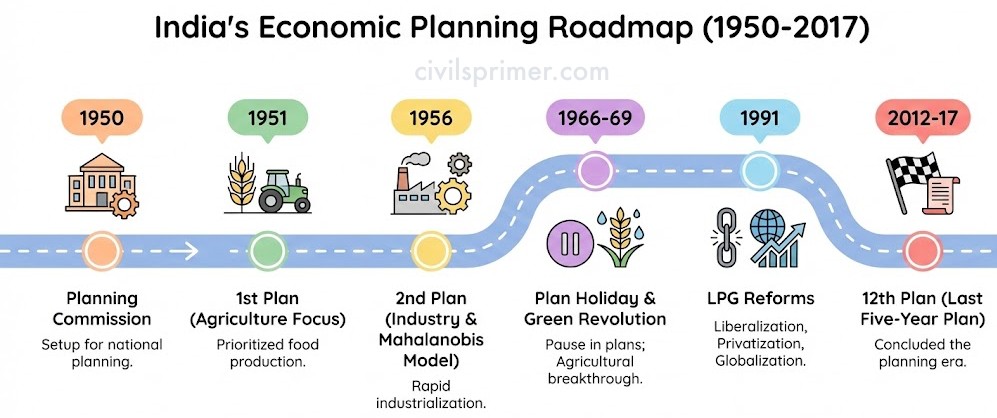
- The Start (1st Plan 1951-56): Focused on agriculture to solve food shortage. It was based on the Harrod-Domar Model.
- The Big Push (2nd Plan 1956-61): The ship needed an engine. Based on the Mahalanobis Model, this plan focused on heavy industries (steel, machinery),.
- The Crisis & Response (3rd & 4th Plans): Wars and droughts hit the ship. The government shifted focus back to agriculture, launching the Green Revolution to achieve self-sufficiency in food,.
- The Social Turn (5th & 6th Plans): The slogan “Garibi Hatao” (Remove Poverty) became central. The focus shifted to the poorest of the poor.
- The Reform (8th Plan onwards): After the 1991 crisis, the economy opened up (LPG Reforms). Planning changed from “doing everything” to “helping the private sector grow” (Indicative Planning).
- The Final Leg (11th & 12th Plans): The focus shifted to “Inclusive Growth”. The 12th Plan’s motto was “Faster, Sustainable and More Inclusive Growth”.
Planning Commission vs. NITI Aayog: The Changing of the Guard #
By 2014, the old map wasn’t working. The Planning Commission was seen as a “Headmaster” sitting in Delhi, telling states what to do. It followed a “Top-Down” approach. It controlled the money strings (allocating funds to states), often ignoring local needs.
On January 1, 2015, the government replaced it with NITI Aayog (National Institution for Transforming India).
| Feature | Planning Commission (The Old Boss) | NITI Aayog (The New Partner) |
| Approach | Top-Down (Center tells States). | Bottom-Up (States tell Center). |
| Role | Policymaker & Funder. | Think Tank & Advisor. |
| Money Power | Could allocate funds to States/Ministries. | No power to allocate funds (Finance Ministry does it now). |
| Member Role | States were spectators (NDC meetings). | States are active partners (Governing Council). |

Cooperative Federalism: The New Philosophy #
NITI Aayog is built on the principle that “Strong States make a Strong Nation.” This is Cooperative Federalism. It means the Central Government and State Governments are teammates, not rivals.
How NITI does it:
1. Team India Hub: It provides a platform where the Centre and States sit together to solve issues.
2. Competitive Federalism: NITI Aayog ranks states on Health, Water, and Innovation. This forces states to compete to be the best, improving governance.
3. Flexibility: Unlike the rigid Five-Year Plans, NITI allows states to make plans suited to their specific geography and culture.

Aspirational Districts Programme (ADP): Fixing the Weakest Links #
Imagine the Indian train is moving fast, but some compartments (districts) are rusty and slowing it down. The Aspirational Districts Programme (launched in 2018) aims to fix these 112 most under-developed districts.
The Strategy (3 Cs):
- Convergence: Bringing together different government schemes (Central and State) so they work in harmony.
- Collaboration: Central officers, State officers, and District Collectors working together.
- Competition: Districts are ranked monthly. If a district improves its delta (change), it gets rewarded. This creates a “naming and shaming” or “fame” motivation.
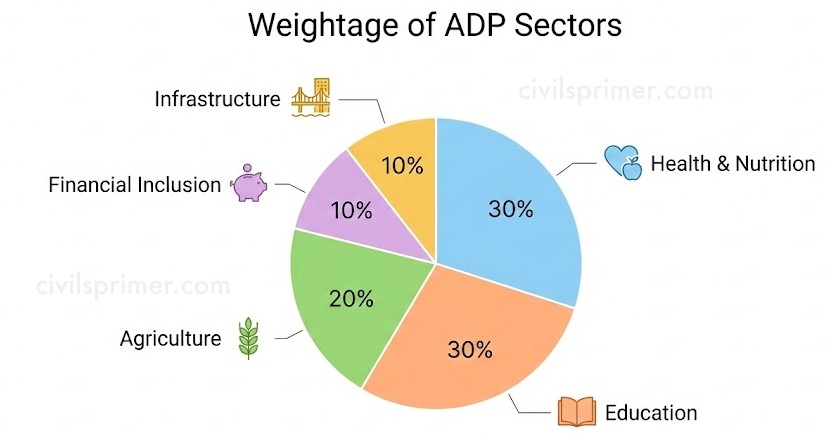
Focus Areas: The districts are judged on 5 themes: Health & Nutrition, Education, Agriculture, Financial Inclusion, and Infrastructure.
The Vision Ahead: Strategy for New India @75 #
Since we stopped Five-Year Plans in 2017, how do we plan now? NITI Aayog released a document called “Strategy for New India @75” (marking the 75th year of independence in 2022).
It replaced the rigid 5-year structure with a dynamic Three-Tier Framework:
- 15-Year Vision: Broad goals.
- 7-Year Strategy: Specific roadmap to convert vision into reality.
- 3-Year Action Agenda: Concrete tasks and targets to be achieved immediately.
Key Focus Areas:
- Doubling Farmers’ Income: By modernizing agriculture and marketing (e-NAM).
- Infrastructure: Housing for all, 100% electricity (Saubhagya), and digital connectivity.
- Inclusion: Focus on women, tribals, and the poor.
Summary Checklist for Prelims #
- Origin: Planning concept derived from Russia (USSR).
- Mahalanobis Model: Used in the 2nd Five-Year Plan; focused on heavy industries.
- Planning Commission vs NITI: NITI is an executive body (not constitutional), acts as a Think Tank, and cannot allocate funds.
- NDC: The National Development Council gave final approval to 5-Year Plans.
- Aspirational Districts: Focuses on 3 Cs (Convergence, Collaboration, Competition).
Mains PYQs: Economic Planning UPSC Exam #
Planning in India and NITI Aayog Mains PYQs
- 2020: Explain the rationale behind the Goods and Services Tax (Compensation to states) act of 2017. How has COVID-19 impacted the GST compensation fund and created new federal tensions? (Topic: Cooperative/Fiscal Federalism)
- 2018: How are the principles followed by the NITI Aayog different from those followed by the erstwhile Planning Commission in India? (Topic: Planning Commission vs NITI Aayog)
Latest Current Affairs: Economic Planning UPSC Exam #
Planning in India and NITI Aayog – Current Affairs
| [November, 2025] -> NITI Aayog Unveils Reimagining Agriculture Report: NITI Aayog’s Frontier Tech Hub released a roadmap for technology-led agricultural transformation. It proposes a Digital Agriculture Mission 2.0 to integrate AI, IoT, and drones to enhance productivity and farmer incomes, aligning with the Viksit Bharat 2047 vision. |
| [October, 2025] -> Launch of Frontier 50 Initiative for Aspirational Districts: NITI Aayog announced the ‘Frontier 50 Initiative’ to deploy advanced technologies in 50 Aspirational Districts and Blocks. The initiative aims to bridge the digital divide by saturating government services in health, education, and skilling through public-private partnerships,. |
| [October, 2025] -> Roadmap on AI for Inclusive Societal Development: NITI Aayog released a strategic plan to empower India’s informal workforce using AI. It proposes a “Digital ShramSetu Mission” to integrate social security and skilling, aiming to transform AI from a disruptor into an instrument of social inclusion for 490 million workers,. |
| [October, 2025] -> Strategy for Harnessing Blue Economy: NITI Aayog released a report outlining a roadmap for India’s deep-sea and offshore fisheries. It recommends drafting a national EEZ Fisheries Act and establishing a Deep-Sea Fisheries Authority to boost exports and modernize the sector,. |
| [October, 2025] -> Debate on Fiscal Federalism and NITI Aayog’s Role: Discussions on restoring state fiscal space highlighted the shift from the Planning Commission’s resource allocation role to NITI Aayog’s deliberative function. Concerns were raised that the Governing Council must remain a platform for genuine Cooperative Federalism rather than political contestation,. |
| [August, 2025] -> India Electric Mobility Index (IEMI) 2024: NITI Aayog launched the IEMI to track and rank the EV transition performance of States/UTs. This index fosters competitive federalism by benchmarking states on transport electrification, charging infrastructure, and innovation ecosystems,. |
| [August, 2025] -> Rethinking Homestays Policy Framework: NITI Aayog released a report to standardize and boost the homestay sector across states. The document serves as a strategic roadmap to enhance tourism entrepreneurship and economic opportunities at the local level. |
| [August, 2025] -> Unlocking $200 Billion EV Opportunity Report: A NITI Aayog report outlined investment strategies to accelerate electric vehicle adoption. It emphasizes the need for key reforms to position India as a global manufacturing hub, projecting a $200 billion market opportunity by 2035. |
| [January, 2025] -> Fiscal Health Index (FHI) 2025: NITI Aayog launched the FHI to evaluate the fiscal health of 18 major states. Using CAG data, it tracks metrics like quality of expenditure, revenue mobilization, and debt sustainability to encourage fiscal prudence among states. |
| [January, 2025] -> Trade Watch Quarterly Report: NITI Aayog released its flagship analytical report tracking India’s quarterly trade performance. It highlighted growth in IT services and pharmaceuticals while identifying challenges in labour-intensive sectors like textiles, aiding data-driven policy planning. |