
Imagine stepping into a time machine and landing in the Indo-Gangetic plains around the 6th Century BCE. You have left behind the pastoral, tribal life of the Early Vedic age. The landscape has transformed. The dense forests that once covered the Gangetic basin are being cleared, not just by fire, but by a revolutionary new metal: Iron. This clearing of forests has paved the way for large territorial states to emerge. These are no longer small tribes (Janas); they have expanded into massive territories known as Mahajanapadas. As you walk through this new world, you witness the birth of India’s Second Urbanisation (the first being the Harappan civilization). Let us explore the story of this era through its economy, its cities, and its power struggles.

The Green Revolution of Antiquity #
The journey begins in the fields. You notice that the farmers are no longer randomly scattering seeds. They have adopted a sophisticated technique called Paddy transplantation. They grow saplings separately and then transplant them into waterlogged fields. This method is backbreaking work, often done by dasas (slaves) and kammakaras (labourers), but the results are miraculous. Combined with the fertile alluvial soil and the heavy iron ploughshare, Rice cultivation yields have skyrocketed. This surplus grain is the heartbeat of this era. It feeds the growing population and, more importantly, fills the King’s granaries.
You walk past a wealthy farmhouse. The owner is a Gahapati. In the Vedic texts, he was just a householder, but now, he has evolved into a wealthy landowner and the head of a production unit. He controls the land, the resources, and the labor
The King’s Treasury and the Taxman #
Because the fields are producing surplus, the King demands his share. The voluntary offerings of the past have turned into a mandatory system. You witness a feared official walking through the village—the Balisadhaka. He is the officer appointed specifically for Tax collection. He ensures that the King receives his Bhaga (share), typically fixed at one-sixth of the produce.
To manage this complex administration, the King cannot rule alone. He appoints high-ranking officers. You see the Ayukta, a class of officials performing executive functions, working alongside ministers to maintain order. At the local level, the village is managed by the Gramini (or Gramabhojaka). He is a powerful figure—part landlord, part policeman, and the bridge between the village and the King
The Shiny Black Cities #
Leaving the village, you enter a bustling city. The architecture has changed. Gone are the flimsy mud huts; you now see sturdy structures made of Burnt bricks. The sanitation system has also evolved. You look down to see rows of terracotta rings sunk deep into the ground. These are Ring wells, used as drains and soak pits, a distinct feature of this urban phase.
Inside the city market, a wealthy merchant, known as a Setthi, is conducting business. He represents the new financial power, often organizing trade guilds (shrenis). The Setthi is holding a piece of pottery that looks like black metal. It has a glossy, mirror-like shine. This is the famous Northern Black Polished Ware (NBPW). It marks a significant upgrade from the earlier Painted Grey Ware (PGW) culture. The NBPW phase is the archaeological signature of this prosperous era.
How does the Setthi pay for his goods? Barter is no longer the only option. He hands over a handful of Silver coins (and some copper ones). These are irregular pieces of metal with symbols stamped onto them—hills, trees, bulls, and elephants. These are Punch-marked coins, the earliest coinage of India. Their circulation has lubricated trade, connecting the South India trade routes (Dakshinapath) with the northern Uttarapath.
The Great Nations (The Important Mahajanapadas) #
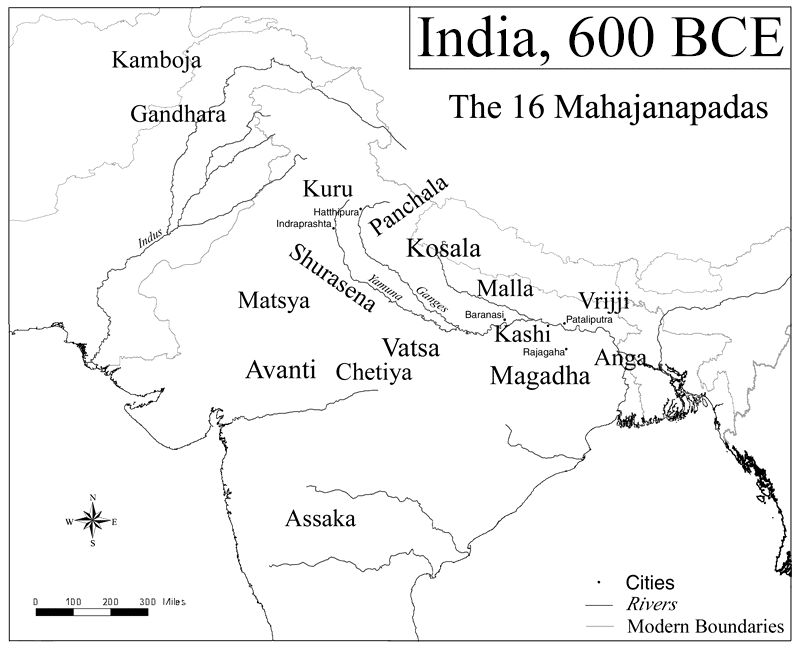
As you travel the trade routes, you realize the land is divided into sixteen great states. While some are Republics (Gana-Sanghas) where power is shared, most are monarchies. Let’s visit the most strategic ones.
1. Magadha: The Iron Giant You arrive at Rajgriha (modern Rajgir), the first capital of Magadha. It is a fortress provided by nature, surrounded by five hills, making it impregnable. Magadha is destined for greatness not just because of its ambitious rulers, but because of its geography. It sits near rich iron deposits (modern Jharkhand) for weapons and has forests providing elephants for the army. Later, the capital would shift to Pataliputra, dominating the river trade.
2. Kosala: The Rival To the west lies Kosala (modern Eastern UP), with its capital at Shravasti. Its King, Prasenjit, is a contemporary of the Buddha. Kosala is powerful and prosperous, having captured the holy city of Kashi (Varanasi). The rivalry between Kosala and Magadha is legendary, often settled through matrimonial alliances or war.
3. Vatsa: The Land of Cotton Further along the Yamuna river lies Vatsa, with its capital at Kaushambi. This city is a hub for fine cotton textiles. Its ruler, Udayana, is a romantic figure in history, known for his elopement with the princess of Avanti. This state controls the key river traffic between the east and west.
4. Avanti: The Warrior State In Central India (Malwa), you enter Avanti. Its capital, Ujjain, is a crucial junction on the southern trade route. Avanti is rich in iron and ruled by the fierce King Pradyota. He is known as “Chanda Pradyota” (the fierce) and once engaged in a 100-year rivalry with Magadha. However, diplomacy exists too; when Pradyota suffered from jaundice, the Magadhan King Bimbisara sent his royal physician Jivaka to cure him.
5. Gandhara: The Gateway to Knowledge Traveling to the far northwest (modern Pakistan), you reach Gandhara. Its capital, Taxila, is not just a trade center but a world-renowned seat of learning. Scholars and students flock here. It sits strategically on the Uttarapath, connecting India to Central Asia and Persia.
6. Vajji: The Republic Crossing the Ganga northwards, you enter a different political world—the Vajji confederacy. Its capital is Vaishali. Unlike the monarchies, this is a Gana-Sangha (oligarchy). Here, there is no single king; instead, thousands of Rajas rule together through an assembly. It is here that Mahavira belonged, and democracy (in a primitive form) flourished before being crushed by the imperial ambitions of monarchies.
7. Anga: The Merchant’s Port To the east of Magadha lies Anga, with its capital at Champa. This city is famous for its wealth and commerce. Merchants here set sail on the Ganga, heading towards the open sea, possibly even for trade with Suvarnabhumi (Southeast Asia). Anga was the first major victim of Magadha’s expansion.
8. Assaka: The Southern Outpost Finally, you hear of Assaka, the only Mahajanapada situated south of the Vindhya mountains, on the banks of the Godavari river. Its capital is Potali. It represents the reach of Aryan culture into the South India trade sphere and the Dakshinapath.
The Survival of the Fittest: From Sixteen to One #
As the 6th Century BCE progressed, the balance of power among the sixteen Mahajanapadas began to crumble. The era of peaceful coexistence ended, turning into a ruthless game of survival where smaller states were swallowed by the strong. Soon, the dust settled to reveal only four titans standing: Vatsa, Avanti, Kosala, and Magadha.
But destiny favored Magadha. Blessed with rich iron deposits for weapons and the wild elephants of the forests, it possessed a military edge no other state could match. Its capitals were fortresses provided by nature—Rajgriha, guarded by five hills, and later Pataliputra, the “water fort” at the strategic confluence of the Ganga and Son rivers.
The march to hegemony began with Bimbisara, who used matrimony as a tool of diplomacy, marrying into the families of Kosala and Vaishali while conquering the trade-rich Anga. His son, Ajatashatru, turned innovation into destruction, deploying terrifying war engines like the Mahashilakantaka (catapult) and Rathamusala (chariot-mace) to crush the Vaishali confederacy. The final rival, Avanti, fell to the Shishunaga dynasty, ending a century-long feud.
The stage was now set for Mahapadma Nanda, the first “Empire Builder,” to rise. Commanding a massive army that would later terrify Alexander the Great, he claimed the title of Ekarat (Sole Sovereign). The age of the sixteen kingdoms was over; the age of the Magadhan Empire had begun.
Current Affairs Linkage #
- The Bihar art and culture department has nominated INTACH to prepare a dossier to include the Chhath festival in UNESCO’s Intangible Cultural Heritage list.
- Vedic Connection: The sources describe Chhath as one of the oldest Vedic rituals dedicated to the Sun God (Surya). References to this sun worship are found in the Rig Veda, and the festival’s rituals emphasise austerity and purity similar to ancient Vedic practices
- “Digvijay Divas” was observed to mark Swami Vivekananda’s historic speech at the World Parliament of Religions in 1893
- Vedic Connection: The speech is noted for introducing Vedanta (the philosophy based on the “conclusion” of the Vedas) to the West. The sources explain that Vedanta roots itself in the Upanishads, which are elaborations of the Vedas. Vivekananda’s concept of “spiritual nationalism” and universal humanism was derived from these Vedic teachings.
- The Kanwar Yatra, an annual pilgrimage undertaken by devotees of Shiva, was discussed in the context of heritage
- Vedic Connection: The notes clarify that while the Yatra is linked to the Hindu month of Shravan, the practice in its current mass form is not mentioned in major ancient Vedic scriptures, suggesting it is a more recent tradition originating around the 1700s.
Mains PYQs #
2024 → Underline the changes in the field of economy and society from Rig Vedic to later Vedic period. (Note: This period immediately precedes and sets the foundation for the Mahajanapadas).
2019 → Highlight the Central Asian and Greco-Bactrian elements in Gandhara art. (Note: Gandhara was one of the 16 Mahajanapadas).
2014 → Taxila University was one of the oldest universities in the world, associated with a number of renowned learned personalities of different disciplines. Its strategic location caused its fame to flourish, but unlike Nalanda, it is not considered a university in the modern sense. Discuss. (Note: Taxila was the capital of the Gandhara Mahajanapada).
2014 → Gandhara’s sculpture owed as much to the Romans as to the Greeks. Explain.
Answer Writing Minors #
Here are a versatile Introduction and Conclusion that you can use as a template for most UPSC Mains questions regarding the Mahajanapadas.
Common Introduction (3-4 Lines) The 6th Century BCE marks a watershed moment in Indian history, often termed the era of “Second Urbanisation.” Driven by the widespread use of iron technology and agricultural surplus in the fertile Gangetic basin, this period witnessed a fundamental political shift from small tribal kinship groups (Janas) to large, fortified territorial states known as Mahajanapadas,.
Common Conclusion (3-4 Lines) The intense rivalry among these sixteen states ultimately culminated in the hegemony of Magadha, which utilized its strategic geographical advantages, iron resources, and military innovation to subdue its neighbours. This consolidation of power marked the end of regional fragmentation and laid the administrative and political foundation for India’s first pan-subcontinental empire under the Mauryas