
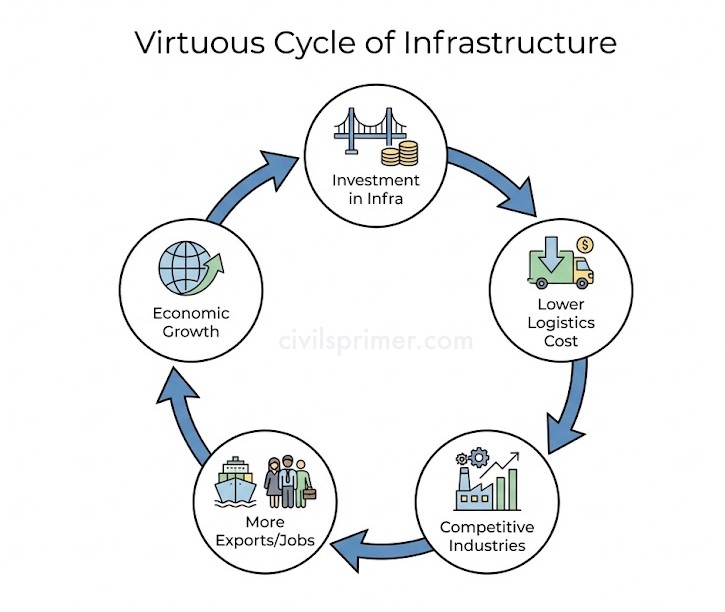
Imagine a farmer in a remote village growing high-quality tomatoes. Without a road, he cannot reach the market. Without a cold storage chain (energy), his produce rots. Without a digital payment system (telecom), he cannot get paid instantly. This is why infrastructure is called the force multiplier—it amplifies the effort put into the economy.
The Energy Sector: The Fuel of the Engine #
The Context : Energy is critical for both agriculture (tractors, pumps) and industry. India is currently the 3rd largest primary energy consumer in the world. Our goal is to achieve Energy Independence by 2047.
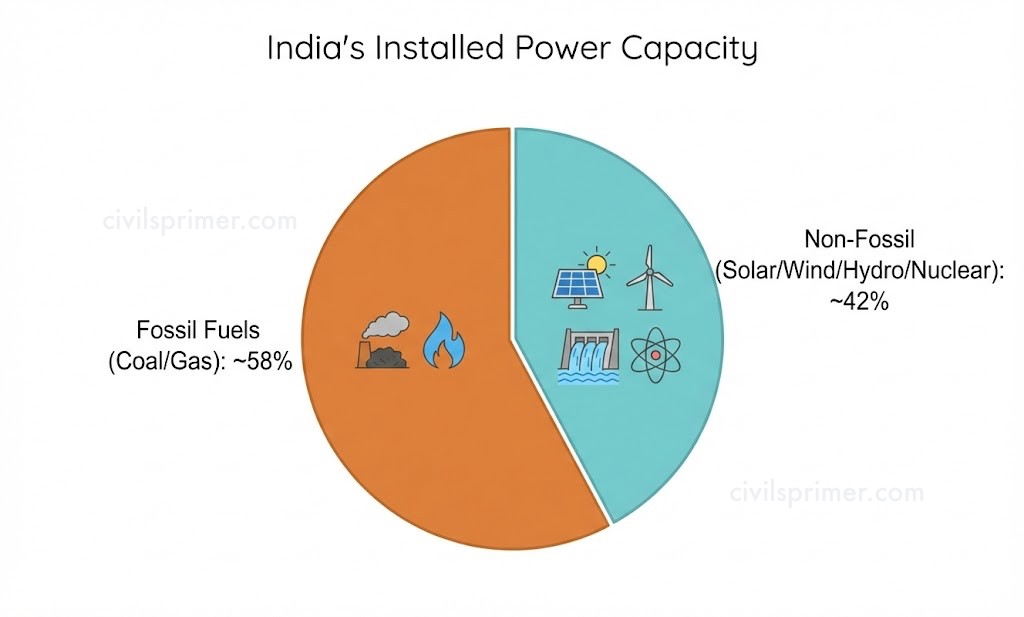
A. The Shift: From Black Gold to Green Power For decades, India relied on “Black Gold” (Coal) to power its thermal plants. Even today, fossil fuels make up about 90% of our primary energy supply. However, to fight climate change, we are shifting gears.
- Renewable Energy: India has witnessed the fastest growth in renewable energy capacity among major economies. We aim to achieve 500 GW of installed electricity capacity from non-fossil sources by 2030.
- Solar Power: We stand 4th globally in solar power capacity. Initiatives like the International Solar Alliance (ISA) and the One Sun One World One Grid (OSOWOG) show India’s global leadership.
B. The Weakest Link: DISCOMs (Distribution Companies) While we generate enough power, the entities that sell it to our homes—Distribution Companies (DISCOMs)—are in financial distress.
- The Problem: High Aggregate Technical and Commercial (AT&C) losses (theft, leakage, poor billing).
- The Solution: Schemes like UDAY (Ujwal DISCOM Assurance Yojana) were launched for their financial turnaround.
Transport: The Arteries of the Nation #
If energy is the fuel, transport is the circulatory system. India’s logistics cost is about 14% of GDP, which is very high compared to the global average of 8%. We need to bring this down to make our exports cheap and competitive.
A. Roads: The Last Mile Connector India has the second-largest road network in the world (approx. 5.89 million km).
- National Highways (NH): Though they are only about 2% of the total road length, they carry 40% of the total traffic.
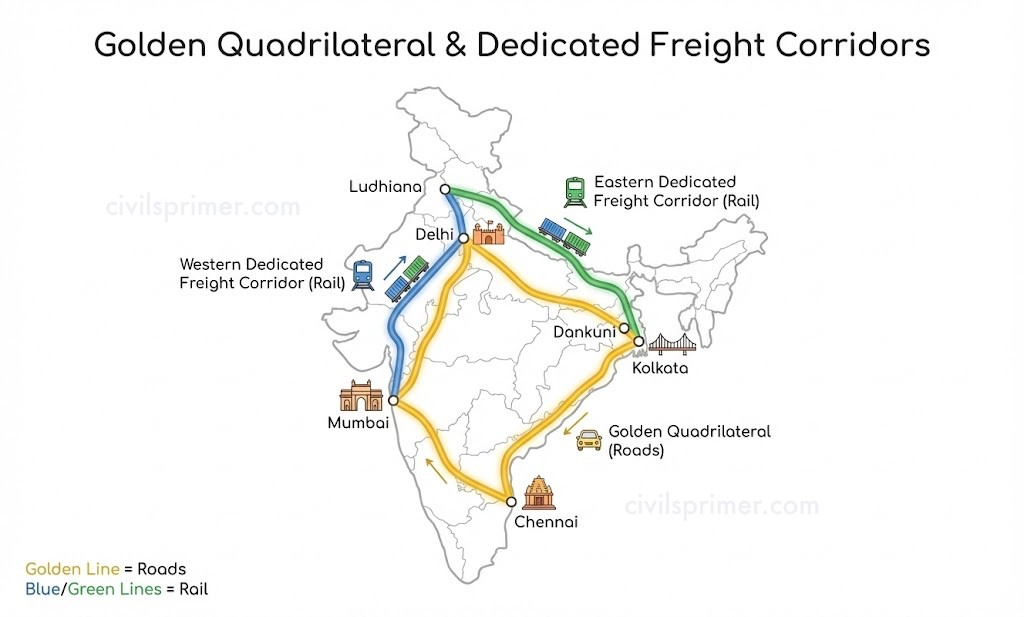
- Bharatmala Pariyojana: This is an umbrella project to connect economic corridors and borders, improving freight movement.
- PMGSY (Pradhan Mantri Gram Sadak Yojana): A massive success story in connecting rural villages with all-weather roads, integrating rural India into the mainstream economy.
B. Railways: The Heavy Lifter Indian Railways is the third-largest network in the world under single management.
- The Problem: Congestion. Passenger and goods trains run on the same tracks, slowing everything down.
- The Solution: Dedicated Freight Corridors (DFCs). Imagine a “Superhighway” exclusively for goods trains. The Eastern and Western DFCs will decongest the network and reduce logistics costs.
- Safety: We are implementing Kavach, an indigenous anti-collision system, to prevent accidents.
C. Ports & Waterways: The Gateways to the World Ports handle 95% of India’s foreign trade by volume.
- Sagarmala: This is not just about building ports, but “Port-led development.” It involves reducing the cost of transporting goods for domestic and export markets.
- Inland Waterways: Moving goods by water is cheaper and eco-friendly. The Jal Marg Vikas Project on National Waterway-1 (Ganga) is a prime example of using rivers for commerce.
D. Aviation: Wings for the Common Man India is among the top 10 civil aviation markets.
- UDAN (Ude Desh Ka Aam Naagrik): This Regional Connectivity Scheme (RCS) aims to make flying affordable and connect smaller towns (tier-2 and tier-3 cities) to the aviation map.
Telecom & Digital Infrastructure: The Nervous System #
In the modern economy, data is the new oil.
- Digital India: Launched to transform India into a digitally empowered society. It rests on pillars like Broadband Highways and Universal Access to Mobile.
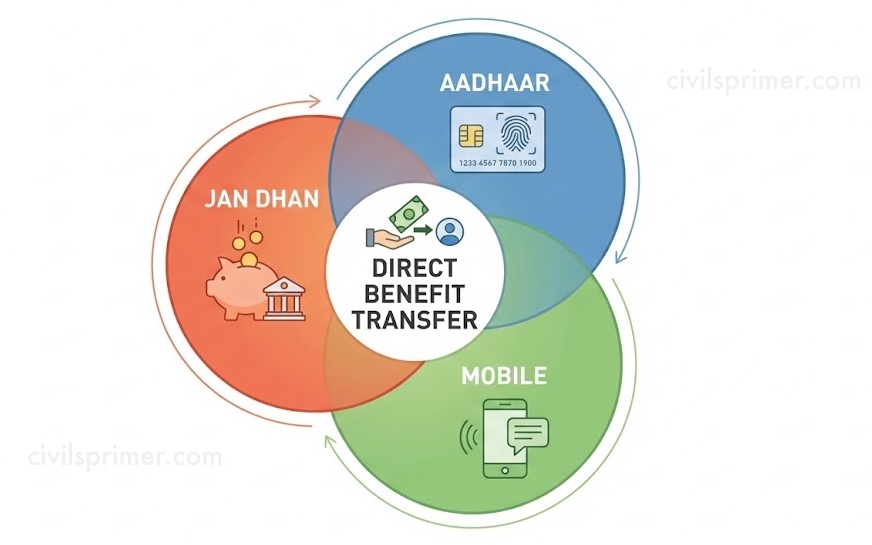
- JAM Trinity: Jan Dhan (Banking), Aadhaar (Identity), and Mobile. This combination has revolutionized Financial Inclusion and Direct Benefit Transfers (DBT), removing middlemen and corruption.
- BharatNet: A project to connect all Gram Panchayats with high-speed optical fiber, bridging the rural-urban digital divide.
National Infrastructure Pipeline (NIP): The Master Plan #
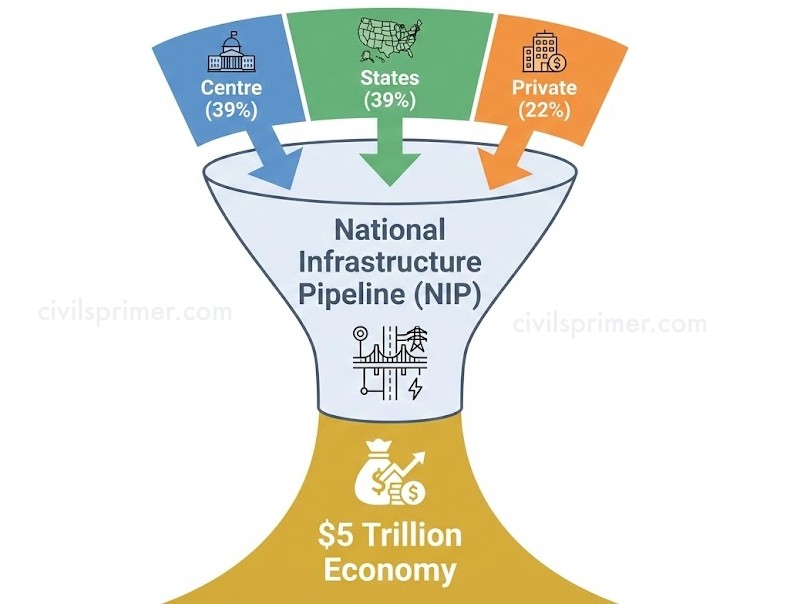
To become a $5 Trillion economy, India cannot build infrastructure in bits and pieces. We need a coordinated plan.
- What is NIP? It is a roadmap for investing ₹111 lakh crore in infrastructure over five years (2020-2025).
- The Funding: It’s a joint effort. The Centre, States, and Private sector share the burden in a 39:39:22 ratio.
- PM Gati Shakti: While NIP is the list of projects, Gati Shakti is the digital platform to coordinate them. It brings 16 ministries together to ensure that a newly built road isn’t dug up the next day to lay telephone cables.
Public-Private Partnership (PPP): The Handshake #
Why do we need it? The government has limited funds (taxpayer money) and implementation challenges. The private sector has money and efficiency but needs profit. PPP brings them together to build public assets.
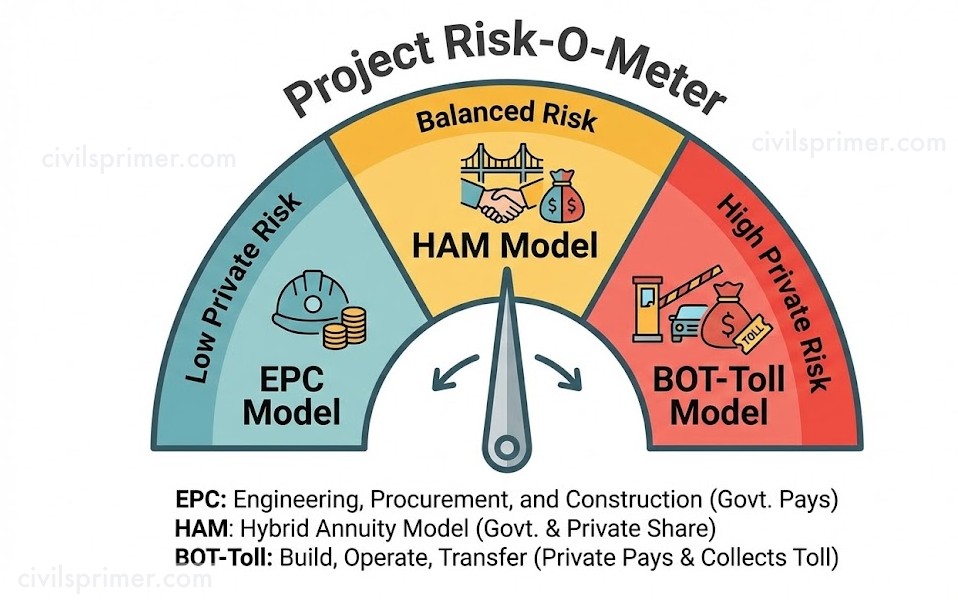
Key Investment Models (The “Risk” Story):
1. BOT (Build-Operate-Transfer): The private player builds the road, collects the toll for 20-30 years to recover costs, and then gives it back to the government.
- Issue: If traffic is low, the private player loses money. Private players stopped bidding for these projects due to high risk.
2. EPC (Engineering, Procurement, Construction): The Government pays 100% of the money; the private player just builds it like a contractor.
- Issue: High financial burden on the government.
3. HAM (Hybrid Annuity Model): The “Middle Path.”
- The Mix: It combines EPC (40%) and BOT-Annuity (60%).
- How it works: The government pays 40% of the cost upfront (reducing private risk). The remaining 60% is paid by the government in instalments (annuities) over time. The government collects the toll, not the private player. This model revived the stalled highway sector.
Mains PYQs #
Infrastructure and Core Sectors in India Current Affairs
Energy Sector:
- 2025→ India aims to become a semiconductor manufacturing hub. What are the challenges faced by the semiconductor industry in India? Mention the salient features of the India Semiconductor Mission. (15 M)
- 2025→ How can India achieve energy independence through clean technology by 2047? How can biotechnology play a crucial role in this endeavour? (10 M)
- 2022→ Do you think India will meet 50 percent of its energy needs from renewable energy by 2030? Justify your answer. How will the shift of subsidies from fossil fuels to renewable help achieve the above objective? Explain. (15 M)
- 2021→ “Investment in infrastructure is essential for more rapid and inclusive economic growth.” Discuss in the light of India’s experience. (15 M)
- 2020→ Explain the rationale behind the Goods and Services Tax (Compensation to States) Act of 2017. How has COVID-19 impacted the GST compensation fund and created new federal tensions? (15 M)
- 2016→ Give an account of the current status and the targets to be achieved pertaining to renewable energy sources in the country. Discuss in brief the importance of the National Programme on Light Emitting Diodes (LEDs). (12.5 M)
Transport:
- 2024→ What is the need for expanding regional air connectivity in India? In this context, discuss the government’s UDAN Scheme and its achievements. (15 M)
- 2020→ Explain the meaning of investment in an economy in terms of Capital Formation. Discuss the factors to be considered while designing a concession agreement between a public entity and a private entity. (15 M)
- 2016→ Examine the development of Airports in India through Joint Ventures under the Public-Private Partnership (PPP) model. What are the challenges faced by the authorities in this regard? (10 M)
Telecom and Digital Infrastructure:
- 2022→ Why is Public Private Partnership (PPP) required in infrastructural projects? Examine the role of the PPP model in the redevelopment of Railway Stations in India. (10 M)
Public-Private Partnership (PPP) in India:
- 2024→ Explain how Public-Private Partnership arrangements, in long gestation infrastructure projects, can transfer unsustainable liabilities to the future. What arrangements need to be put in place to ensure that successive generations’ capacities are not compromised? (12.5 M)
- 2014→ Adoption of the PPP model for infrastructure development in the country has not been free of criticism. Critically discuss the pros and cons of the model. (10 M)
Answer Writing Minors #
Template Introduction: “Infrastructure is the backbone of economic development, acting as a force multiplier for other sectors. To achieve the vision of a $5 Trillion economy, India has shifted focus from fragmented development to an integrated approach through the National Infrastructure Pipeline (NIP) and PM Gati Shakti, aiming to reduce logistics costs from 14% to global standards of 8%.”
Template Conclusion: “While India has made rapid strides in physical connectivity, sustaining this growth requires bridging the funding gap through innovative models like Asset Monetization (NMP) and Green Bonds. A robust infrastructure ecosystem, balanced with environmental sustainability (Green Growth), will be the bedrock of India’s transition into a developed nation during the ‘Amrit Kaal’.”
Latest Current Affairs #
Infrastructure and Core Sectors Current Affairs
| (November, 2025): National Critical Mineral Mission (NCMM) Launched To power India’s Energy Sector transition, this mission focuses on end-to-end value creation—from exploration to recycling—of critical minerals like lithium and rare earth elements. It aims to reduce import dependence and support clean energy technologies through domestic mining and overseas asset acquisition. |
| (October, 2025): Navi Mumbai International Airport (NMIA) Inaugurated India’s largest greenfield airport was inaugurated, enhancing Transport infrastructure. Built at a cost of ₹19,650 crore, it is designed as a carbon-neutral facility and is integrated with multimodal connectivity options like expressways, metro, and water transport to boost regional economic growth. |
| (October, 2025): PM E-DRIVE Scheme Guidelines Released The Ministry of Heavy Industries released operational guidelines for this ₹10,900 crore scheme to accelerate the Energy and Transport transition. It replaces FAME-II, incentivizing electric 2-wheelers, 3-wheelers, buses, and trucks, and funding the installation of 72,300 public charging stations. |
| (October, 2025): KOYLA SHAKTI Dashboard and CLAMP Portal Launched Strengthening Digital Infrastructure in the energy sector, these platforms integrate the entire coal value chain. KOYLA SHAKTI enables real-time monitoring of coal operations, while the CLAMP portal streamlines land acquisition and compensation processes to improve transparency and efficiency. |
| (September, 2025): National Policy on Geothermal Energy 2025 Notified The MNRE released this policy to harness India’s 10 GW geothermal potential. It creates a framework for exploring and deploying geothermal resources for power generation and direct-use applications like cooling and drying, diversifying India’s Renewable Energy mix. |
| (September, 2025): U.K. India Infrastructure Financing Bridge (UKIIFB) Report Marking its first anniversary, the UKIIFB recommended policy changes to de-risk investments in India’s National Infrastructure Pipeline. It aims to mobilize long-term capital for major projects like highways and renewable energy by addressing barriers such as revenue risks and taxation. |
| (September, 2025): Logistics Ease Across Different States (LEADS) 2025 Launched This initiative benchmarks logistics performance across states to support the PM Gati Shakti National Master Plan. It introduces new assessment criteria like real-time corridor performance tracking to enhance efficiency in the Transport and logistics sector. |
| (August, 2025): India’s First Private EO Satellite Constellation under PPP Model n a major Public-Private Partnership (PPP) milestone, IN-SPACe selected a consortium led by PixxelSpace India to build an indigenous Earth Observation satellite Constellation. This project will provide high-resolution data for agricultural and disaster management applications. |
| (August, 2025): State Energy Efficiency Index (SEEI) 2024 Released The Bureau of Energy Efficiency released this index to track state-level progress in energy conservation. Andhra Pradesh, Maharashtra, and others were recognized as top performers, encouraging states to align with India’s Energy Sector goals and climate commitments. |
| (June, 2025): India Energy Stack (IES) Task Force Launched The Ministry of Power initiated this task force to build a Digital Public Infrastructure for the Energy Sector. The IES aims to create a secure, interoperable data exchange framework to streamline payments, improve grid management, and facilitate renewable energy integration. |