
Imagine the economy as a vehicle. Agriculture is the wheels that have supported us for centuries, but Industry is the engine that provides speed and power. For a country to develop, it must shift from relying solely on farming to building factories, infrastructure, and technology. This transition creates stable jobs and modernizes society.
Industrial Policy Evolution: From “Control” to “Freedom” #
The Story: When India gained independence in 1947, we had very few industries (mostly cotton and jute). The leaders of that time, like Nehru, believed that the government should be the main driver of the economy because private businessmen didn’t have enough money to build big factories (like steel plants).
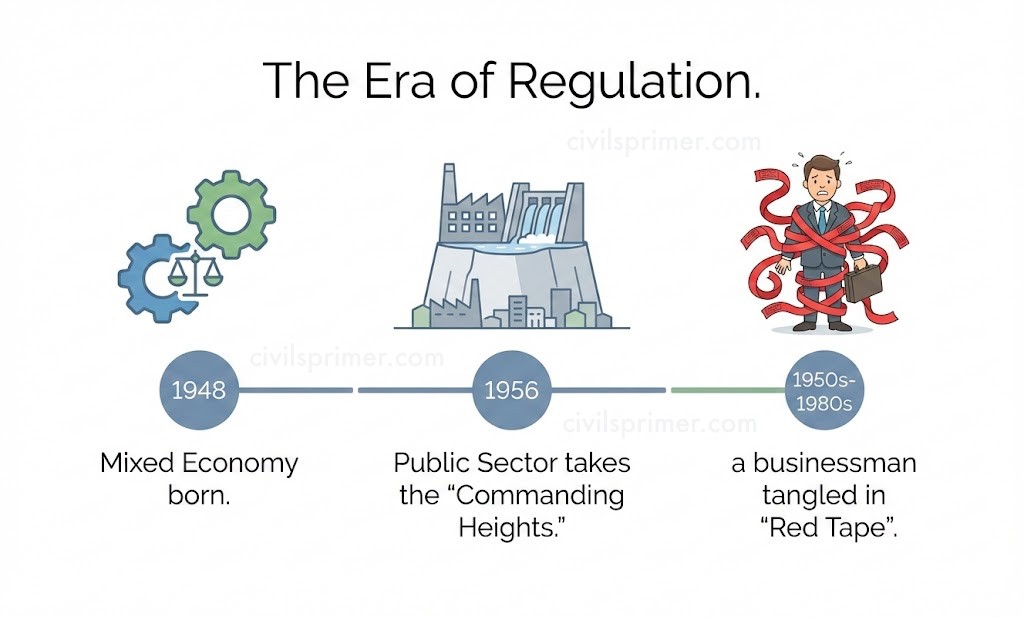
- 1948 Policy: This was the first blueprint. It established a Mixed Economy, meaning both the Government (Public Sector) and Private companies would exist, but the Government would be the “Captain” of the ship.
- 1956 Policy (The Economic Constitution): This policy solidified the government’s power. It classified industries into three schedules. The most important industries (Atomic energy, defense, railways) were strictly reserved for the state. This created the “Commanding Heights” of the economy where the Public Sector dominated.
- The License Raj: To open a private factory, expand it, or even produce a new product, you needed a license from the government. This created the infamous “License Raj,” where businessmen spent more time pleasing bureaucrats than improving products.
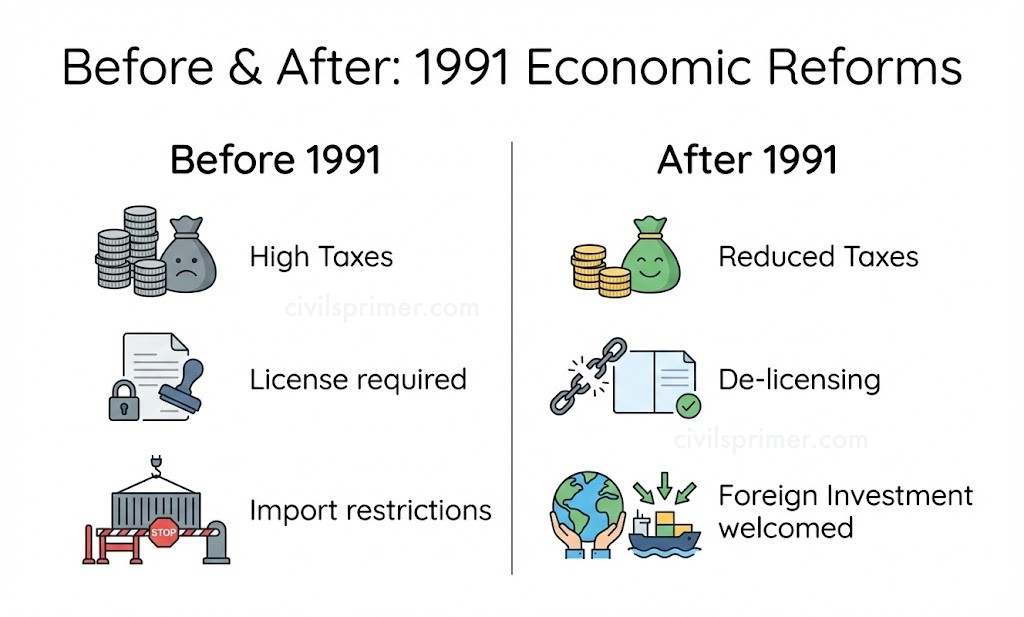
The Turning Point: 1991 Reforms (LPG) By 1991, India faced a severe crisis. We didn’t have enough foreign money (forex) to pay for imports for even two weeks. To save the economy, India approached the IMF and World Bank, who advised opening up the economy. This led to the New Economic Policy of 1991, famously known as LPG:
1. Liberalization: Removing the strict licenses. Companies could now decide what to produce and how much.
2. Privatization: Reducing the government’s role and selling government companies (Disinvestment) to the private sector.
3. Globalization: Opening borders to foreign trade and foreign investments.
MSMEs: The Silent Backbone #
What are they? MSME stands for Micro, Small, and Medium Enterprises. Think of the small pickle factory in your town, the local textile weaver, or a small auto-parts workshop.
Why are they important?
- Employment: They are the second-largest employer after agriculture,.
- Inclusive Growth: They provide jobs in rural areas and helping reduce regional imbalances.
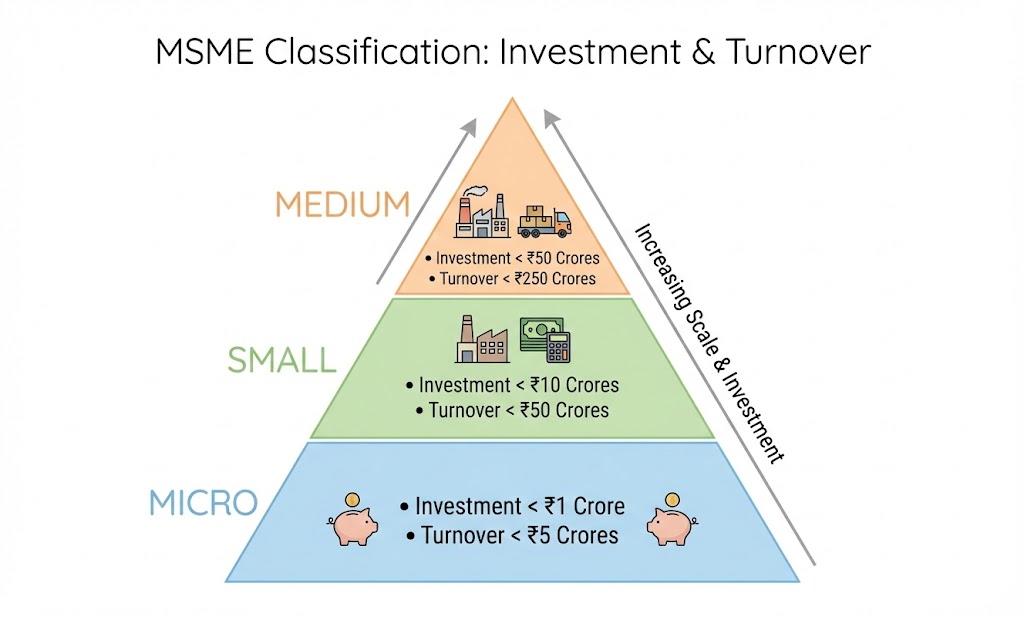
The Definition Change (2020): The government redefined MSMEs based on Investment (machinery/plant) and Turnover (sales) to encourage them to grow without losing benefits.
- Micro: Investment < ₹1 Cr, Turnover < ₹5 Cr.
- Small: Investment < ₹10 Cr, Turnover < ₹50 Cr.
- Medium: Investment < ₹50 Cr, Turnover < ₹250 Cr.
Challenges: They often struggle to get loans (credit), lack modern technology, and face stiff competition from big global companies. To help, the government launched schemes like MUDRA Loans (small loans for small businesses) and the Udyam registration portal.
Make in India & Production Linked Incentive (PLI) #
Make in India (2014): The goal was simple: Transform India into a global design and manufacturing hub. The government wanted companies to not just sell in India, but make in India. It focused on 27 sectors, inviting Foreign Direct Investment (FDI) and improving infrastructure.
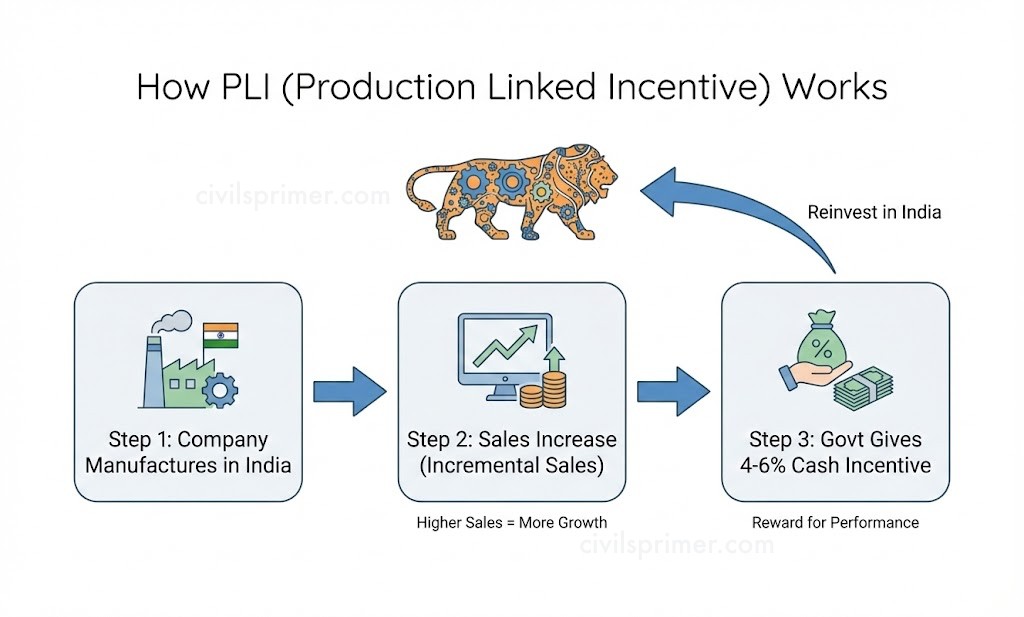
Production Linked Incentive (PLI): This is a game-changer. Imagine a teacher telling a student, “If you score higher marks than last year, I will give you a prize.”
• How it works: The government gives cash incentives (4% to 6%) to companies on their incremental sales (additional sales) of goods manufactured in India.
• Goal: To boost domestic manufacturing and reduce imports (like making mobile phones in India instead of buying them from China).
Industrial Corridors: The Arteries of Growth #
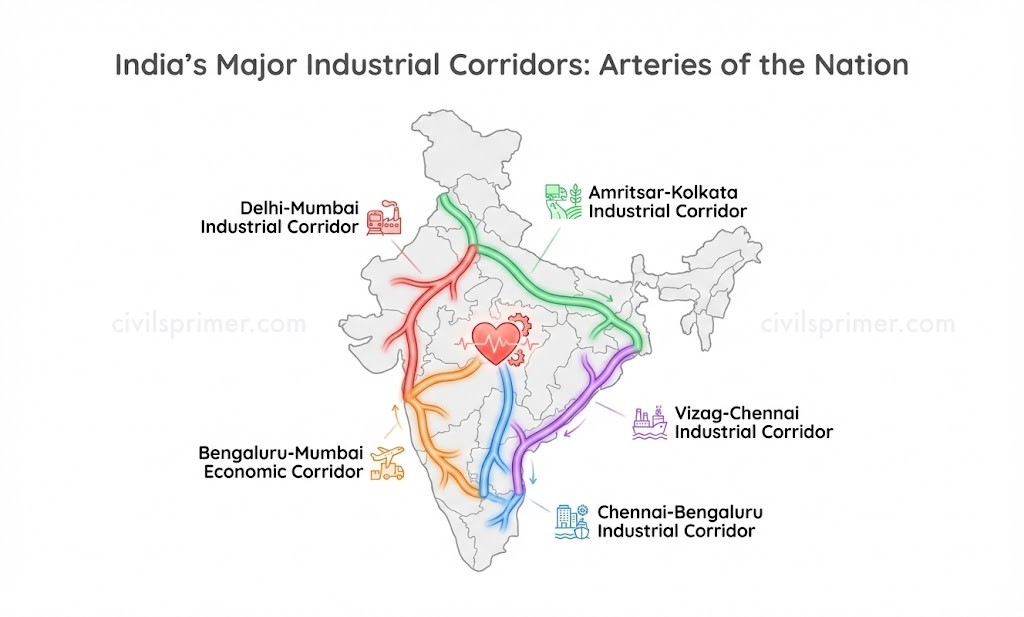
Factories cannot run in isolation. They need roads to bring raw materials and railways/ports to send finished goods. Industrial Corridors are dedicated high-speed infrastructure zones connecting major cities. The idea is to build “Smart Industrial Cities” along these routes.
Key Examples: 1. DMIC (Delhi-Mumbai Industrial Corridor): One of the biggest infrastructure projects; 2. CBIC: Chennai-Bengaluru Industrial Corridor. These corridors aim to implement “plug and play” infrastructure—meaning a business can just come in and start working without worrying about building basic facilities like power or roads.
Startup Ecosystem: The Innovation Engine #
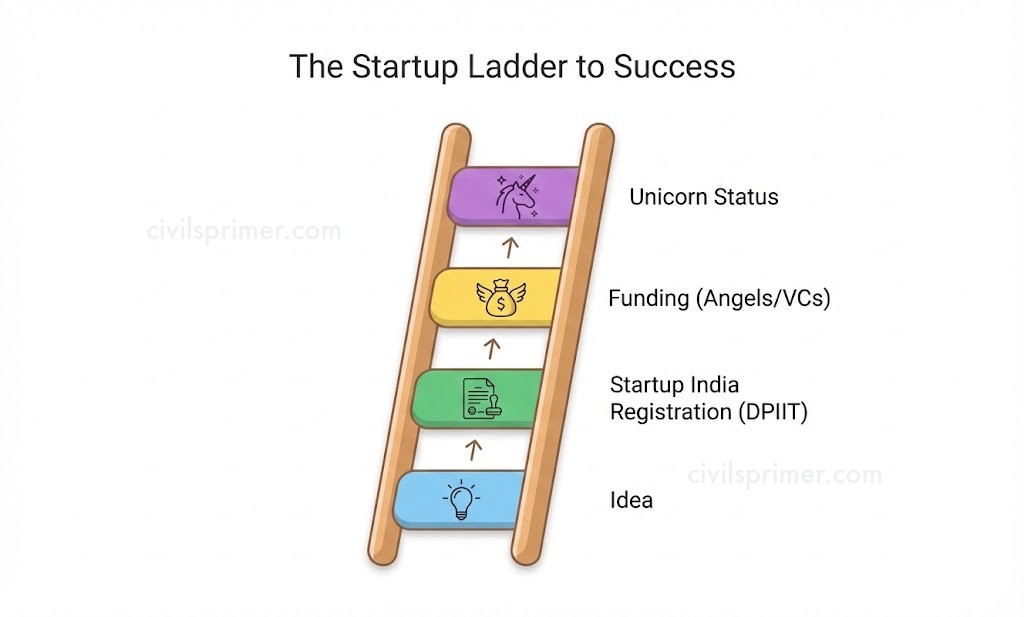
The Rise of Unicorns: India has the 3rd largest startup ecosystem in the world. A “Unicorn” is a startup valued at over $1 billion.
Government Support:
- Startup India (2016): A flagship initiative to build a strong ecosystem for innovation.
- Definition: An entity is a startup up to 10 years from incorporation, with a turnover not exceeding ₹100 Crores.
- Incentives: Tax exemptions (no income tax for 3 years), self-certification to reduce compliance burden, and help with patents.
- BHASKAR: A new digital platform to connect startups, investors, and mentors under one roof.
Funding: The government set up a Fund of Funds to help startups get capital. However, startups sometimes face the “Angel Tax” (a tax on funding raised above fair market value), though the government has exempted recognized startups from this.
Ease of Doing Business: The Lubricant #
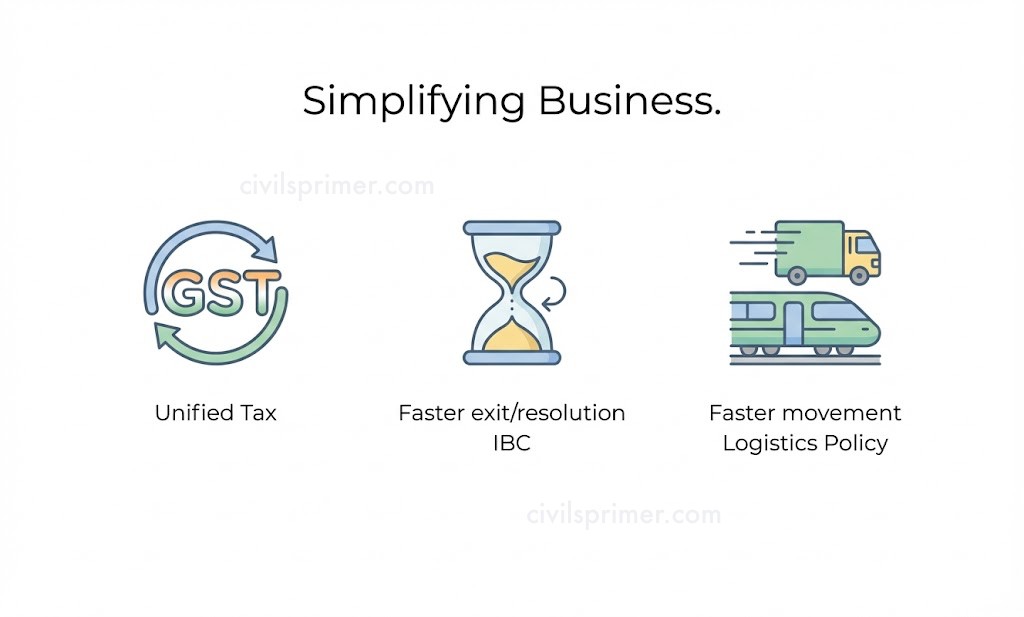
For all the above to work, it must be easy to start and run a business. This is called Ease of Doing Business (EoDB). Following are some Key Reforms:
1. GST (One Nation, One Tax): Replaced a mess of multiple taxes (VAT, Excise, Service Tax) with a single tax system, making logistics and trade smoother.
2. IBC (Insolvency and Bankruptcy Code): Earlier, if a company failed, it took years to close it. IBC creates a time-bound process (330 days) to resolve bad loans and close failed firms, freeing up money for new uses.
3. National Logistics Policy & PM Gati Shakti: These aim to reduce the cost of moving goods (logistics) in India, which is currently high (14% of GDP) compared to developed nations (8-10%).
The Indian industrial sector has moved from a closed, government-controlled system to an open, competitive global player. With MSMEs providing employment and Startups driving innovation, the government is now acting as a “Facilitator” (providing roads, simplified taxes, and PLI incentives) rather than a “Regulator”
Mains PYQs #
Industrial Sector and Industrial Policies
Industrial Policy and Manufacturing Sector
- 2017: “Industrial growth rate has lagged behind in the overall growth of Gross-Domestic-Product (GDP) in the post-reform period” Give reasons. How far are the recent changes in Industrial Policy capable of increasing the industrial growth rate?,
- 2017: Account for failure of the manufacturing sector in achieving the goal of labour intensive exports. Suggest measures for more labour-intensive rather than capital intensive exports.
- 2014: Normally countries shift from agriculture to industry and then later to services, but India shifted directly from agriculture to services. What are the reasons for the huge growth of services vis-a-vis industry in the country? Can India become a developed country without a strong industrial base?
Make in India, SEZs, and Investment Models
- 2015: “Success of ‘Make in India’ programme depends on the success of ‘Skill India’ programme and radical labour reforms.” Discuss with logical arguments.
- 2015: There is a clear acknowledgement that Special Economic Zones (SEZs) are a tool of Industrial development, manufacturing and exports. Recognising this potential, the whole instrumentality of SEZs requires augmentation. Discuss the issues plaguing the success of SEZs with respect to taxation, governing laws and administration.
FDI and Industrial Reforms
- 2014: Foreign direct investment in the defence sector is now said to be liberalised. What influence is this expected to have on Indian defence and economy in the short and long run?
- 2013: Discuss the impact of FDI entry into the multi-trade retail sector on supply chain management in commodity trade patterns of the economy.
Answer Writing Minors #
Here are two versatile Common Introductions and Common Conclusions that you can use for almost any UPSC Mains question related to the Industrial Sector (including MSMEs, Startups, Policy, or Make in India).
Option 1: The “Evolution & Reform” Approach – Use this when the question asks about changes, policy history, or liberalisation.
- Introduction: “India’s industrial trajectory has evolved from the protectionist ‘Commanding Heights’ of the 1956 Policy to the liberalized LPG reforms of 1991. Today, with initiatives like ‘Make in India’ and ‘Startup India,’ the government has shifted its role from a ‘regulator’ to a ‘facilitator’ to integrate India into the Global Value Chains and achieve self-reliance (Atmanirbhar Bharat).”
- Conclusion: “To realize the dream of a $5 Trillion economy, India must bridge the gap between policy formulation and ground-level implementation. Focusing on reducing logistics costs, ensuring credit flow to MSMEs, and fostering R&D will be critical to transforming India into a global manufacturing hub while ensuring Inclusive Growth for all.”
Option 2: The “Growth & Potential” Approach – Use this when the question asks about potential, specific schemes (PLI/Startups), or economic contribution.
- Introduction: “The industrial sector is the engine of India’s economic growth, contributing significantly to GDP and providing employment next only to agriculture. Driven by the ‘Make in India’ vision and the Production Linked Incentive (PLI) schemes, the sector is currently undergoing a structural transformation to boost domestic manufacturing, innovation, and export competitiveness.”
- Conclusion: “While India has jumped significantly in the ‘Ease of Doing Business’ rankings, sustaining this momentum requires continuous structural reforms in land, labor, and contract enforcement,. A synergistic approach involving robust infrastructure (Industrial Corridors) and a vibrant startup ecosystem is essential to propel India towards its ‘Amrit Kaal’ development goals.”
Latest Current Affairs #
Industrial Sector and Industrial Policies Current Affairs
(November, 2025): Draft National Labour & Employment Policy (Shram Shakti Niti 2025 The Ministry of Labour unveiled this draft policy to shift its role from a regulator to an “employment facilitator,” aligning with Industrial Policy Evolution. It proposes a “Unified Labour Stack” to integrate databases like EPFO and e-Shram, ensuring interoperability and simplifying compliance for businesses to improve the Ease of Doing Business. |
| (November, 2025): Research, Development, and Innovation (RDI) Scheme Launched A ₹1 lakh-crore corpus was launched to fund private-sector R&D in sunrise sectors through long-term, low-interest loans. It includes a “Deep-Tech Fund of Funds” specifically to support the Startup Ecosystem and de-risk high-impact projects in areas like AI and green hydrogen. |
| (November, 2025): Export Promotion Mission (EPM) Approved With an outlay of ₹25,060 crore, this mission aims to consolidate export schemes and boost MSME competitiveness. It introduces two sub-schemes: ‘Niryat Protsahan’ for affordable trade finance and ‘Niryat Disha’ for market access and branding, directly supporting the Make in India export vision. |
| (October, 2025): Electronics Components Manufacturing Scheme (ECMS) Projects Approved Supporting Make in India, the government approved the first batch of projects worth ₹5,532 crore to manufacture critical components like PCBs and camera modules. This scheme aims to deepen the domestic value addition (DVA) and integrate Indian firms into Global Value Chains. |
| (October, 2025): Expansion of Credit Guarantee Scheme for Startups (CGSS) To boost the Startup Ecosystem, the government doubled the collateral-free loan guarantee limit for DPIIT-recognized startups from ₹10 crore to ₹20 crore. This move enables better access to venture debt and Working Capital for innovation-led enterprises |