
Imagine travelling back in time roughly 4,500 years to the banks of the Indus and Ghaggar-Hakra rivers. You would not find primitive villages, but rather a sophisticated, urban world known today as the Harappan Civilization (c. 2600–1900 BCE). This was a Bronze Age society that valued order, trade, and cleanliness over warfare and ostentatious displays of power.
A Tour of the Great Cities #
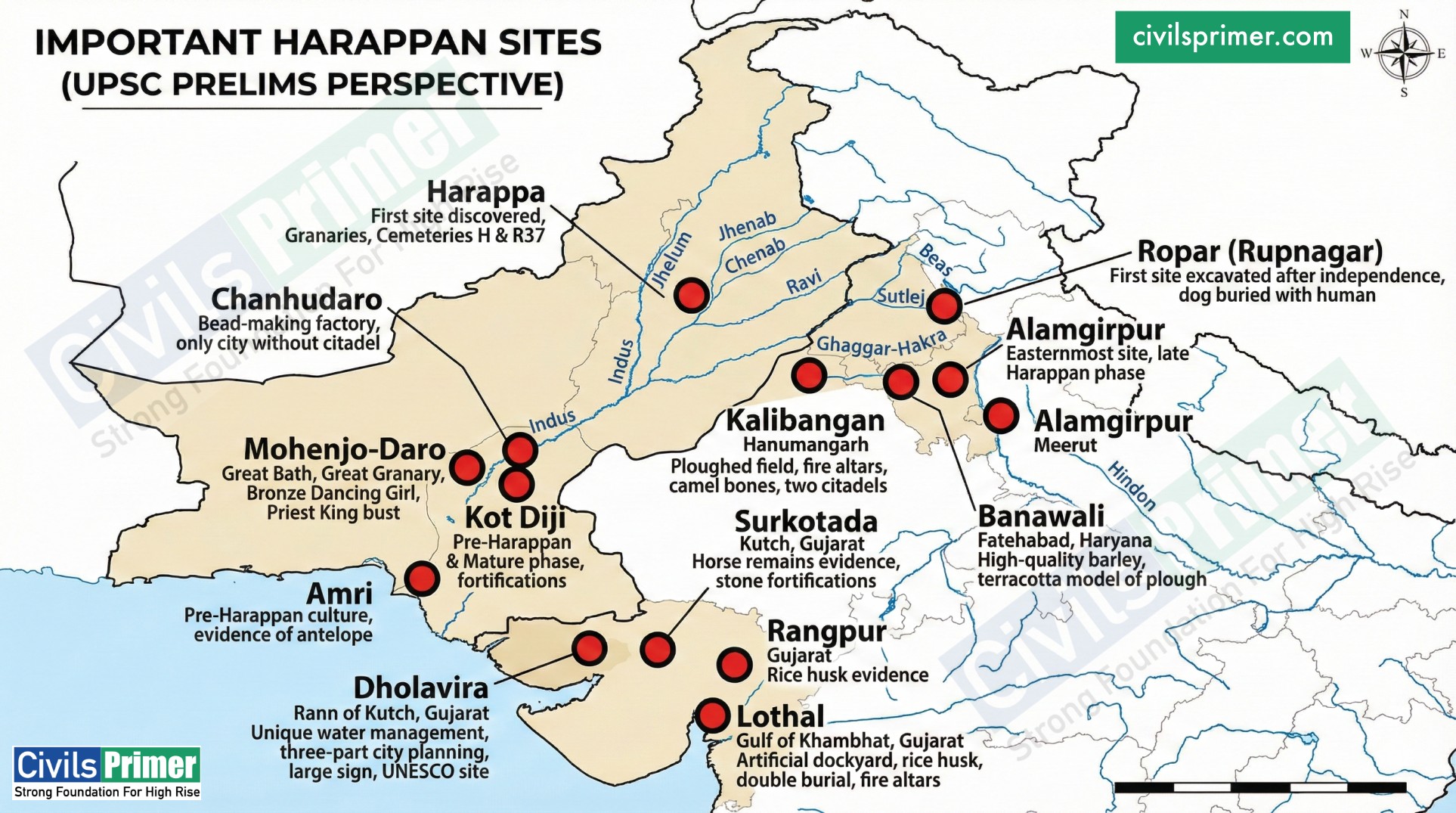
As you traverse this vast Harappan civilization, you encounter distinct cities, each with unique characteristics that archaeologists have uncovered over the last century. If you travelled to the coastal region of Gujarat, you would arrive at Lothal, a bustling trade centre. Here, engineering marvels allowed ships to dock and load goods. Evidence confirms that Lothal: Ancient dockyard existed here, facilitating trade with distant lands like Mesopotamia,. It is reconfirmed in records simply as Lothal: Dockyard,. Moving north to Rajasthan, you would visit Kalibangan. Unlike the coastal hubs, this was an agricultural heartland. Excavations here revealed the world’s earliest evidence of a specific farming technique: a Kalibangan: Ploughed field showing a grid of furrows, suggesting they grew two crops at once.
Further north in Haryana, at Banawali, you wouldn’t find the actual wooden ploughs used by farmers (as wood decays), but you would find a toy left behind by a child or used for ritual: a Banawali: Terracotta replica of a plough,.If you journeyed to the Rann of Kutch in Gujarat, you would stand before the grand city of Dholavira. Unlike other sites where writing is found only on small seals, here you would look up at a massive gateway to see Dholavira: An inscription comprising ten large sized signs of the Harappan script, often dubbed the world’s first signboard. Your journey would also take you to other significant settlements, confirming their place in this cultural network: Chanhudaro is a Harappan Site known for bead-making, Kot Diji is a Harappan Site in present-day Pakistan, and Desalpur is a Harappan Site in Gujarat.
The Hallmark of Indus Valley Civilization is Standardised Urban Planning
- The Grid System: Streets cut at right angles. This was not haphazard; it was planned.
- Drainage: They had advanced underground drainage systems connecting houses to street drains.
- The Division: Most cities had two parts: a raised Citadel (West) and a Lower Town (East).
- Exception/Trap: Chanhudaro is the only city without a citadel.
- Exception/Trap: Dholavira was divided into three parts (Citadel, Middle, Lower).
Life, Culture, and Religion #
As you walk through the streets of Mohenjo-Daro or Harappa, you might look for grand cathedrals or royal residences. However, unlike ancient Egypt or Mesopotamia, they possessed great palaces and temples is an incorrect assumption; the IVC people did not leave evidence of such structures. Instead, their engineering efforts went into public baths and granaries. The spiritual life of the Harappans is interpreted through their artifacts. It was predominantly a secular civilization and the religious element, though present, did not dominate the scene,. Their faith was personal and nature-centric. They worshipped both male and female deities, evidenced by “Pashupati” seals and terracotta figurines of the Mother Goddess. The Animals represented on seals and terracotta art of the Harappan culture included bulls, elephants, tigers, and rhino. However, the cow and the lion were notably absent from their art.
Irrigation: They mostly relied on floodplains and wells. Canal irrigation is rare, found only at Shortughai (Afghanistan)
Crops: They grew wheat, barley, pulses, and sesame and the first to produce Cotton. Rice was relatively rare (found mostly in Lothal/Rangpur)
In the markets, you would see merchants trading goods. One specific mismatch often cited in historical analysis regarding their pottery is The Harappan civilization – Painted Greyware. This statement is historically incorrect; Painted Greyware is associated with the later Vedic period, whereas Harappans typically used Red and Black pottery. What were the people wearing? You would see them dressed in woven fabrics. It is a verified fact that During this period, cotton was used for manufacturing textiles in India, making them some of the earliest cotton producers in the world.
Harappans vs. The Rigvedic Aryans #
Historians often understand the Harappans by comparing them to the culture that followed: the Rigvedic Aryans. The differences are stark, particularly regarding warfare and technology. The Harappans were a generally peaceful, trade-oriented society. The statement that They employed horse-drawn chariots in warfare is incorrect regarding the Harappans; this was a characteristic of the later Aryans. When comparing their military gear, Rigvedic Aryans used the coat of mail and helmet in warfare whereas the people of Indus Valley Civilization did not leave any evidence of using them. The Harappans were not equipped for large-scale military conflict.
There was also a distinct technological divide in metallurgy. Rigvedic Aryans knew gold, silver and copper whereas Harappans knew gold, silver, and copper (Bronze Age), but they did not know iron. Iron was introduced later by the Aryans or during the Vedic age. Finally, the relationship with animals differed fundamentally. Rigvedic Aryans had domesticated the horse whereas there is no evidence of Indus Valley people having been aware of this animal. While some disputed remains exist (like at Surkotada), the horse was not central to Harappan culture or seals, unlike its central role in Vedic culture.
Previous Years Questions #
2021: Which one of the following ancient towns is well-known for its elaborate system of water harvesting and management by building a series of dams and channelizing water into connected reservoirs?
(a) Dholavira (b) Kalibangan (c) Rakhigarhi (d) Ropar
Answer: (a) Dholavira
2019: Which one of the following is not a Harappan Site?
(a) Chanhudaro (b) Kot Diji (c) Sohgaura (d) Desalpur
Answer: (c) Sohgaura – (Sohgaura is a Mauryan copper plate site.)
2002: Match List-I (Ancient Site) with List-II (Archaeological Finding):
| List-I | List-II |
| A. Lothal B. Kalibangan C. Dholavira D. Banawali | Dockyard Ploughed field Terracotta replica of a plough An inscription comprising ten large-sized signs |
Correct Match:
- Lothal — Dockyard; Kalibangan — Ploughed field; Dholavira — Inscription / Signboard; Banawali — Terracotta plough
2013: Which of the following characterizes the people of the Indus Civilization?
- They possessed great palaces and temples.
- They worshipped both male and female deities.
- They employed horse-drawn chariots in warfare.
Answer: 2 only
Explanation: Statement 1 is false: No evidence of temples or palaces has been found. Statement 3 is false: Horses and chariots are features of the Vedic age.
2011: Regarding the Indus Valley Civilization, consider the following statements:
- It was predominantly a secular civilization and the religious element, though present, did not dominate the scene.
- During this period, cotton was used for manufacturing textiles in India.
Answer: Both 1 and 2
2001: Which one of the following animals was not represented on seals and terracotta art of the Harappan culture?
(a) Cow (b) Elephant (c) Rhinoceros (d) Tiger
Answer: (a) Cow
The cow was significant to the Aryans/Vedic age, not the Harappans.
2017: With reference to the difference between the culture of Rigvedic Aryans and Indus Valley people, which of the following statements is/are correct?
- Rigvedic Aryans used the coat of mail and helmet in warfare, whereas the people of the Indus Valley Civilization did not leave any evidence of using them.
- Rigvedic Aryans knew gold, silver, and copper, whereas Indus Valley people knew only copper and iron.
- Rigvedic Aryans had domesticated the horse, whereas there is no evidence of Indus Valley people having been aware of this animal.
Answer: 1 and 3 only – Explanation: Statement 2 is false because the Indus Valley people did not know iron.
- 2025: “Discuss the salient features of the Harappan architecture.” (10 Marks)
- 2015: “The ancient civilization in the Indian sub-continent differed from those of Egypt, Mesopotamia, and Greece in that its culture and traditions have been preserved without a breakdown to the present day. Comment.” (12.5 Marks)
- 2014: “To what extent has the urban planning and culture of the Indus Valley Civilization provided inputs to present-day urbanization?” (10 Marks)
Did you notice? #
- Do you notice how the 2017 question combines the “Iron Trap” and the “Horse Trap” we discussed earlier?
- The “Omani” Copper Connection While copper was available in Rajasthan (Khetri mines), chemical analysis has shown that Harappan copper and copper from Oman (Magan) both contain traces of nickel, suggesting a common origin. This proves long-distance maritime trade.