
Imagine the Indian Economy as a protagonist in a grand novel. It is not just a collection of numbers; it is a living, breathing entity that has evolved from being a “Golden Bird” to a colonial subject, and now, to one of the world’s largest emerging markets. To understand the Indian Economy Overview, we must trace its journey through time, understanding its scars, its growth spurts, and its current ambitions.
Indian Economy: The Shackles (Pre-Independence) #
Our story begins in a dark era. Before 1947, the Indian economy wasn’t working for Indians; it was a “Feeder Economy” for the British Empire. India, once famous for its handicrafts and textiles (like the muslin of Dhaka), faced systematic de-industrialization. The British rulers transformed India into a net supplier of raw materials and a consumer of finished industrial products from Britain. The surplus wealth generated in India didn’t stay here; it was drained away. This “Drain of Wealth” left the agricultural sector saddled with surplus labour and extremely low productivity. Remember that the traditional handicraft industries were ruined under British rule to create a market for British manufactured goods.

The Rebirth (Post-Independence to 1991) #
When the British left in 1947, India had to choose a new path. We didn’t choose the pure Capitalist path (like the USA) or the pure Socialist path (like the USSR). The Strategy: We adopted a Mixed Economy model. Here, the public sector (government) and private sector co-exist,. The government took the “commanding heights,” controlling vital industries while the private sector played a complimentary role.
The Planning Era: We used Five-Year Plans to drive growth. The focus shifted from agriculture (First Plan) to heavy industries (Second Plan/Mahalanobis Model).
The Green Revolution: In the mid-1960s, we faced a hunger crisis. The introduction of High Yielding Variety (HYV) seeds, fertilizers, and irrigation ushered in the Green Revolution. The Green Revolution made India self-sufficient in food grains but was largely confined to wheat and rice crops in regions like Punjab, Haryana, and western UP.
The Structural Puzzle (Sectoral Composition) #
This is the most “peculiar” chapter in our story. Usually, as an economy matures, it follows a specific path:
Agriculture →Industry →Services.
However, the Indian Economy Structure decided to break the rules.
The Great Leap: India skipped the phase of heavy industrial dominance and jumped directly from an agriculture-dominated economy to a Services-dominated economy.
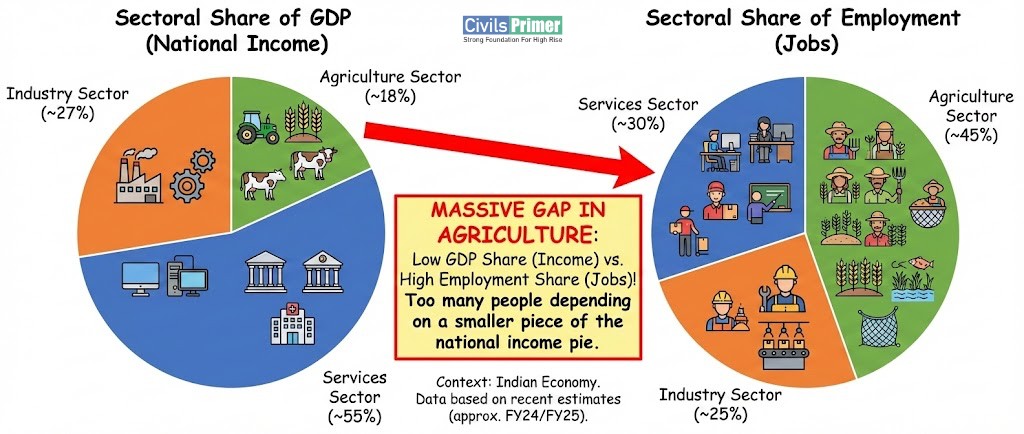
Primary Sector (Agriculture) is the foundation. It involves natural resource extraction. While its contribution to GDP has fallen to around 18-20%, it still employs the largest share of the workforce (over 45-55%).
Secondary Sector (Industry) transforms raw materials into goods. It includes manufacturing, electricity, gas, and—crucially for Prelims—Construction. The Eight Core Industries (Coal, Crude Oil, Natural Gas, Refinery Products, Fertilizers, Steel, Cement, Electricity) form the backbone of this sector and have a combined weight of approx 40% in the Index of Industrial Production (IIP). Tertiary Sector (Services) sector supports the others (transport, banking, software). It creates intangible goods. In the last three decades, this sector has grown the fastest, now contributing over 50% to the GDP.
UPSC Prelims Pointer
- The Tertiary sector contributes the most to India’s GDP, but the Primary sector still employs the largest proportion of the workforce.
- Construction activities fall under the Secondary sector, not the Tertiary sector.
Growth vs. Development (The Quality Struggle) #
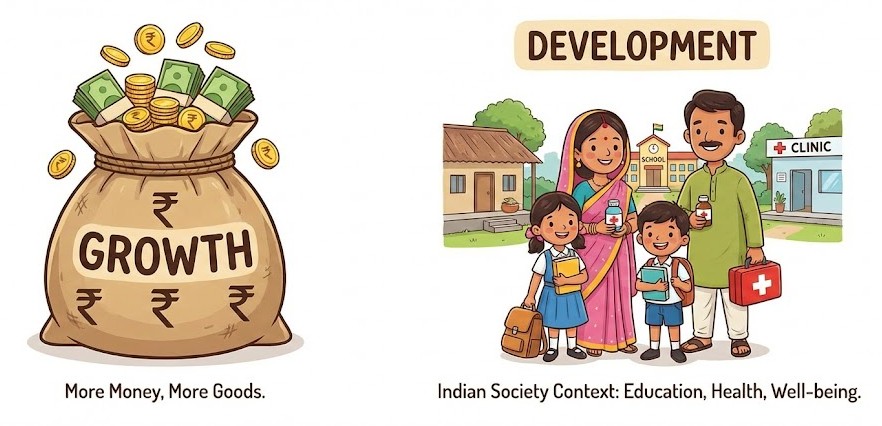
Is getting richer the same as getting better? Not necessarily. This distinction is vital for the Features of Indian Economy. Economic Growth (The Quantity) is simply the increase in the real output of the economy (Real GDP). It is quantitative. Economic Development (The Quality) is Growth + Change. It involves qualitative improvements in life—better health, education, and standard of living.
Investment Rule: Economic growth in a country will necessarily occur if there is Capital Formation (investment) in the economy,.
UPSC Prelims Pointer
- If a country is experiencing economic growth, Real GDP (calculated at constant prices to adjust for inflation) must increase. Nominal GDP might rise just because prices (inflation) went up, even if production didn’t change.
- An increase in absolute and per capita real GNP does not connote a higher level of economic development if poverty and unemployment increase simultaneously. Development must include the well-being of the people.
The Twin Goals (Inclusive & Sustainable) #
In the current plotline, the Indian economy is fighting two major battles: Exclusion and Environmental degradation.
- Inclusive Growth: Growth is meaningless if it doesn’t reach the bottom of the pyramid. Inclusive Growth creates opportunities for all segments of society and distributes the dividends fairly.
- Financial Inclusion: Schemes like Pradhan Mantri Jan-Dhan Yojana are tools for Inclusive Growth, bringing the unbanked into the financial fold.
- The Challenge: Despite growth, India has a high number of poor people. The pattern of growth has been uneven, leading to regional disparities.
- Sustainable Development: We cannot burn our future to heat our present. Sustainable development meets present needs without compromising the ability of future generations to meet their own needs.
UPSC Prelims Pointer
Sustainable development involves inter-generational equity
The Demographic Destiny (Dividend & Challenges) #
India is currently one of the youngest nations in the world. This is our Demographic Dividend. This dividend occurs when the share of the working-age population (15-64 years) is higher than the non-working age population (children and elderly). A younger population means more workers, more savings, and more demand. It can boost growth rates significantly. Mere population growth is not enough. If these young people are not skilled or employed, the dividend turns into a Demographic Disaster.
A major villain in the Indian story is Disguised Unemployment in agriculture. This happens when more people are working on a farm than required. If you remove a few, the total production doesn’t drop. Their marginal productivity is essentially zero. There is a concern that while GDP is growing, employment generation is not keeping pace, particularly in the formal manufacturing sector, known as Jobless Growth.
Summary Checklist for the UPSC Prelims #
- GDP Calculation: GDP includes final goods and services produced within the domestic territory. It excludes intermediate goods to avoid double counting.
- Inflation Impact: Inflation generally benefits debtors (borrowers) because they return money that is worth less than when they borrowed it, and it hurts bond-holders (creditors).
- Currency & Trade: Devaluation of domestic currency generally leads to the expansion of export trade because it makes domestic goods cheaper for foreign buyers.
- Employment: The primary sector (Agriculture) holds the maximum share of employment (approx 46-60%), not the service sector,.
- Planning Goal: The central objective of planning in India was to initiate a process of development to raise living standards and open new opportunities.
By understanding this narrative—from the colonial drain to the modern service-led growth—you now possess the framework to tackle questions on the Indian Economy Overview. Keep an eye on the “structural” shifts and the difference between “growth” and “development” as these are favourite traps in the UPSC exam.
Mains PYQs #
Indian Economy: Features, Structure and Growth
Economic Growth vs. Economic Development & GDP
- 2017: “Industrial growth rate has lagged behind in the overall growth of Gross-Domestic-Product (GDP) in the post-reform period” Give reasons. How far are the recent changes in Industrial Policy capable of increasing the industrial growth rate?.
- 2015: The nature of economic growth in India is described as Jobless Growth. Do you agree with this view? Give arguments in favour of your answer.
Inclusive Growth and Sustainable Development
- 2020: Explain intragenerational and intergenerational issues of equity from the perspective of Inclusive Growth and sustainable development.
- 2017: What are the salient features of ‘Inclusive Growth’? Has India been experiencing such a growth process? Analyze and suggest measures for Inclusive Growth.
- 2016: Comment on the challenges for Inclusive Growth which include careless and useless manpower in the Indian context. Suggest measures to be taken for facing these challenges.
- 2016: Pradhan Mantri Jan-Dhan Yojana (PMJDY) is necessary for bringing unbanked to the institutional finance fold. Do you agree with this for financial inclusion of the poorer section of the Indian society? Give arguments to justify your opinion.
- 2014: Capitalism has guided the world economy to unprecedented prosperity. However, it often encourages short-sightedness and contributes to wide disparities between the rich and the poor. In this light, would it be correct to believe and adopt capitalism driving Inclusive Growth in India? Discuss.
Demographic Dividend and Employment Challenges
- 2014: While we flaunt India’s demographic dividend, we ignore the dropping rates of employability. What are we missing while doing so? Where will the jobs that India desperately needs come from? Explain.
- 2016: How has globalization led to the reduction of employment in the formal sector of the Indian economy? Is increased informalisation detrimental to the development of the country?.
- 2015: “Success of ‘Make in India’ programme depends on the success of ‘Skill India’ programme and radical labour reforms.” Discuss with logical arguments.
Structural Composition: Industry, Services, and Agriculture
- 2017: Account for failure of the manufacturing sector in achieving the goal of labour intensive exports. Suggest measures for more labour-intensive rather than capital intensive exports.
- 2014: Normally countries shift from agriculture to industry and then later to services, but India shifted directly from agriculture to services. What are the reasons for the huge growth of services vis-a-vis industry in the country? Can India become a developed country without a strong industrial base?
Answer Writing Minors #
Structural Composition (Primary, Secondary, Tertiary Sectors)
- Introduction: The Indian economy has witnessed a “peculiar” structural transformation, shifting directly from an agrarian economy to a service-led one, bypassing the industrial manufacturing phase. While the tertiary sector contributes the highest share to the GDP (over 50%), the primary sector continues to employ the largest proportion of the workforce, creating a structural imbalance.
- Conclusion: To ensure balanced economic progress, India must focus on revitalizing the secondary sector to absorb surplus labor from agriculture, as service sector growth alone cannot generate mass employment. A symbiotic relationship between all three sectors is essential to transition from a developing to a developed economy.
Role of Agriculture, Industry, and Services
- Introduction: Agriculture remains the backbone of Indian livelihood security employing nearly half the workforce, while the Services sector has emerged as the primary growth engine. However, the Industry sector acts as the critical link for modernization and sustainable employment generation, essential for absorbing the demographic dividend.
- Conclusion: Future economic resilience depends on integrating these sectors through initiatives like ‘Make in India’ and food processing to link agriculture with industry. A holistic approach ensuring high productivity in agriculture and robust growth in manufacturing is vital for India’s long-term stability.
Economic Growth vs. Economic Development
- Introduction: Economic growth is a quantitative increase in real GDP, whereas economic development is a qualitative transformation encompassing improvements in health, education, and standard of living. While growth is a necessary condition for raising incomes, development is the ultimate goal ensuring those incomes translate into human well-being.
- Conclusion: Mere increase in GDP without improvements in social indicators leads to “growth without development”. Therefore, policy focus must shift from purely chasing GDP numbers to enhancing human capabilities and welfare to ensure the fruits of prosperity reach the last mile.
Inclusive Growth and Sustainable Development
- Introduction: Inclusive Growth ensures that the benefits of economic expansion are shared by all sections of society, particularly the vulnerable, while sustainable development ensures meeting present needs without compromising the future. Together, they form the cornerstone of India’s development strategy, moving beyond simple GDP metrics to equity and environmental protection.
- Conclusion: Achieving the twin goals of ‘Antyodaya’ (upliftment of the poorest) and environmental sustainability is non-negotiable for India’s future. Adhering to the Sustainable Development Goals (SDGs) ensures that growth is not just rapid, but also equitable and enduring.
Demographic Dividend and Challenges
- Introduction: India is currently witnessing a “youth bulge,” where the working-age population (15-64 years) outnumbers dependents, offering a unique window of economic opportunity known as the demographic dividend. However, this potential can only be realized if the workforce is healthy, skilled, and gainfully employed in the formal sector.
- Conclusion: Without adequate investment in Human Capital (Skill India) and job creation (Make in India), this dividend risks turning into a demographic liability. Harnessing the productive potential of the youth is pivotal for India to transform into a global economic powerhouse by 2047.
Recent Current Affairs #
Indian Economy, Features and Structure
| October, 2025 – Structural Crisis: Unemployment of the Educated Recent data reveals a deep structural crisis in the Indian labour market where highly educated youth (graduates and postgraduates) are applying for low-skill jobs like sanitation and peon roles. Despite a 4–6% official unemployment rate, 66% of India’s unemployed are educated, indicating a severe mismatch between the tertiary education system and the industrial/service sector’s skill requirements. This reflects the phenomenon of “Jobless Growth” where the service sector contributes 54% to GDP but generates under 30% of jobs. |
| October, 2025 – Agriculture in the Age of Inequality (Post-1991 Reforms Impact) An analysis of the agrarian economy highlights the systemic erosion of farm viability due to neoliberal policies adopted post-1991. While agriculture sustains 45% of the workforce, it contributes less than 20% to GDP. The terms of trade have fallen drastically (e.g., a farmer’s purchasing power regarding gold has plummeted since the 1970s). The focus has shifted from state support to corporate penetration, widening the gap between rural poverty and elite wealth accumulation, posing a challenge to Inclusive Growth. |
| October, 2025 – Role of Non-Farm Primary Activities in Rural Livelihoods As the structural transformation of the Indian economy remains slow (agriculture’s share in employment falls slower than its share in GDP), rural households are increasingly diversifying into Non-Farm Primary Activities like livestock, fisheries, and mining. These activities act as “insurance” against agrarian distress and seasonal unemployment. The livestock sector alone employs 20.5 million people, often providing more egalitarian income distribution than crop cultivation, highlighting a shift in the primary sector’s composition. |
| October, 2025 – Demographic Dividend vs. Demographic Time Bomb With 800 million people below the age of 35, India faces a decisive decade to harness its demographic dividend. However, reports warn this could turn into a “time bomb” due to an outdated education system and low employability (only 43% of graduates are job-ready). To address this, the Prime Minister announced a “Demographic Mission” to monitor population dynamics and Human Capital development, while experts call for a unified national employment framework to align skills with the AI-driven economy. |
| October, 2025 – Women’s Economic Empowerment Index (Inclusive Growth) To address the “invisibility” of women in economic data (contributing only 18% to GDP despite being half the population), Uttar Pradesh launched the country’s first district-level Women’s Economic Empowerment (WEE) Index. This tool tracks participation across employment, entrepreneurship, and skilling, aiming to shift focus from mere participation numbers to addressing structural barriers, thereby fostering Inclusive Growth and better measurement of economic development. |