
Imagine the Indian economy as a giant, living organism. While the factories (Industry) are the muscles and the offices (Services) are the brain, Agriculture is the heartbeat. It pumps life into the nation, employing a massive chunk of the population and ensuring that 1.4 billion people have food on their plates.
This story explores how this heartbeat functions, the medicines it took to survive (Green Revolution), and the modern surgeries (Reforms) it is undergoing today.
Role of Agriculture in Indian Economy: The Foundation #
Agriculture is not just a profession in India; it is a way of life.
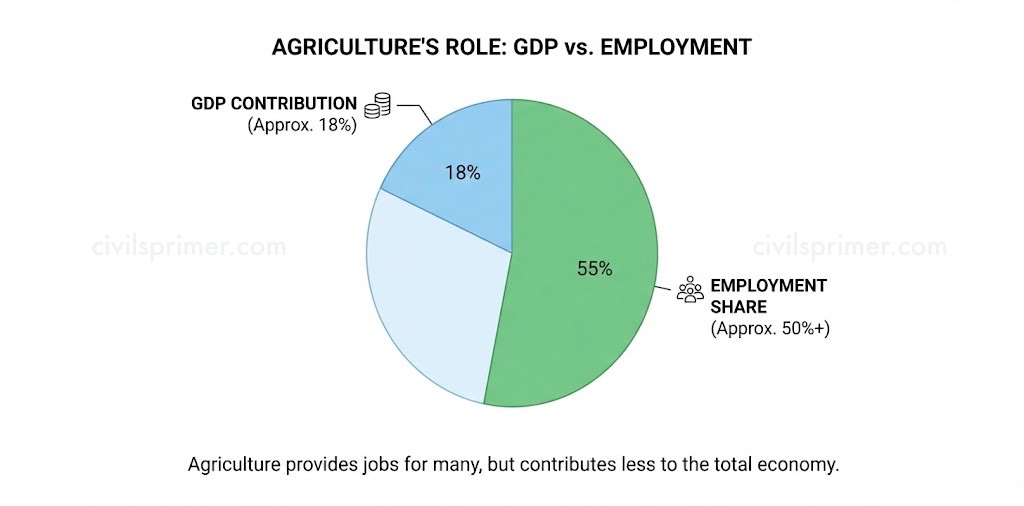
- The Big Employer: While the service sector contributes the most money to the GDP, agriculture employs the most people. About 54.6% of the workforce was engaged in agriculture according to the 2011 Census, though this share contributes roughly 18-20% to the Gross Value Added (GVA). This mismatch implies that a lot of people are producing relatively little value (Disguised Unemployment).
- Food Security: It ensures the nation doesn’t have to beg for food. From a “ship-to-mouth” existence in the 1960s, India is now a net exporter.
- Raw Material Supplier: It feeds industries like textiles (cotton/jute), sugar, and food processing.
Cropping Patterns and Irrigation: The Rhythm of the Land #
Indian agriculture dances to the tune of the weather. There are three distinct beats (seasons) to this dance:
- Kharif (The Monsoon Beat): Sown in June/July with the arrival of the Southwest Monsoon. Major Crops: Rice, Cotton, Bajra, Maize, Jowar, Tur.
- Rabi (The Winter Beat): Sown in October/November when the temperature drops. Major Crops: Wheat, Gram, Mustard, Barley.
- Zaid (The Summer Filler): A short season between Rabi and Kharif (April-June). Major Crops: Watermelons, vegetables, fodder.
The Thirst of the Soil (Irrigation) The biggest challenge is that Indian agriculture is still a “gamble with the monsoon”.
- Status: Only about 40% to 49% of the net sown area is irrigated. The rest is rainfed (Barani),.
- Sources: Tubewells (Groundwater) are the dominant source (approx. 60%), followed by canals.
- The Crisis: Over-reliance on groundwater, especially for water-guzzling crops like Rice in Punjab/Haryana, has led to a severe depletion of the water table.
- The Solution: The government is pushing Pradhan Mantri Krishi Sinchayee Yojana (PMKSY) with the motto “Har Khet Ko Pani” (water to every field) and “More Crop Per Drop“ (micro-irrigation like drips and sprinklers).

Green Revolution: The Great Turning Point #
In the mid-1960s, India faced a severe food crisis. We were importing grains to feed our people. To fix this, the government launched the Green Revolution.
The Magic Formula: It involved a package of modern inputs introduced primarily in Punjab, Haryana, and Western UP:
- HYV Seeds: High Yielding Varieties of Wheat (from Mexico) and Rice (from Philippines).
- Chemicals: Fertilizers and Pesticides.
- Water: Assured irrigation (Tubewells/Canals).
The Result (The Good):
- India achieved Self-Sufficiency in food grains. We stopped begging for food.
- Farmers had a Marketable Surplus (extra produce to sell), which lowered food prices for the poor.
The Side Effects (The Bad):
- Inequality: It initially benefited rich farmers who could afford the expensive inputs.
- Ecological Damage: Excessive use of fertilizers killed soil fertility. Over-irrigation depleted groundwater.
- Skewed Cropping: It promoted Rice and Wheat at the cost of pulses and coarse cereals.

MSP and Agricultural Pricing: The Safety Net #
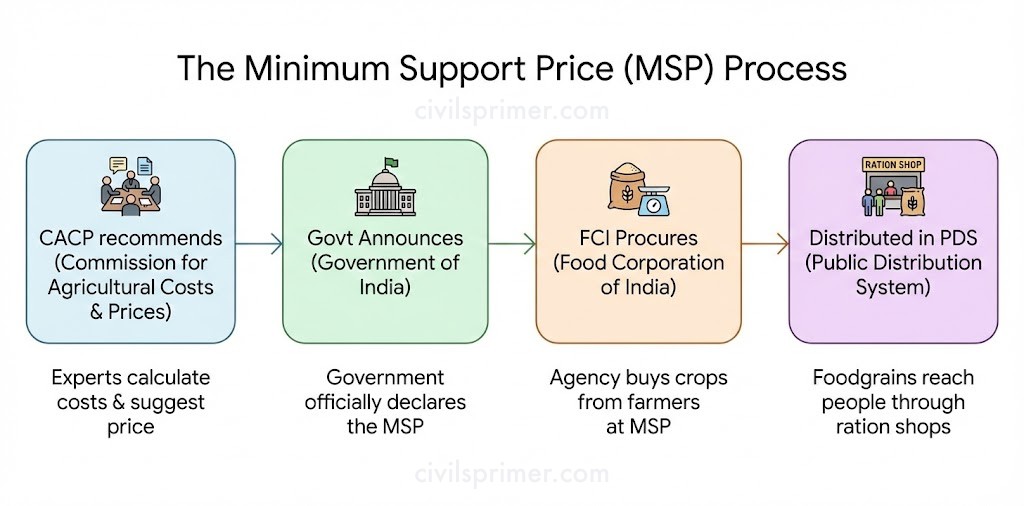
Farmers face two risks: the weather killing the crop, or the market crashing the price. To protect against the price crash, the government offers an Insurance Policy called Minimum Support Price (MSP).
How it works:
- Who Recommends? The Commission for Agricultural Costs and Prices (CACP) calculates the cost of production and recommends the price.
- Who Announces? The Cabinet Committee on Economic Affairs (CCEA) of the Government of India announces it.
- Coverage: It covers 22 mandated crops (7 cereals, 5 pulses, 7 oilseeds, 3 commercial crops) + FRP for Sugarcane,.
- The Flaw: While MSP exists for many crops on paper, effective procurement (government actually buying the crop) usually happens mostly for Wheat and Rice, and mostly in states like Punjab and Haryana. This discourages farmers from growing other important crops like pulses or oilseeds.
Fair and Remunerative Price (FRP): For sugarcane, the government declares FRP. Sugar mills must pay this minimum price to farmers.
Agricultural Marketing Reforms: From Farm to Fork #
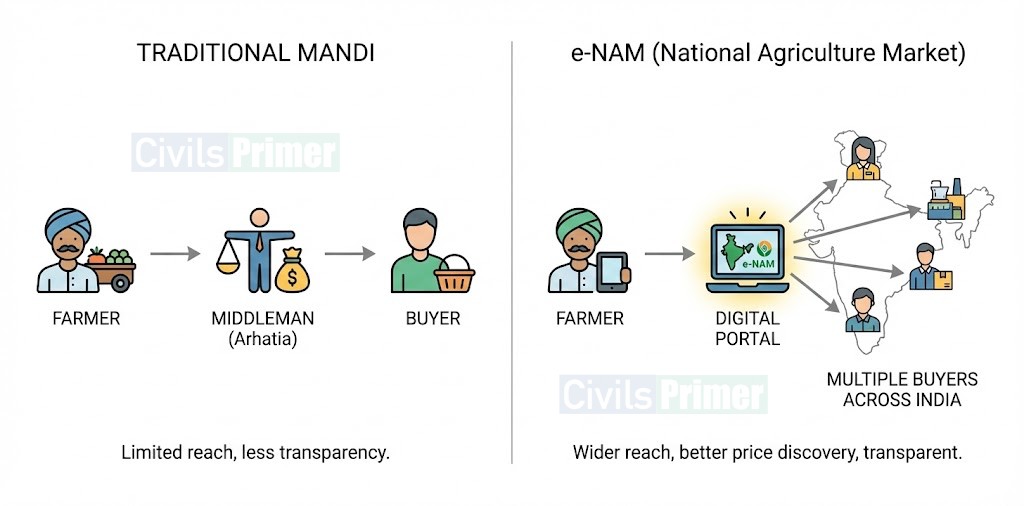
Once the crop is harvested, the farmer needs to sell it. Historically, they had to go to the Mandi (APMC – Agricultural Produce Market Committee).
The Problem with Mandis: Farmers could only sell to licensed middlemen (Arhatiyas) in these mandis. This led to cartelization, high commissions, and lower prices for farmers.
The Reforms:
- e-NAM (National Agriculture Market): An electronic trading portal that connects existing mandis across India. It creates a “One Nation, One Market,” allowing a farmer in one state to theoretically sell to a buyer in another.
- Model APMC Act: The government is encouraging states to delist fruits and vegetables from APMC (allowing direct sale) and promote contract farming.
- FPOs (Farmer Producer Organizations): Small farmers join hands to form a company. This gives them collective bargaining power to buy inputs cheaply and sell produce at better rates.
The Backup Plan: Allied Sectors #
Farming crops is risky. To survive, farmers need “Allied Sectors”—diversification into animals and plants that provide steady cash.
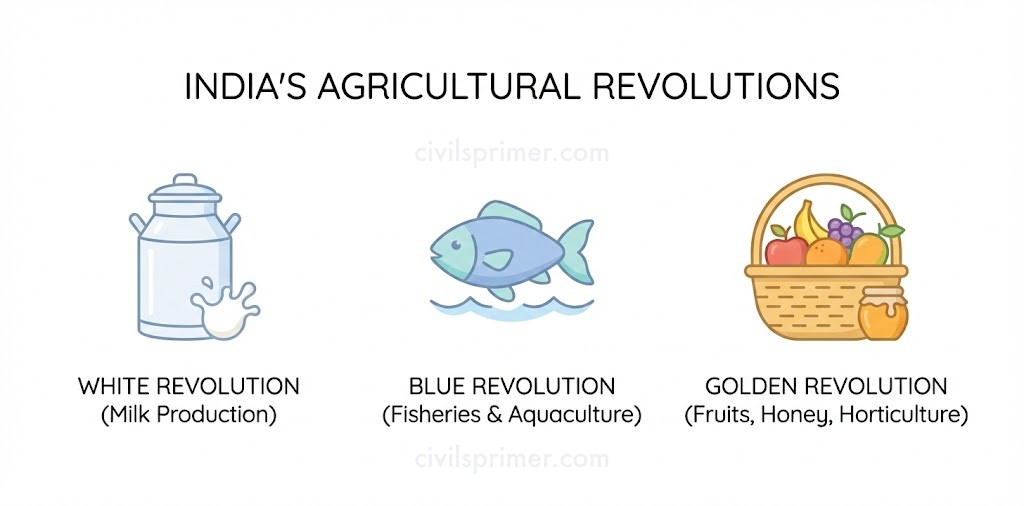
A. Livestock (White Revolution):
- Status: India has the world’s largest livestock population.
- Milk: India is the largest producer of milk in the world (Operation Flood/White Revolution),.
- Role: It provides “insurance” against drought. Even if crops fail, the buffalo still gives milk.
B. Fisheries (Blue Revolution):
- Status: India is the 2nd largest fish producer globally,.
- Shift: The sector is moving from marine (sea) fishing to Inland (freshwater) aquaculture, which now contributes about 75% of production.
- Scheme: Pradhan Mantri Matsya Sampada Yojana (PMMSY) aims to double income of fishers.
C. Horticulture (Golden Revolution): This refers to fruits, vegetables, flowers, and spices.
- Status: India is the 2nd largest producer of fruits and vegetables.
- Benefit: These are “High Value Crops.” They require less water than rice but give more money. However, they are perishable and need cold storage.
Fueling the Engine: Agricultural Credit and Insurance #
Farmers need money to buy seeds/fertilizer (Credit) and protection if the crop dies (Insurance).
Credit (The Money):
- Problem: Small farmers often rely on moneylenders who charge huge interest rates (30-60%), leading to debt traps,.
- Solution – Kisan Credit Card (KCC): Introduced to provide adequate and timely credit from banks. It allows farmers to buy inputs and withdraw cash for needs,.
- Priority Sector Lending (PSL): Banks must lend a certain percentage of their loans to agriculture.
Insurance (The Safety):
- Pradhan Mantri Fasal Bima Yojana (PMFBY):
- This is the flagship crop insurance scheme.
- Premium: Farmers pay a very low premium (2% for Kharif, 1.5% for Rabi, 5% for Commercial/Horticulture). The rest is paid by the government.
- Coverage: It covers yield losses due to non-preventable risks (drought, flood, pests) from pre-sowing to post-harvest.
Summary Checklist for Prelims #
- GDP vs Employment: Agri contributes ~18% to GDP but employs ~50%+ workforce (Disguised Unemployment).
- Seasons: Kharif (Monsoon/Rice) vs. Rabi (Winter/Wheat).
- Green Revolution: HYV Seeds + Fertilizer + Irrigation (Wheat & Rice focus).
- MSP: Recommended by CACP, Announced by CCEA. Not a legal right yet.
- Irrigation: Tubewells are the largest source; PMKSY focuses on micro-irrigation.
- Blue Revolution: Fisheries (Inland fisheries > Marine fisheries in production).
- PMFBY: Premium rates are 2% (Kharif), 1.5% (Rabi), 5% (Cash crops).
UPSC Mains PYQs: Agriculture and Allied Sectors in India #
Agriculture and Allied Sectors Mains PYQs
Cropping Patterns, Irrigation, and Integrated Farming
- 2022: What is an Integrated Farming System? How is it helpful to small and marginal farmers in India?
- 2021: How and to what extent would micro-irrigation help in solving India’s water crisis?
- 2021: What are the present challenges before crop diversification? How do emerging technologies provide an opportunity for crop diversification?
- 2020: What are the salient features of the Jal Shakti Abhiyan launched by the Government of India for water conservation and water security?
- 2020: What are the major factors responsible for making the rice-wheat system a success? In spite of this success, how has this system become a bane in India?
Agricultural Marketing and Reforms
- 2022: What are the major challenges of the Public Distribution System (PDS) in India? How can it be made effective and transparent?
- 2022: What are the main bottlenecks in the upstream and downstream process of marketing of agricultural products in India?
- 2020: What are the main constraints in transport and marketing of agricultural produce in India?
- 2019: What are the reformative steps taken by the Government to make the food grain distribution system more effective?
- 2018: Examine the role of supermarkets in supply chain management of fruits, vegetables and food items. How do they eliminate the number of intermediaries?
- 2015: What are the impediments in marketing and supply chain management in industry in India? Can e-commerce help in overcoming these bottlenecks?
MSP, Pricing, and Subsidies
- 2015: In what way could replacement of price subsidy with Direct Benefit Transfer (DBT) change the scenario of subsidies in India? Discuss.
Food Processing and Allied Sectors (Fisheries, Livestock)
- 2020: What are the challenges and opportunities of the food processing sector in the country? How can income of the farmers be substantially increased by encouraging food processing?
- 2019: Elaborate on the policy taken by the government of India to meet the challenges of the food processing sector.
- 2017: What are the reasons for poor acceptance of cost-effective small processing units? How will the food processing unit be helpful to uplift the socio-economic status of poor farmers?
- 2013: India needs to strengthen measures to promote the pink revolution in the food industry for better nutrition and health. Critically elucidate the statement.
Green Revolution, Land Reforms, and Role of Agriculture
- 2021: How did land reforms in some parts of the country help to improve the socio-economic conditions of marginal and small farmers?
- 2017: Explain various types of revolutions, took place in Agriculture after independence in India. How have these revolutions helped in Poverty alleviation and food security in India?
- 2016: Discuss the role of land reforms in agricultural development. Identify the factors that were responsible for the success of land reforms in India.
- 2015: How can the ‘Digital India’ programme help farmers to improve farm productivity and income? What steps has the Government taken in this regard?
- 2013: Establish the relationship between land reform, agriculture productivity and elimination of poverty in the Indian Economy. Discuss the difficulty in designing and implementation of the agriculture friendly?
Latest Current Affairs: Agriculture and Allied Sectors in India #
Agriculture and Allied Sectors in India
| [November, 2025] -> India’s Fisheries Sector Achievements: On World Fisheries Day, it was highlighted that India has become the world’s 2nd largest aquaculture producer with fish production doubling to 195 lakh tonnes since 2013-14. The sector now supports 30 million livelihoods. |
| [November, 2025] -> World Bank Report on AI for Agricultural Transformation: A new report outlines how Artificial Intelligence can be responsibly scaled to improve yields and climate resilience, emphasizing a shift towards generative and multimodal AI for farmer advisories. |
| [November, 2025] -> NITI Aayog Unveils Reimagining Agriculture Roadmap: A vision document for 2047 was released, proposing a Digital Agriculture Mission 2.0. It classifies farmers into ‘Aspiring’, ‘Transitioning’, and ‘Advanced’ to tailor tech-driven productivity interventions. |
| [October, 2025] -> Mission for Aatmanirbharta in Pulses Launched: A ₹11,440 crore national mission was launched to achieve self-sufficiency in pulses by 2027. It assures 100% MSP procurement for Tur, Urad, and Masoor for four years to reduce import dependence. |
| [October, 2025] -> Pradhan Mantri Dhan-Dhaanya Krishi Yojana (PMDDKY): A new ₹24,000 crore/year scheme was launched to transform agriculture in 100 low-performing districts. It focuses on convergence of existing schemes to boost productivity, irrigation, and market access. |
| [October, 2025] -> Minimum Support Price (MSP) Hike for Wheat: The government announced a 6.59% increase in the MSP for wheat, raising it to ₹2,585 per quintal for the 2026-27 marketing year, alongside a record production target of 119 million tonnes. |
| [October, 2025] -> New Rules for Pradhan Mantri Fasal Bima Yojana (PMFBY): New guidelines now cover crop losses due to wild animal attacks and paddy inundation, addressing long-standing protection gaps for farmers in flood-prone and conflict-prone areas. |
| [October, 2025] -> Marine Fisheries Census 2025 Launched: The government initiated India’s first fully digital and geo-referenced fisheries census. It targets 1.2 million fisher households to gather real-time socio-economic data for better policy planning. |
| [September, 2025] -> Modified Interest Subvention Scheme (MISS) Approved: The Cabinet approved the continuation of MISS for 2025-26, providing a 1.5% interest subvention to lending institutions to ensure farmers receive short-term credit at a 7% interest rate. |
| [September, 2025] -> BHARATI Initiative for Agri-Exports: APEDA launched the BHARATI (Bharat’s Hub for Agritech, Resilience, Advancement and Incubation) initiative to support 100 agri-food startups, aiming for $50 billion in agri-food exports by 2030. |