
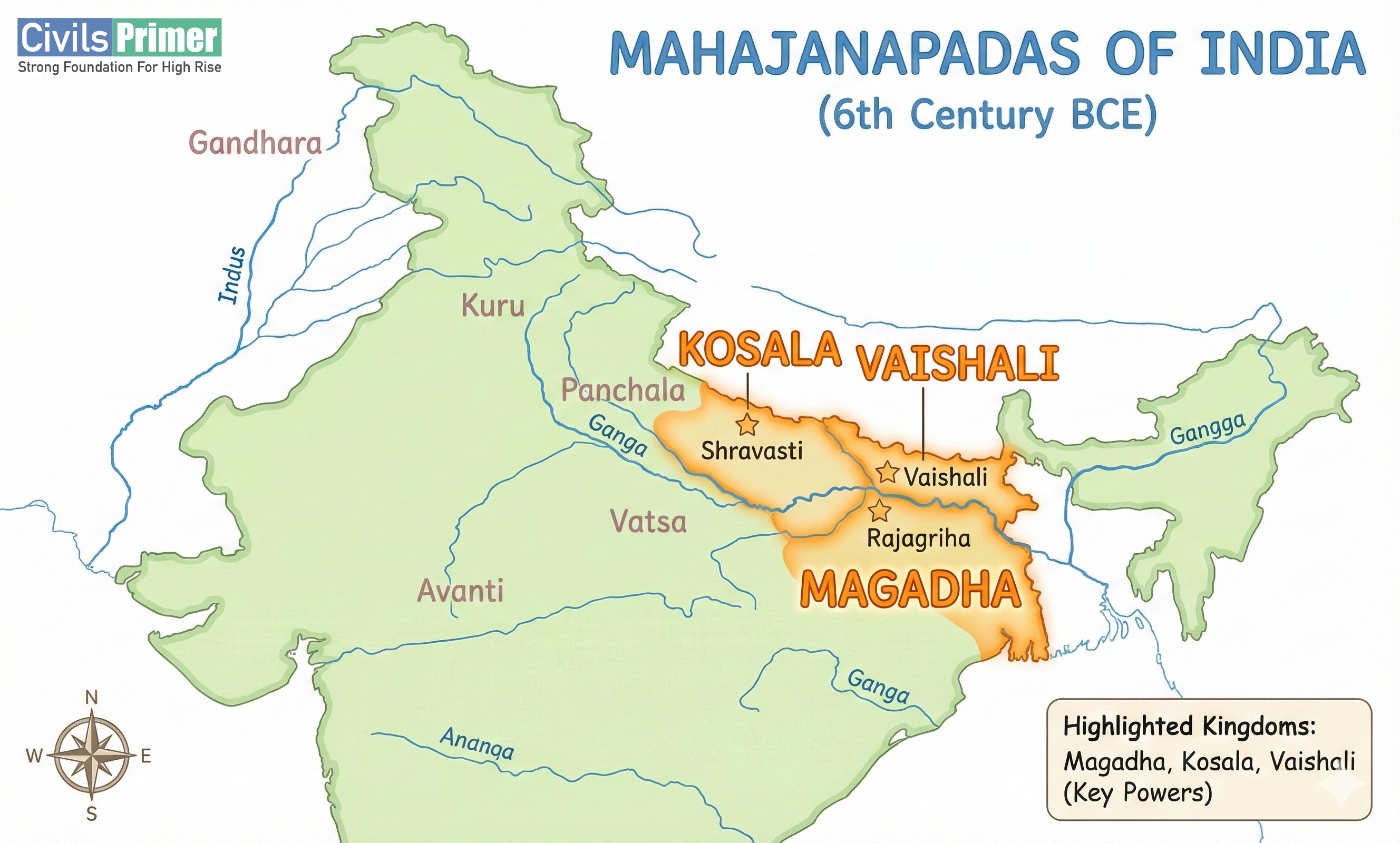
In the 6th century BCE, the Gangetic valley was in a state of intellectual ferment. The iron plough had revolutionized agriculture, cities were expanding, and the old Vedic social order was under scrutiny. Amidst the rising dust of new empires, wanderers and ascetics left their homes to find the truth behind suffering. In ancient terminology, you must remember that a Parivrajaka refers to a renunciant and wanderer, while a Shramana refers to an ascetic or one who strives (often anti-Vedic), not a priest with high status.
From this churning emerged two distinct but related traditions: Jainism and Buddhism. Despite their differences, they shared a common rebellion against the established order. Both Buddhism and Jainism denied the authority of the Vedas and the efficacy of rituals. They saw the violence in Vedic sacrifices as spiritual folly. Consequently, Both Buddhism and Jainism were opposed to animal sacrifices.
Part I: The Way of the Jinas #
Let us first walk the path of the Tirthankaras. To understand the lineage of Lord Mahavira, we must look at his royal connections carefully: Vardhamana Mahavira’s mother was the sister (not daughter) of the Lichchhavi chief Chetaka.
Mahavira’s view of the universe was unique. He did not preach of a creator God. Instead, Jain philosophy holds that the world is created and maintained by Universal Law, not by a Universal Soul or Creator. This universe is complex and multifaceted, leading to the doctrine of Anekantavada, which is a core theory and philosophy of Jainism.
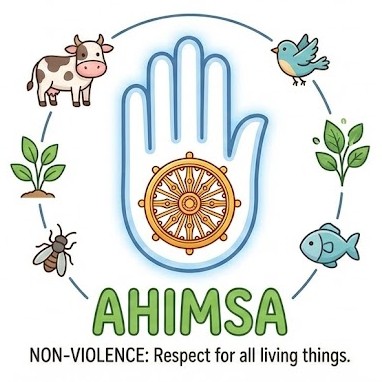
The most distinctive feature of Jainism is its rigorous application of non-violence (Ahimsa). This is based on the belief that Every object, even the smallest particle, is believed to have a soul. This belief had practical socio-economic consequences. For instance, Agriculturalists were often prevented from embracing Jainism because the emphasis on non-violence (ahimsa) prohibited the killing of insects and pests involved in cultivation
The ultimate goal for a Jain is to scrub the soul clean of Karma. In Jainism, the surest way of annihilating Karma is to practice penance. However, for the common householder who could not practice extreme asceticism, The concept of Anuvrata (small vows) was advocated by Jainism, allowing them to live a righteous life without total renunciation.
The Great Divide History tells us of a catastrophic famine in Magadha that lasted twelve years. This event split the community. The Jainas who remained in Magadha under the leadership of Sthalabahu were called Shvetambaras, while those who went South under Bhadrabahu were called Digambaras. Over centuries, other sects emerged; for example, The Sthanakvasi sect belongs to Jainism.
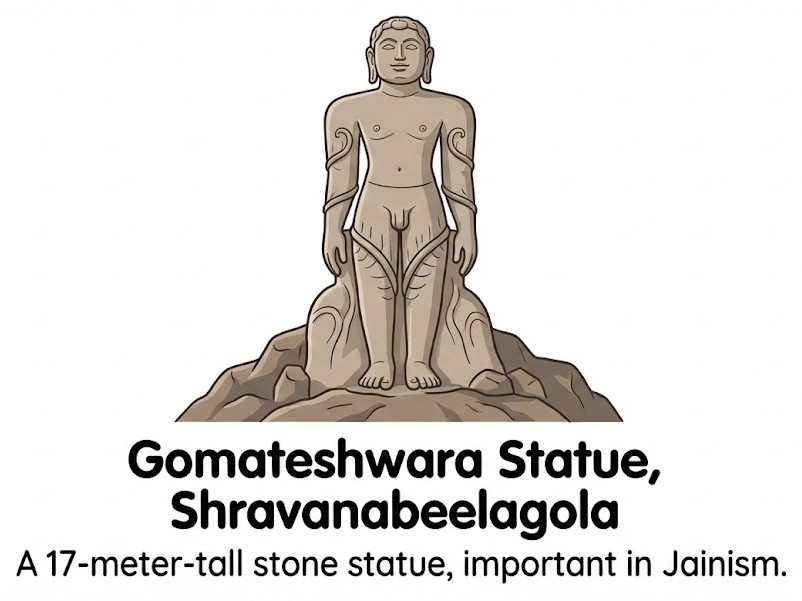
Jainism found royal patrons who etched its history into India’s landscape. It is recorded that Jainism enjoyed the patronage of the Kalinga king Kharavela in the first century BC. In the South, the massive monolith at Shravanabelagola stands tall. You must note that The statue of Gomateshwara at Shravanabelagola represents Bahubali, not the last Tirthankara.
Part II: The Middle Path of the Buddha #
While Mahavira walked the path of austerity, Siddhartha Gautama found the “Middle Way.” His origins, too, were royal: Gautama Buddha’s mother was a princess from the Koliya dynasty. His ministry was geographically concentrated; The kingdoms of Kosala and Magadha were associated with the life of the Buddha (Avanti and Gandhara were not).
The Buddha preached the Dhamma to monks and lay followers (known as Upasakas). A Upasaka refers to a lay follower of Buddhism. His ultimate aim was Nirvana, which in Buddhism is best described as the extinction of the flame of desire. To achieve this, he turned the Wheel of Law. The concept of the Eightfold path forms the theme of the Dharma Chakra Pravartana Sutta.
The Splintering of the Sangha Like Jainism, Buddhism did not remain a monolith. It fractured into various philosophical schools. You might encounter complex names, but remember: Sautrantika and Sammitiya were sects of Buddhism. Another school, the Sarvastivadins held that the constituents of phenomena were not wholly momentary but existed forever in a latent form.
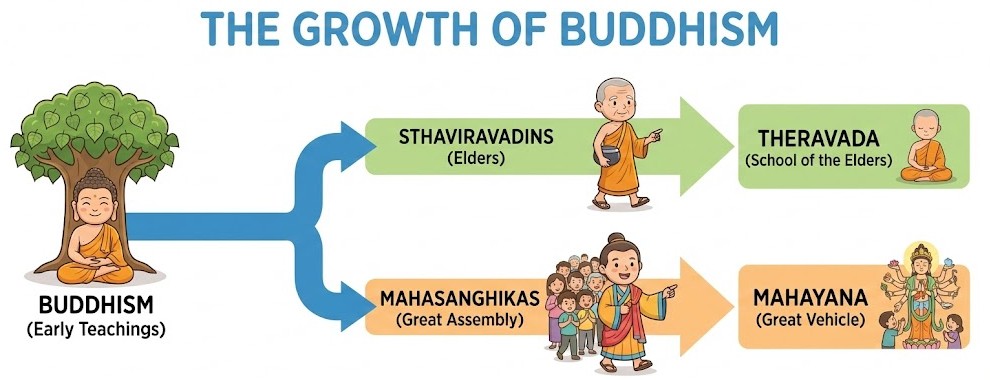
A major rift occurred between the orthodox elders and the reformists. Sthaviravadins belong to Hinayana (Theravada) Buddhism, not Mahayana. On the other side, the Mahasanghikas paved the way for the Great Vehicle. The Lokottaravadin sect was an offshoot of the Mahasanghika sect of Buddhism. Crucially, The deification of Buddha by Mahasanghikas fostered Mahayana Buddhism. The Rise of Mahayana This evolution crystallized at the Fourth Buddhist Council in Kashmir. Vasumitra presided over the Fourth Buddhist Council held during the reign of Kanishka in Kashmir. Here, the Mahayana identity became distinct. Mahayana Buddhism is characterized by the deification of the Buddha, treading the path of Bodhisattvas, and image worship/rituals.
In Mahayana, the ideal changed from the Arhat to the Bodhisattva. To become a Bodhisattva, one practiced specific virtues: Paramitas are perfections whose attainment led to the Bodhisattva path. You must recognize specific Bodhisattvas: In Mahayana Buddhism, the Bodhisattva Avalokitesvara is also known as Padmapani. Furthermore, believers await Maitreya, the future Buddha, yet to come to save the world. Royal patronage fuelled this spread. Emperor Harshavardhana convened the Prayag Assembly to popularize Mahayana Buddhism. Even foreign rulers found solace here; Many Greeks, Kushanas, and Shakas embraced Buddhism because caste-ridden Hinduism did not attract them.
Part III: The Legacy in Ink and Stone #
The intellectual richness of this era was captured in vibrant literature. Milindapanho is in the form of a dialogue between the Indo-Greek king Menander and the Buddhist monk Nagasena. The Buddha’s life was dramatized in the Buddhacharita, written by Ashvaghosha. Even the voices of women renunciants were preserved: Therigatha is a part of Buddhist literature (not Jain).
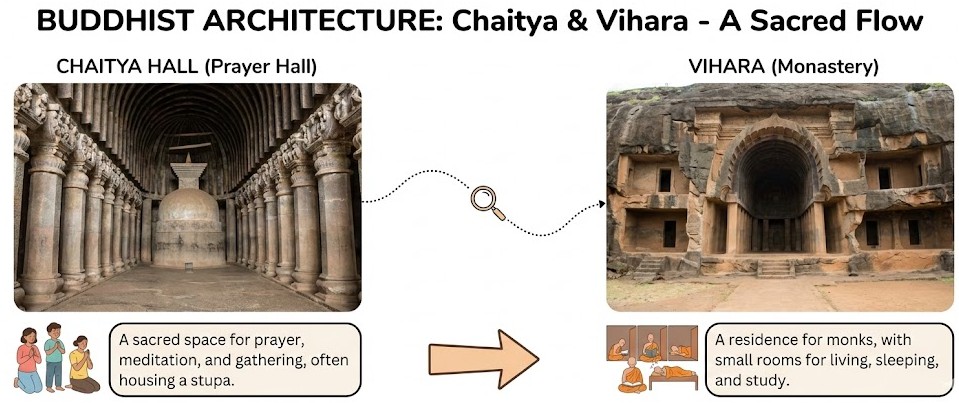
Finally, we look at the physical structures. In Buddhist architecture, the distinction is clear: Chaityas are places of worship, while Viharas are the dwelling places of monks.
The art tells stories through gestures (Mudras). The Bhumisparsha Mudra symbolizes Buddha calling the Earth to witness his purity and chastity despite the temptations of Mara.
The caves of Ajanta are a gallery of this devotion. The painting of Bodhisattva Padmapani is found at Ajanta, as is A grand image of Buddha’s Mahaparinirvana with celestial musicians.
From the caves of the Deccan to the Himalayas, the legacy endures. Tabo monastery is located in Spiti Valley, Lhotsava Lhakhang is in Himachal Pradesh (Nako), and Alchi temple is in Ladakh. And in the plains, the most iconic symbol of Mauryan peace remains: The Lion Capital of Ashoka is located at Sarnath.
Mains PYQs #
- 2020 → The Pala period is the most significant phase in the history of Buddhism in India. Enumerate.
- 2019 → Highlight the Central Asian and Greco-Bactrian elements in Gandhara art.
- 2016 → Early Buddhist Stupa-art, while depicting folk motifs and narratives successfully expounds Buddhist ideals. Elucidate.
- 2014 → Gandhara’s sculpture owed as much to the Romans as to the Greeks. Explain.
- 2014 → Taxila University was one of the oldest universities in the world, associated with a number of renowned learned personalities of different disciplines. Its strategic location caused its fame to flourish, but unlike Nalanda, it is not considered a university in the modern sense. Discuss.
History Optional
- 2014 → The Buddha’s teachings to a large extent could be helpful in understanding and resolving the problems of today’s society. Analyse critically. (History Optional)
- 2011 → Assess the importance of Jaina tenets and their relevance to humanity. (History Optional)
- 2015 → How far is it correct to say that changes in the post-Vedic economy gave birth to new religious movements in India? (History Optional)
Current Affairs Linkage #
- Nomination of Sarnath for UNESCO World Heritage List: India has officially nominated Sarnath, the site where Lord Buddha delivered his first sermon (Dhammachakka-pavattana), for the UNESCO World Heritage List for the 2025-26 cycle. Additionally, the Archaeological Survey of India (ASI) plans to install a plaque crediting local ruler Babu Jagat Singh for the site’s preservation/rediscovery rather than the British. (October, 2025)
- Repatriation of Sacred Buddhist Piprahwa Gemstones: A collection of 349 gemstones, part of the sacred Piprahwa Buddhist relics, was repatriated to India from the US. These relics, discovered in 1898 in Uttar Pradesh (believed to be ancient Kapilavastu), were previously in the possession of the Honolulu Museum of Art. This move reinforces India’s identity as the cradle of Buddhism. (September, 2025)
- Inauguration of New Nalanda University Campus: A new campus for Nalanda University was inaugurated near the ancient ruins in Rajgir, Bihar. The ancient Nalanda Mahavihara was a renowned center for Buddhist learning, teaching major philosophies like Mahayana and Vajrayana before its destruction in the 1190s. (September, 2025)
- Presentation of Daruma Doll to PM Modi: During a visit to Japan, the Indian Prime Minister was presented with a Daruma doll. This traditional Japanese doll is modeled after Bodhidharma, an Indian monk from Kancheepuram who travelled to China and Japan over a thousand years ago and founded the Zen tradition of Buddhism. (September, 2025)
- Focus on Jaina Ethics in Governance: A comprehensive analysis on Jaina ethics was featured, highlighting principles such as Tri Ratna (Right Faith, Knowledge, Conduct) and Panch Vrata (including Ahimsa and Aparigraha). These principles were discussed in the context of their application to civil services to foster integrity and non-violence in governance. (August, 2025)
- Announcement regarding the 15th Dalai Lama: The 14th Dalai Lama announced that the 600-year-old institution would continue and asserted that the Gaden Phodrang Trust would be the sole authority to recognize his future reincarnation. He explicitly stated that no recognition should be given to a successor selected for political purposes by the Chinese government. (August, 2025)