
Economics Basics: The Story of Arthapura #
Imagine you have just arrived in Arthapura, a bustling village that represents a mini-economy. You have a limited budget of ₹100 in your pocket, but you want to buy food, a notebook, and a ticket to a cricket match.
The Problem of Scarcity and Choice #
As you stand in the market, you realize you can’t buy everything. You must choose.
The Concept: This is the heart of economics. It is the study of how people and society choose to employ scarce resources that have alternative uses to produce commodities and distribute them. Scarcity implies that resources are limited relative to human wants. No individual has unlimited resources compared to their needs. Opportunity Cost: You choose the notebook over the cricket ticket. The value of the ticket (the next best alternative forgone) is your Opportunity Cost.

Microeconomics vs Macroeconomics #
You walk up to a single fruit vendor named Raju.
- Microeconomics: When you study how Raju sets his prices or how you decide to buy apples, you are doing Microeconomics. It studies the behaviour of individual economic agents (consumers and producers) in markets
- Macroeconomics: Now, look at the entire market of Arthapura—total sales, total employment in the village, and the general price rise (inflation) of all goods. This is Macroeconomics. It studies the economy as a whole.

The Factors of Production (The Farm Visit) #
You leave the market and visit a farm on the outskirts. Here, production happens. To grow crops, the farmer needs four things:
- Land: Natural resources like water and soil.
- Labour: People doing the work.
- Capital:
- Fixed Capital: The tractor and the barn. These are tools/machines used over many years.
- Working Capital: The seeds, fertilizer, and money in hand. These are used up during production.
- Note: Capital Goods are final goods used as inputs (like machinery) that do not get transformed, unlike intermediate goods.
- Human Capital: The farmer’s knowledge and enterprise to organize the other three.
UPSC Reality Check
In cases of Disguised Unemployment (where more labor is engaged than required, common in Indian agriculture), the marginal productivity of labor is zero.
Production Possibility Curve (PPC) #
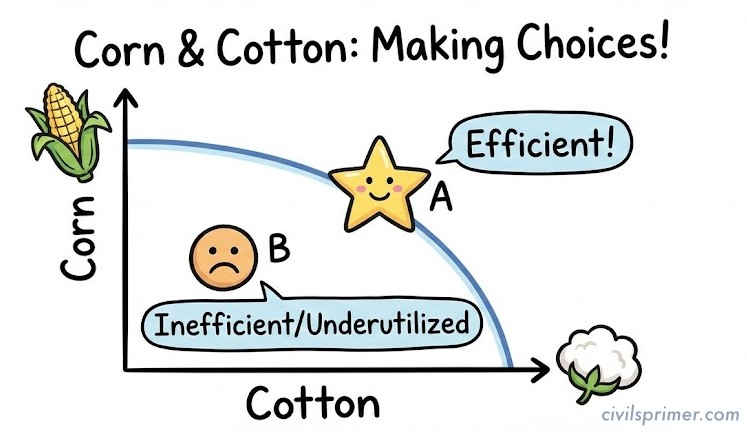
The farmer has a finite plot of land. He can grow Corn or Cotton.
- The Dilemma: If he uses all land for Corn, he grows 0 Cotton. If he grows some Cotton, he must give up some Corn.
- The Curve: This trade-off is depicted by the Production Possibility Frontier (PPF). It shows the maximum combinations of two goods that can be produced with available resources.
Economic Systems: Who Decides? #
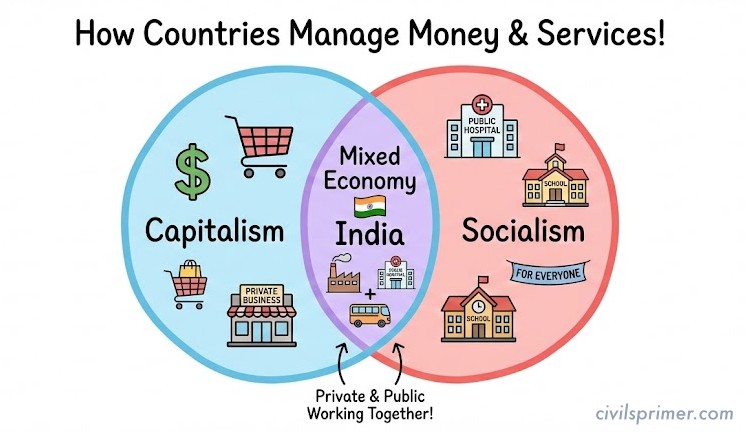
Arthapura is debating how to run its market. Three elders propose three different systems:
- Elder 1 (The Capitalist): “Let the market decide! Goods should be distributed based on Purchasing Power (who can afford them), not on what people need. Only goods in demand that can be sold profitably will be produced”.
- Prelims Pointer: In a Free Market, pricing is driven by supply and demand without government restraint.
- Elder 2 (The Socialist): “No! The government should decide. Goods must be distributed based on Need, not affordability. Strictly speaking, there is no private property; the state owns everything”.
- Elder 3 (The Mixed Economy – India): “Let’s combine them. The market provides what it does well, and the government provides essential services the market ignores. We will answer ‘what to produce’ and ‘how to distribute’ together”.
Circular Flow of Income #
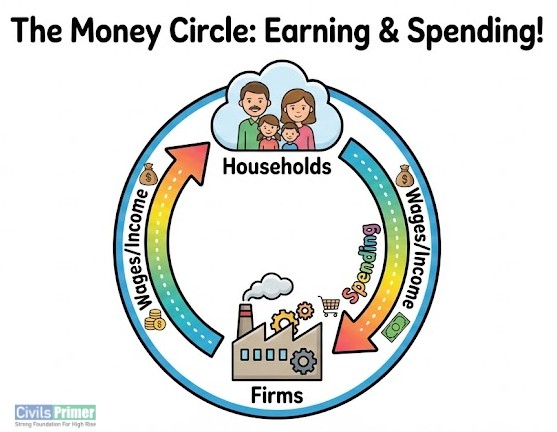
Finally, you watch money flow through the village. This cycle is the Circular Flow of Income.
- Households (You) provide labor to Firms (The Farm).
- Firms pay Income (Wages) to Households.
- Households spend that income on Goods produced by Firms.
UPSC Reality Check
- GDP (Income Method): GDP = Income received by the four factors of production: Wages + Rent + Interest + Profit.
- Closed Economy: An economy where neither exports nor imports take place.
UPSC Prelims Pointers #
| Economics is the study of how people and society choose to employ scarce resources that have alternative uses to produce commodities and distribute them. |
| A Closed Economy is an economy in which neither exports nor imports take place. |
| A Dual Economy refers to the coexistence of a traditional agricultural sector and a modern industrial sector. |
| In a Capitalist (Market) Economy, goods and services are distributed based on purchasing power rather than need. |
| In a Socialist Economy, the government decides what goods are produced, and the major means of production are owned by the State. |
| A Mixed Economy combines features of both market and planned economies, where the private sector and government coexist. |
| Public goods are goods whose benefits are non-excludable and shared by the entire community (e.g., national defence, lighthouses). |
| Pure private goods are goods from which individuals can be excluded if they do not pay for them. |
| The four factors of production are Land, Labour, Physical Capital, and Human Capital. |
| Fixed capital includes tools, machines, and buildings that can be used repeatedly in the production process. |
| Working Capital refers to raw materials and money in hand that are used up during the production process. |
| Capital Formation refers to the creation of capital goods that increase future productive capacity and economic growth. |
| The Incremental Capital Output Ratio (ICOR) shows the additional capital required to produce one additional unit of output; a lower ICOR indicates higher efficiency. |
| The Laissez-Faire philosophy advocates minimal government intervention in economic activities. |
| Price discrimination occurs when the same product is sold at different prices to different consumers. |
| “Green shoots” refer to early signs of economic recovery following a period of downturn. |
UPSC Mains PYQs #
Basics of Economy: UPSC Mains PYQs for Answer Writing Practice
Economic Systems (Capitalism/Mixed) & Growth Models
- 2021: Do you agree that the Indian economy has recently experienced V-shapes recovery? Give reasons in support of your answer.
- 2015: The nature of economic growth in India is described as Jobless Growth. Do you agree with this view? Give arguments in favour of your answer.
- 2014: Capitalism has guided the world economy to unprecedented prosperity. However, it often encourages short-sightedness and contributes to wide disparities between the rich and the poor. In this light, would it be correct to believe and adopt capitalism driving Inclusive Growth in India? Discuss.
National Income & Macroeconomic Concepts
- 2021: Explain the difference between computing methodology of India’s Gross Domestic Product (GDP) before the year 2015 and after the year 2015.
- 2020: Define potential GDP and explain its determinants. What are the factors that have been inhibiting India from realising its potential GDP?
- 2019: Do you agree with the view that steady GDP growth and low inflation have left the Indian economy in good shape? Give reasons in support of your arguments.
Factors of Production (Labour/Demographics)
- 2014: While we flaunt India’s demographic dividend, we ignore the dropping rates of employability. What are we missing while doing so? Where will the jobs that India desperately needs come from? Explain.
Answer Writing Minors #
Introduction and Conclusion: Suitable for adding to answers of UPSC Mains questions related to Basic Economic Concepts (Resource Allocation, Growth, Economic Systems, etc.).
Introduction: Economic development encompasses not just the quantitative increase in real Per Capita Income but also progressive changes in the socio-economic structure of a country. As a developing Mixed Economy, India faces the dual challenge of accelerating growth to meet the aspirations of its demographic dividend while managing the constraints of limited resources and structural rigidities.
Conclusion: To sustain the growth momentum, there is a need to shift focus from mere capital accumulation to productivity enhancement and human Capital Formation. Achieving a balance between economic efficiency and social justice is crucial for attaining the constitutional ideals of a welfare state and meeting the Sustainable Development Goals (SDGs)
Related Current Affairs #
Economy Fundamentals Current Affairs
- Review of Inflation Targeting Framework (Micro vs Macro) – With the flexible inflation targeting framework set to expire in March 2026, the RBI is reviewing whether to target headline or Core Inflation. While economists favor continuing the 4% target, the debate highlights the macroeconomic trade-off between price stability and growth. (October 2025)
- Problem with Low Inflation (Meaning and Scope) – Recent data showing CPI inflation at 2.07% highlights a macroeconomic challenge where low inflation slows nominal GDP growth, impacting government revenue, fiscal arithmetic, and debt sustainability. (October 2025)
- Unemployment of the Educated (Factors of Production – Labor) – A structural crisis where highly educated youth face unemployment or underemployment, reflecting a mismatch between human Capital Formation and labor market demand. (October 2025)
- Unified National Employment Framework (Resource Allocation) – Experts call for a unified framework to address job–skill mismatches and better allocate human resources to convert the demographic dividend into economic productivity. (October 2025)
- Consumerism and Identity (Economic Systems) – Analysis of how globalization and market economies promote consumerism, linking personal identity to consumption and reflecting behavioural dimensions of capitalist systems. (October 2025)
- Non-Farm Primary Activities (Resource Allocation) – Rural households are diversifying into livestock and mining to mitigate agricultural risks, indicating adaptive resource reallocation at the household level. (October 2025)
- State Finances 2022–23 Report (Meaning and Scope) – The CAG report notes that states’ total debt reached 22.17% of GDP, highlighting issues related to fiscal sustainability and public finance management. (September 2025)
- Annual Survey of Industries 2023–24 (Factors of Production) – MoSPI data shows GVA growth of 11.89%, reflecting returns to capital and labor and trends in manufacturing employment and investment. (September 2025)
- Need for Separate Agriculture Budget (Resource Allocation) – Calls for a distinct agriculture budget to address sectoral vulnerabilities and improve allocation of subsidies and public investment. (September 2025)
- Navigating the New Techno-Capitalist Order (Types of Economies) – The emergence of technology-driven capitalism, contrasting the US private-led model, China’s state-led approach, and India’s hybrid economic pathway. (August 2025)
- System of National Accounts 2025 (Meaning and Scope) – The UN’s updated framework expands economic measurement to include natural capital and unpaid work, broadening the understanding of sustainability and welfare. (August 2025)
- India–China Reform Deficit (Factors of Production) – India’s challenge lies in reforming land, labor, and capital markets, while China faces overinvestment and weak consumption, reflecting differing structural constraints. (August 2025)
- Corporate Investment Lagging (Circular Flow of Income) – Despite high corporate profits, weak demand has limited reinvestment, disrupting the Circular Flow of Income between firms and households. (August 2025)
- National Cooperative Policy 2025 (Economic Systems) – The policy promotes cooperative enterprises based on collective ownership, offering an alternative to purely capitalist or state-led economic models. (August 2025)
- DAP Fertiliser Crisis (Scarcity) – China’s export restrictions caused fertilizer shortages in India, demonstrating how scarcity affects supply chains and resource allocation decisions. (August 2025)
- India’s “Goldilocks Moment” (Macroeconomics) – The economy is described as experiencing balanced growth with controlled inflation, indicating equilibrium between aggregate demand and supply. (July 2025)
- India as 4th Largest Economy (Meaning and Scope) – India’s rise in nominal GDP rankings highlights differences between nominal GDP and PPP as measures of economic size. (July 2025)
- Capping MGNREGS Spending (Scarcity & Opportunity Cost) – Limiting expenditure under MGNREGS reflects fiscal constraints and the Opportunity Cost involved in allocating limited public funds. (July 2025)