
Part I: The Cosmic Ballet – From a Tiny Point to the Blue Planet #
Imagine a time when time itself did not exist. There was no space, no matter, and no light. Everything that we see today—the mountains, the oceans, the sun, and the distant stars—was squeezed into a single point of unimaginable density and infinite temperature. This was the “Singularity,” a tiny ball smaller than an atom.
Then, about 13.7 billion years ago, something spectacular happened. The tiny ball didn’t just expand; it exploded violently. This event is what we call the Big Bang Theory. In a fraction of a second, this explosion triggered a massive expansion, converting energy into matter.
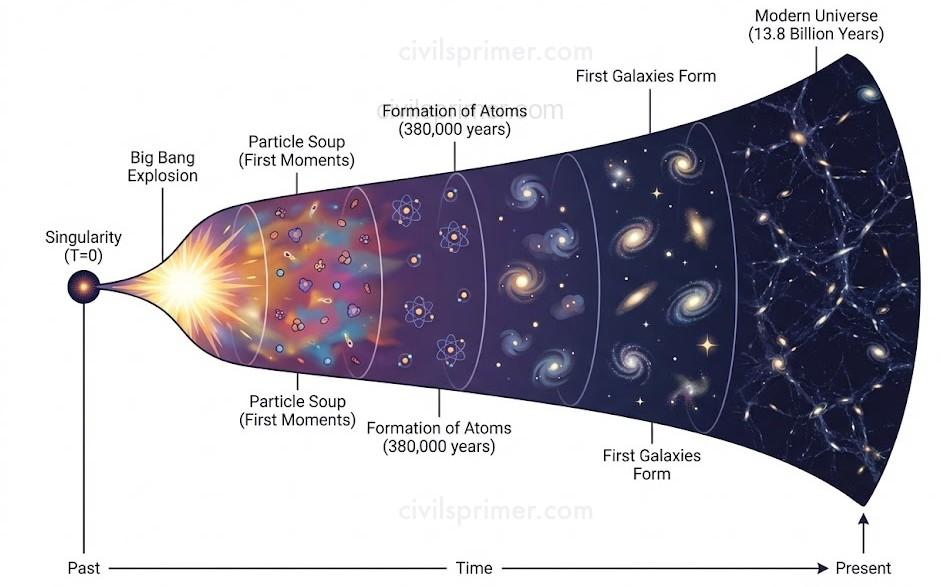
As the universe grew, it cooled. Within the first three minutes, the very first atom began to form. However, it took another 300,000 years for the temperature to drop to 4,500 Kelvin, allowing atomic matter to stabilize and the universe to finally become transparent.
The Balloon Experiment: To understand this expansion, imagine you have a balloon. Mark little black dots on it to represent galaxies. As you blow air into the balloon, the surface stretches, and the dots move away from each other. This is exactly what Edwin Hubble observed in 1920: the galaxies are moving further apart because the universe is expanding. However, keep in mind that while the space between galaxies expands, the galaxies themselves (the dots) do not expand, which makes the balloon analogy only partially correct.
Part II: The Birth of Stars and the Nebular Nursery #
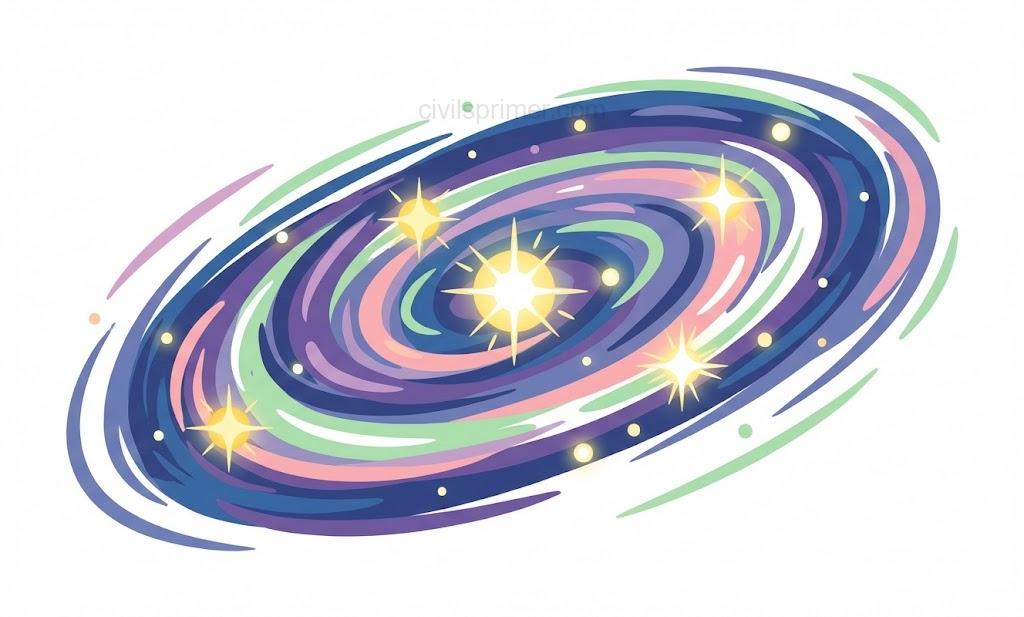
The early universe was not perfectly smooth. There were tiny differences in density. As gravity loves clumps, it began to pull matter together in the denser areas. These clumps of gas—mostly hydrogen—accumulated to form massive clouds called Nebulae. Inside these nebulae, the gas continued to clump together, growing denser and hotter. Eventually, about 5 to 6 billion years ago, these gaseous bodies ignited to become stars.
Part 3: Building the Solar System #
While the stars were lighting up the dark void, our own neighbourhood was under construction. There have been many storytellers (scientists) with different versions of how our Solar System was born.
The Early Tales: First came Immanuel Kant and Laplace with the Nebular Hypothesis. They believed that the planets formed out of a cloud of material associated with a slowly rotating youthful sun. Later, Chamberlain and Moulton proposed a dramatic encounter: a wandering star approached the sun, ripping a cigar-shaped extension of material from the solar surface. As the star moved away, this material revolved around the sun and condensed into planets. This is known as the Planetesimal Hypothesis. Similarly, Jeans and Jeffrey proposed the Tidal Hypothesis, suggesting a bi-parental origin of the sun where a passing star created tidal distortions.
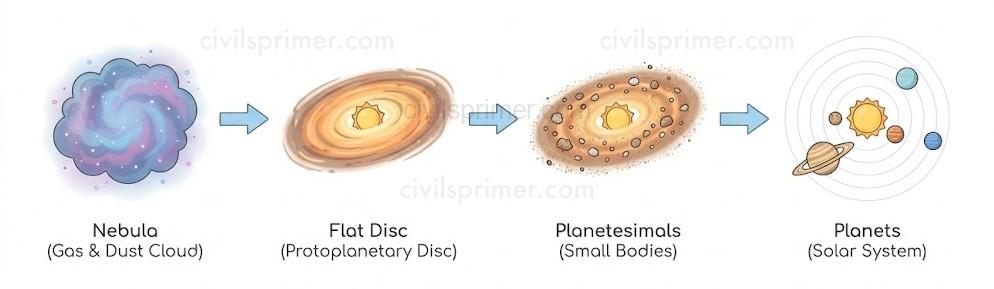
The Modern Story (The Binary Theory): Today, we look at the Big Bang as the foundational context. In this view, our solar system formed from a Solar Nebula.
- The Disc: The friction and collision of particles in the Nebula caused it to flatten into a disk-shaped cloud rotating around the sun.
- Planetesimals: The gas clouds condensed. Matter clumped together into small, rounded objects. Through cohesion, these developed into “planetesimals”.
- Accretion: These small bodies collided and stuck together due to gravity. The smaller planetesimals accreted to form fewer, larger bodies—the planets.
Part 4: A Tour of the Solar Family #
Our solar family consists of the Sun (the head of the family), eight planets, satellites, and other celestial bodies like asteroids and meteoroids.
The Sun: Sitting at the center, the Sun is a ball of extremely hot gases. It provides the gravitational pull that binds the entire system. Though it is our nearest star, it is still about 150 million km away.
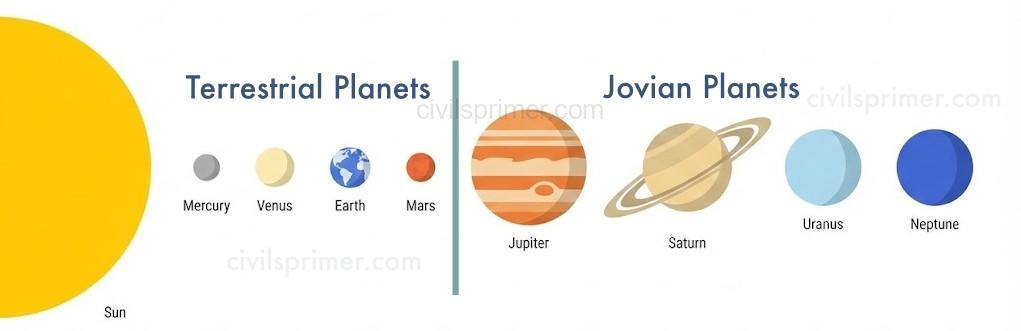
The Planets: We can remember the order of the planets from the sun with the phrase: “My Very Efficient Mother Just Served Us Nuts” (Mercury, Venus, Earth, Mars, Jupiter, Saturn, Uranus, Neptune).
- The Inner Circle (Terrestrial Planets): These are Mercury, Venus, Earth, and Mars. They are made up of rocks and metals and are located close to the sun.
- Mercury: The nearest to the sun, taking only 88 days to complete one orbit.
- Venus: Known as “Earth’s Twin” because its size and shape are very similar to Earth.
- Mars: The Red Planet.
- Earth: Our home, the third planet. It is a Geoid (earth-shaped), flattened slightly at the poles and bulging at the equator. It is the only known planet with life, air, and water.
- The Outer Giants (Jovian Planets): These are Jupiter, Saturn, Uranus, and Neptune. They are huge and made of gases and liquids.
- Jupiter, Saturn, and Uranus: They possess rings around them, which are essentially belts of small debris.
The Others:
- Asteroids: Tiny rocky bodies found orbiting between Mars and Jupiter.
- Meteoroids: Small pieces of rocks that move around the sun. When they enter Earth’s atmosphere and burn up, we call them shooting stars.
- The Moon: Earth’s only satellite, about 384,400 km away.
Part 5: The Evolution of Earth #
Initially, our Earth wasn’t the blue paradise it is today. It was a barren, rocky, and hot object with a thin atmosphere of hydrogen and helium.
Stage 1: Differentiation (The Great Sorting) The early earth was volatile. As density increased, the temperature rose. This caused the material inside to separate. Heavier materials like Iron sank to the center to form the Core, while lighter materials rose to the surface to form the Crust. This process of separating the earth into layers (Crust, Mantle, Outer Core, Inner Core) is called Differentiation.
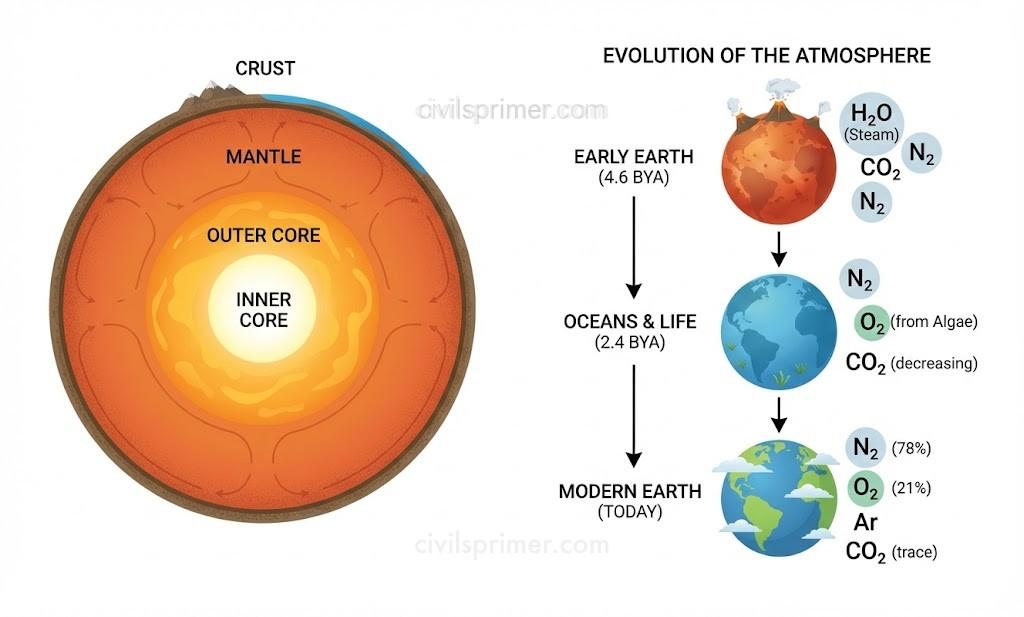
Stage 2: Evolution of the Atmosphere There were three stages to making our air breathable:
- Loss of Primordial Atmosphere: The early hydrogen and helium were stripped away by solar winds.
- Degassing: The hot interior of the earth released gases and water vapour through volcanic eruptions. This process, called Degassing, filled the air with water vapour, nitrogen, carbon dioxide, methane, and ammonia.
- Photosynthesis: Finally, the living world modified the atmosphere by introducing oxygen.
Stage 3: The Birth of Oceans (Hydrosphere) As the earth cooled, the water vapour released by volcanoes began to condense. This caused rains that lasted for millions of years, filling the depressions on the crust and creating the oceans. The oceans are estimated to be as old as 4,000 million years. Life began here around 3,800 million years ago, and eventually, photosynthesis flooded the atmosphere with oxygen.
And thus, from a Singularity to a diverse ecosystem, the story of our physical world unfolded.
UPSC Mains Subjective Previous Years Questions #
Here are the questions asked by the UPSC in the Mains examination related to the topics of the Universe and Earth’s evolution.
- 2017: How does the Juno Mission of NASA help to understand the origin and evolution of the Earth?
Answer Writing Minors #
- Common Introduction: “The origin and evolution of the Earth and the Universe have been subjects of scientific inquiry for centuries, transitioning from early hypotheses like the Nebular Theory to modern concepts like the Big Bang. Understanding these geomorphological processes is crucial as they laid the foundational structure for the Lithosphere, atmosphere, and hydrosphere that sustain life today.”
- Common Conclusion: “Conclusively, the study of the Earth’s cosmic origins and internal evolution offers vital insights into the dynamic nature of our planet. As scientific advancements like deep-space missions continue to refine our understanding, deciphering these primordial events remains essential for comprehending the Earth’s past climate, magnetic field, and potential future changes.”