
The Arrival of the Mahatma and the Early Experiments #
The story of India’s mass movement begins with the return of a barrister who had spent over two decades in South Africa fighting racial racism. Mohandas Karamchand Gandhi returned to India on January 9, 1915, bringing with him a novel weapon: Satyagraha (Truth-force). On the advice of his political guru, G.K. Gokhale, Gandhi spent a year travelling across India to understand the pulse of the nation before intervening in politics.
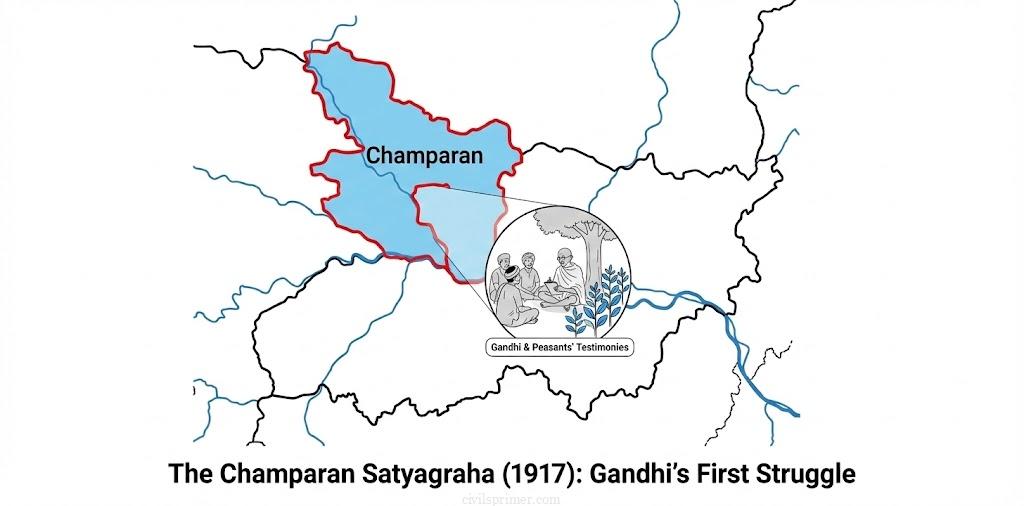
The Stain of Indigo: Champaran (1917) The first call came from the rural heartlands of Bihar. A local man, Rajkumar Shukla, doggedly persuaded Gandhi to visit Champaran. Here, European planters forced peasants to grow indigo on 3/20th of their land under the oppressive tinkathia system. When German synthetic dyes ruined the market, planters demanded illegal dues to release peasants from this obligation. When Gandhi arrived, authorities ordered him to leave. In a move that defined his future politics, he defied the order, preferring to face punishment—the first act of Civil Disobedience in India. He was eventually allowed to conduct an enquiry, joined by leaders like Rajendra Prasad and J.B. Kripalani. The government capitulated, abolishing the tinkathia system and refunding 25% of the money taken illegally.
The Mill and the Fast: Ahmedabad (1918) The next battlefield was urban. In Ahmedabad, a conflict brewed between mill owners and workers over the “Plague Bonus.” The owners wanted to withdraw it, while workers demanded a 50% wage hike to cope with wartime inflation. Gandhi intervened, establishing a camp by the Sabarmati river. When the strike’s resolve weakened, he undertook his first hunger strike,. This moral pressure forced the owners to agree to arbitration, eventually awarding a 35% hike.
The Peasant’s Plight: Kheda (1918) Simultaneously, in Kheda (Gujarat), crops had failed due to drought. The British revenue code stated that if the yield was less than one-fourth of the normal produce, farmers were entitled to remission. The government ignored this. Gandhi, supported by a young Vallabhbhai Patel, urged peasants to withhold revenue, marking the first Non-Cooperation experiment. The government secretly issued instructions to collect revenue only from those who could pay, granting a moral victory to the movement.
Part II: The Year of Betrayal (1919) #
The Black Act While Indians expected constitutional concessions after supporting Britain in World War I, they received the “Black Act“—the Rowlatt Act (March 1919). Based on the Sedition Committee‘s report, it allowed the government to imprison political activists without trial for two years. The famous slogan describing this law was “Na dalil, na vakil, na appeal“ (no argument, no lawyer, no appeal). Gandhi organized a Satyagraha Sabha and called for a nationwide hartal on April 6, 1919.
The Massacre at Jallianwala Bagh The protests were fierce in Punjab. On April 13, 1919, Baisakhi day, a crowd gathered at Jallianwala Bagh in Amritsar. Many were villagers unaware of the martial law banning gatherings. General Reginald Dyer entered the enclosed ground, blocked the exit, and without warning, ordered his troops to fire,. Official estimates claimed 379 dead, though reality was far grimmer. The massacre stunned the nation. Rabindranath Tagore renounced his knighthood in protest. The government set up the Hunter Commission to investigate, but it proved to be an eyewash, and the House of Lords even endorsed Dyer’s actions.
Part III: Government of India Act, 1919 – The Constitutional Trap #
Amidst this turmoil, the British introduced the Montagu-Chelmsford Reforms. The Act of 1919 introduced Dyarchy in the provinces.
- Reserved Subjects: Law and order, finance, and land revenue were kept by the Governor and his Executive Council (not responsible to the legislature).
- Transferred Subjects: Education, health, and local government were given to Indian ministers responsible to the legislature.
- Bicameralism: For the first time, a bicameral legislature was introduced at the Centre. However, the franchise was extremely limited, and the Governor-General retained veto power, making the reforms “disappointing and unsatisfactory” for the Congress.
Part IV: The Roar of Non-Cooperation & Khilafat (1920–1922) #
The Unlikely Alliance Indian Muslims were enraged by the harsh treatment of Turkey (and the Khalifa) by the British after WWI. The Khilafat Committee, led by the Ali brothers (Shaukat and Muhammad Ali), was formed. Gandhi saw this as a golden opportunity to cement Hindu-Muslim unity. The Movement Begins At the special Calcutta Session (September 1920) and the Nagpur Session (December 1920), the Congress approved the Non-Cooperation Movement.
- The Program: Surrender of titles, boycott of schools, courts, and foreign cloth.
- The Goal: The Nagpur Session changed the Congress goal from “self-government by constitutional means” to the attainment of Swaraj by peaceful means.
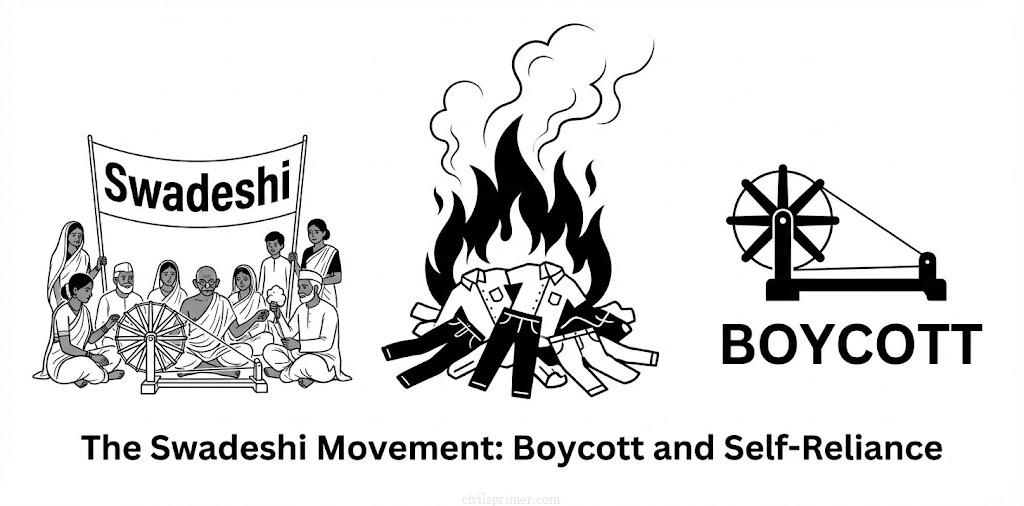
The movement unleashed popular energy. Bonfires of foreign cloth became common, students flooded into national institutions like Jamia Millia and Kashi Vidyapith, and lawyers like Motilal Nehru and C.R. Das gave up lucrative practices.
The Halt at Chauri Chaura In February 1922, the movement turned violent. At Chauri Chaura in Gorakhpur, a mob set a police station on fire, killing 22 policemen. Gandhi, believing the masses were not yet ready for non-violence, abruptly withdrew the movement. This decision shocked leaders like Subhas Chandra Bose, who called it a “national calamity”.
Part V: New Forces and Internal Debates (1920s) #
Swarajists: The Pro-Changers Following the withdrawal, a rift emerged.
- Pro-Changers (Swarajists): Led by C.R. Das and Motilal Nehru, they wanted to enter the legislative councils to “wreck them from within”. They formed the Swaraj Party in 1923.
- No-Changers: Led by Vallabhbhai Patel and Rajendra Prasad, they advocated continuing the boycott and focusing on constructive rural work,. Gandhi eventually reconciled with the Swarajists, allowing them to work in the councils as a wing of the Congress.
Revolutionary Phase II With the pause in mass movements, the youth turned to revolutionary methods to achieve freedom.
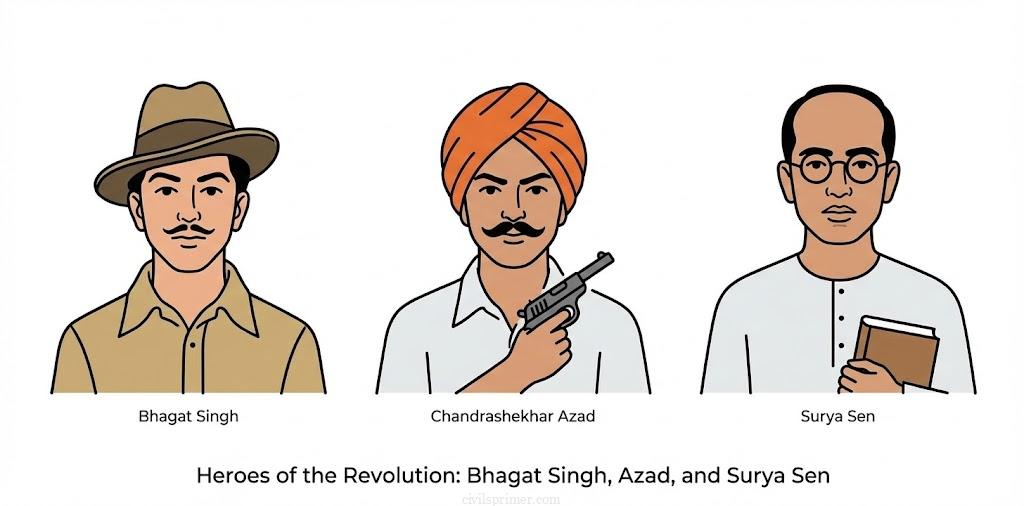
- HRA/HSRA: The Hindustan Republican Association was founded in 1924. They conducted the Kakori Robbery (1925) to fund activities. Later reorganized as HSRA by Chandrashekhar Azad and Bhagat Singh, they adopted socialism as a goal.
- Acts of Defiance: In 1928, Bhagat Singh and Rajguru assassinated Saunders to avenge the death of Lala Lajpat Rai. In 1929, Bhagat Singh and B.K. Dutt threw harmless bombs in the Central Legislative Assembly to “make the deaf hear”.
- Bengal: Surya Sen (Masterda) led the daring Chittagong Armoury Raid in 1930, declaring a provisional government.
Part VI: The Simon Challenge and the Nehru Report #
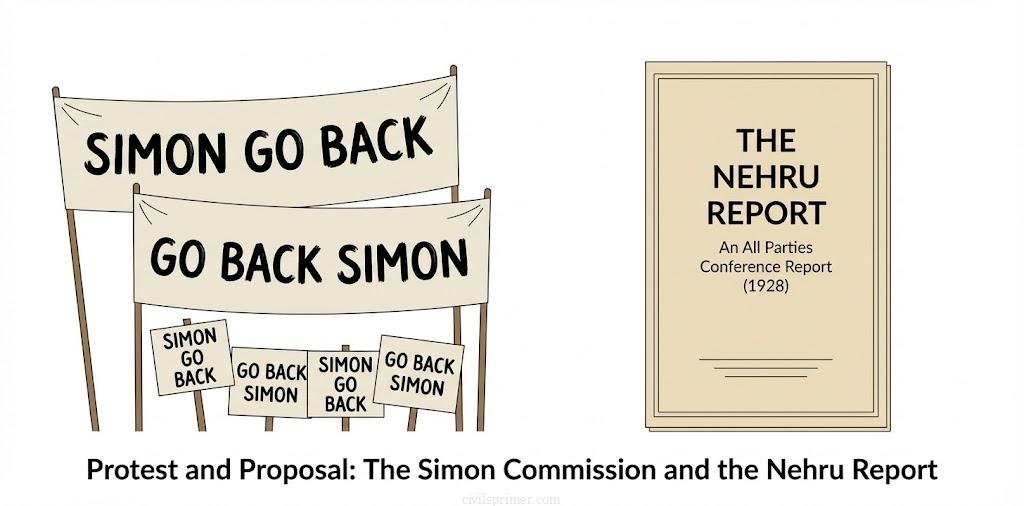
Simon Go Back (1927) In 1927, the British appointed the Indian Statutory Commission under John Simon to review the 1919 Act. It was an all-white commission with no Indian members. The Congress and the Muslim League boycotted it. Wherever the commission went, it faced black flags and chants of “Simon Go Back”. In Lahore, Lala Lajpat Rai was brutally lathi-charged during a protest and succumbed to his injuries, a death that deeply angered the nation.
The Nehru Report (1928) Challenged by Lord Birkenhead to draft a constitution that Indians could agree upon, the All Parties Conference appointed a committee under Motilal Nehru.
- Key Recommendations: It demanded Dominion Status (not complete independence yet), joint electorates, and fundamental rights.
- The Rift: Younger leaders like Jawaharlal Nehru and Subhas Chandra Bose rejected Dominion Status, demanding Purna Swaraj (Complete Independence). This internal debate set the stage for the historic Lahore Session of 1929.
UPSC Mains Subjective Previous Years Questions #
- (2024) What were the events that led to the Quit India Movement? Point out its results.
- (2023) What was the difference between Mahatma Gandhi and Rabindranath Tagore in their approach towards education and nationalism?
- (2021) To what extent did the role of moderates prepare a base for the wider freedom movement? Comment.
- (2021) Bring out the constructive programs of Mahatma Gandhi during the Non-Cooperation Movement and Civil Disobedience Movement.
- (2020) Since the decade of the 1920s, the national movement acquired various ideological strands and thereby expanded its social base. Discuss.
- (2019) Many voices had strengthened and enriched the nationalist movement during the Gandhian phase. Elaborate.
- (2018) Throw light on the significance of thoughts of Mahatma Gandhi in the present times.
- (2017) Why did the Moderates fail to carry conviction with the nation about their proclaimed ideology and political goals by the end of the nineteenth century?
- (2016) Highlight the difference in the approach of Subhash Chandra Bose and Mahatma Gandhi in the struggle for freedom.
Answer Writing Minors #
Here is a comprehensive Introduction and Conclusion pair suitable for a UPSC Mains answer covering the broad spectrum of the Gandhian Era (1917–1929), including the Swarajists, Revolutionary activities, and constitutional developments.
Introduction: The period from 1917 to 1929 marked a paradigm shift in the Indian freedom struggle, characterized by the transition from elite petitioning to mass-based mobilization under Mahatma Gandhi’s leadership,. This era witnessed a multi-pronged challenge to British hegemony through diverse ideological strands, ranging from the non-violent Non-Cooperation Movement and the constitutional obstructionism of the Swarajists to the militant nationalism of the revolutionaries,.
Conclusion: Ultimately, this phase successfully democratized the national movement by integrating peasants, workers, and women, while simultaneously radicalizing political goals from “Dominion Status” to Purna Swaraj (Complete Independence),. Despite varying methods, the combined impact of Gandhian Satyagraha, legislative activism, and revolutionary heroism effectively dismantled the moral foundations of the colonial state, setting the stage for the Civil Disobedience Movement,,.
Related Latest Current Affairs #
- October 2025: Centenary of the Rashtriya Swayamsevak Sangh (RSS)
The RSS, founded on September 27, 1925, by K.B. Hedgewar in Nagpur, marked its 100th year. It emerged as a socio-cultural organization during the 1920s, a period characterized by the rise of diverse political and social forces in India, aiming to foster Hindu unity and cultural revival. - September 2025: 100 Years of the Self-Respect Movement (1925)
The centenary of the Self-Respect Movement, launched by E.V. Ramasamy (Periyar) in 1925, was observed. Emerging alongside other new forces in the 1920s, this movement challenged the caste hierarchy and Brahmanical dominance, promoting rationalism and social equality in Tamil Nadu. - August 2025: 100th Anniversary of the Kakori Train Robbery
The Prime Minister paid tribute to the revolutionaries of the Kakori Conspiracy Case (August 9, 1925). Carried out by members of the Hindustan Republican Association (HRA) like Ram Prasad Bismil and Ashfaqulla Khan to fund revolutionary activities, this event marked a key moment in Revolutionary Phase II before the group reorganized . - July 2025: Commemoration of Alluri Sitarama Raju and the Rampa Rebellion
Tributes were paid to Alluri Sitarama Raju (born 1897) on his birth anniversary. He led the Rampa Rebellion (1922–1924) in Andhra Pradesh, a tribal uprising against the British Forest Act. While inspired by Gandhi’s Non-Cooperation Movement, Raju adopted Guerrilla Warfare when peaceful methods failed - January 2025: Pravasi Bharatiya Divas and Gandhi’s Return
The 18th Pravasi Bharatiya Divas was celebrated to recognize the Indian diaspora, observed annually on January 9 to mark Mahatma Gandhi’s return from South Africa in 1915. This event set the stage for the beginning of the Gandhian Era in Indian politics - December 2024: Centenary of the Belagavi Congress Session (1924)
The 100th anniversary of the 1924 Belagavi Session was commemorated. This was the only session presided over by Mahatma Gandhi, where he restructured the Congress into a mass movement and emphasized social reforms like the eradication of untouchability and the promotion of Khadi