
Journey to the Center of the Earth: The Mystery Beneath Our Feet #
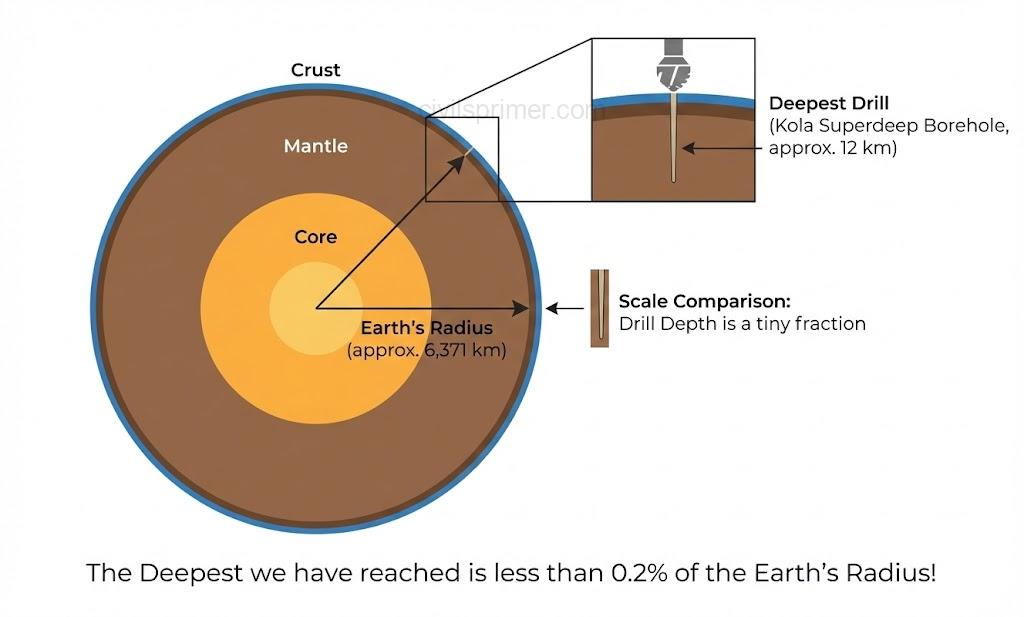
Imagine you have a shovel and an infinite amount of energy. You decide to dig a hole right through the Earth to see what is on the other side. How far would you get? In reality, the deepest hole humanity has ever drilled—the Kola Superdeep Borehole in Russia—only reached about 12 km. To put that in perspective, the centre of the Earth is approximately 6,370 km away!.. Since we cannot physically travel to the centre because of the immense heat and pressure, the Earth’s interior remains a mystery that we solve like detectives. We use “clues” provided by nature.
- Direct Clues: We look at rocks from mining areas (like the gold mines in South Africa, which go 3-4 km deep) and analyze molten magma thrown out by volcanoes.
- Indirect Clues: We study meteors (which are built of the same material as Earth), gravity anomalies, and magnetic fields.
But the greatest detective tool we have is the Earthquake. Just as a doctor uses X-rays to see inside your body, geographers use Seismic Waves to see inside the Earth.
Part 1: P and S Waves – The Messengers #
When an earthquake occurs, energy is released from a point deep inside called the Focus (Hypocenter). This energy travels outward in all directions, eventually reaching the surface point directly above it, known as the Epicenter. This energy moves in the form of waves, which are recorded by an instrument called a Seismograph.
Imagine two messengers running a race through the planet to tell us what is inside:
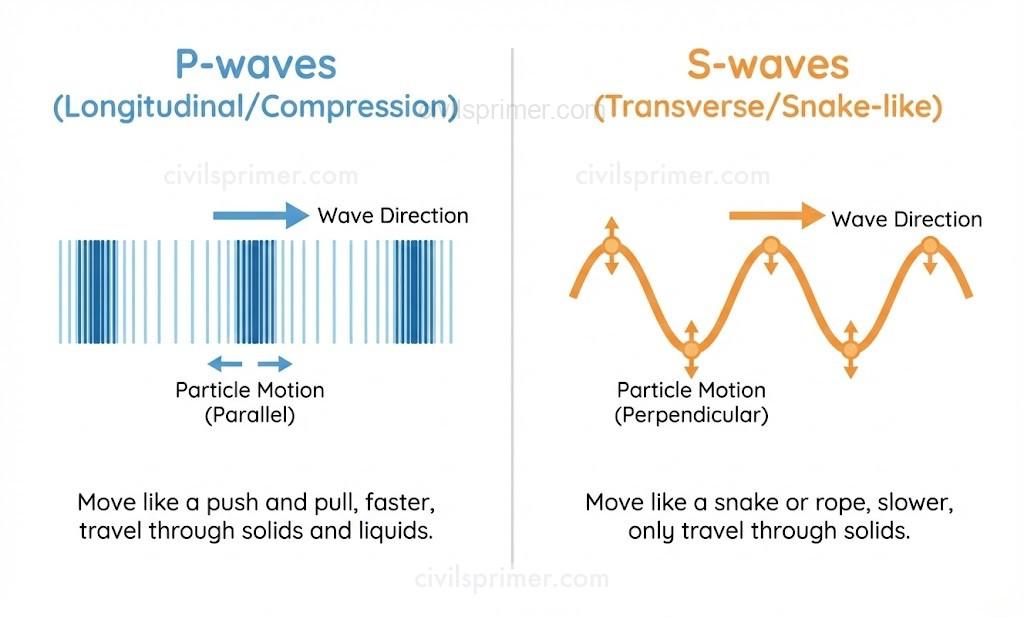
1. Primary Waves or P-Waves: The Sprinter – These are the fastest waves. They run like sound waves, pushing and pulling (compressing) the rock as they move. Superpower: They can travel through everything—solids, liquids, and gases.
2. Secondary Waves or S-Waves: The Dancer – These are slower and arrive second. They move like ripples on water, vibrating side-to-side (transverse). But, They are picky. They cannot travel through liquids. If they hit a liquid layer, they disappear.
Part 2: The Shadow Zone – The Great Reveal #
As these waves race through the Earth, they don’t move in straight lines. They bend (refract) because the density of the Earth changes as we go deeper. Denser materials make waves move faster.
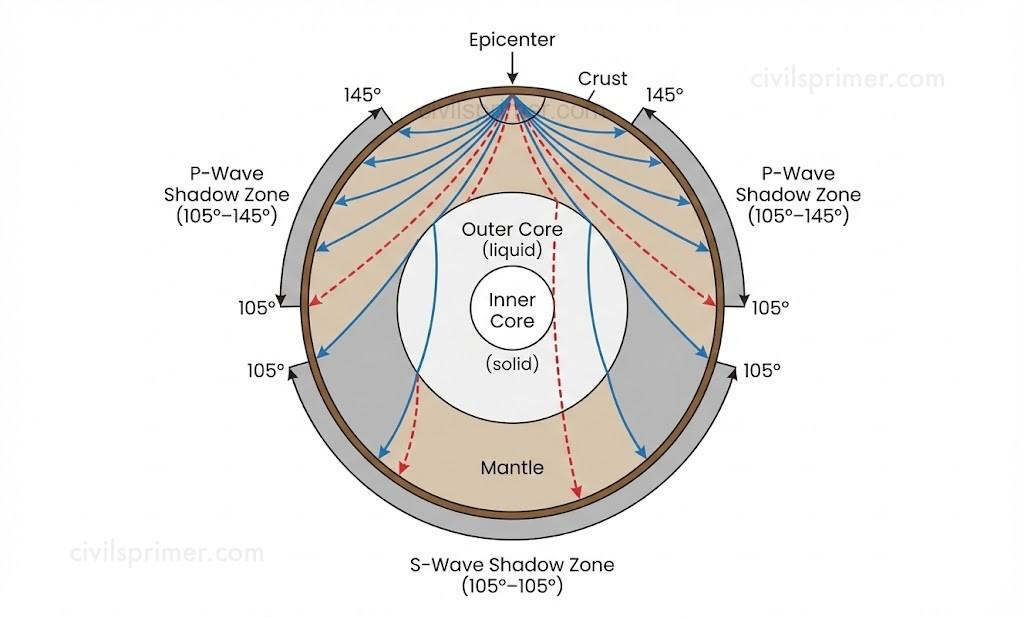
Scientists noticed something strange. If an earthquake happens at point A, seismographs on the opposite side of the Earth record P-waves but no S-waves.
- The S-Wave Shadow Zone: Beyond 105° from the epicenter, S-waves go missing. Since S-waves cannot travel through liquid, this proved that the Earth has a liquid core.
- The P-Wave Shadow Zone: P-waves also disappear between 105° and 145°. This happens because when they hit the liquid core, they bend so sharply (refract) that they miss a specific band of the Earth.
Part 3: Crust, Mantle, and Core – The Onion Structure #
Using these wave patterns, scientists realized the Earth is layered like an onion.
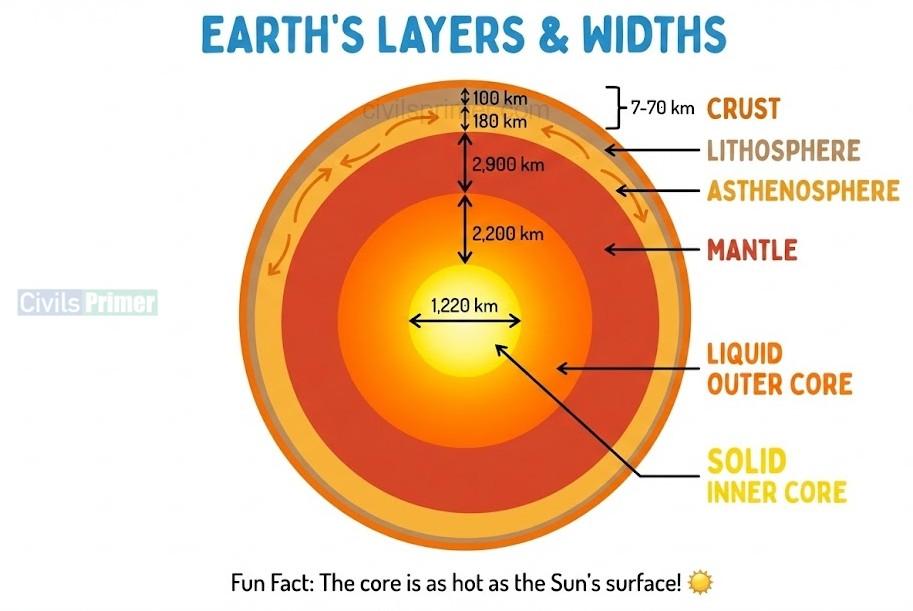
1. The Crust: The Thin Skin: This is the outermost solid part where we live. It is brittle and breaks easily.
- Continental Crust: It is thicker (around 30 km, up to 70 km under Himalayas) and made of lighter rocks like Granite. It is chemically known as Sial (Silica + Aluminium).
- Oceanic Crust: It is thinner (5 km) but heavier and denser. It is made of Basalt. It is chemically known as Sima (Silica + Magnesium).
2. The Mantle: The Heavy Flesh: Below the crust lies the massive Mantle, extending up to 2,900 km deep. It makes up 83% of the Earth’s volume.
- The Asthenosphere: The upper part of the mantle (up to 400 km) is called the Asthenosphere (meaning “weak”). It is not liquid, but “plastic” or semi-molten. This is the source of magma for volcanoes, and the tectonic plates float on top of this slippery layer.
- The Lithosphere: The Crust + the solid Uppermost Mantle make up the hard slab known as the Lithosphere (10-200 km thick).
3. The Core: The Metallic Heart: Deep in the center lies the Core. It is very heavy, made mostly of Nife (Nickel + Iron).
- Outer Core: This layer is liquid. We know this because S-waves cannot pass through it. The churning of this liquid iron creates the Earth’s Magnetic Field.
- Inner Core: At the very center, the pressure is so crushing that even though it is 6,000°C (hotter than the sun’s surface), the iron cannot melt. It remains a solid ball.
Part 4: Discontinuities: The Boundaries #
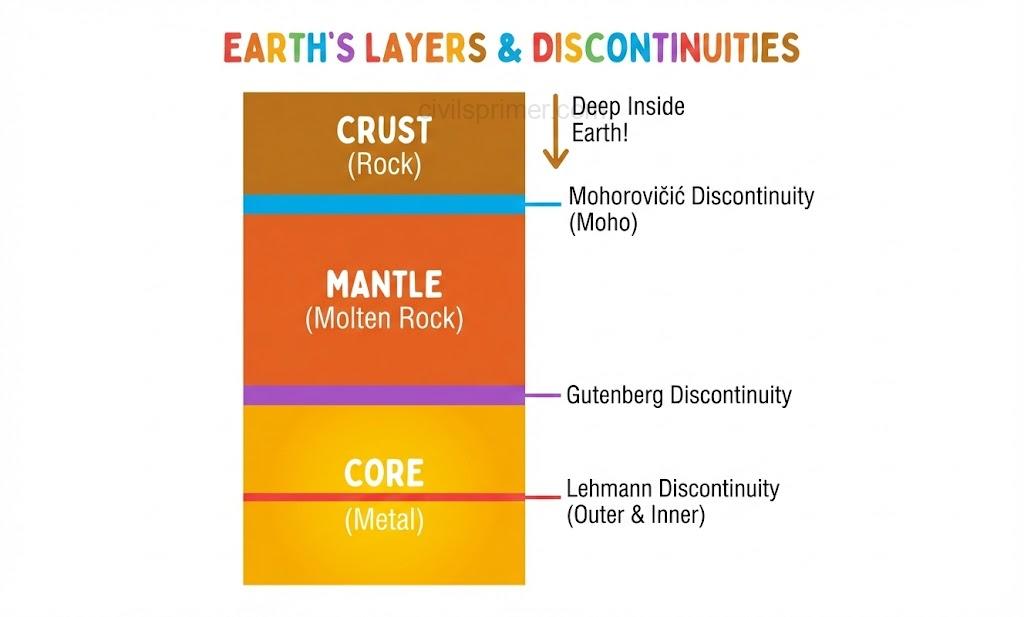
The layers of the Earth don’t just fade into each other; they are separated by sharp boundaries called discontinuities, where seismic waves change speed suddenly. Imagine descending an elevator into the Earth:
- Conrad Discontinuity: Between the Upper and Lower Crust.
- Moho (Mohorovicic) Discontinuity: The boundary separating the Crust from the Mantle.
- Repetti Discontinuity: Between the Upper and Lower Mantle.
- Gutenberg Discontinuity: The boundary separating the Mantle from the Core.
- Lehmann Discontinuity: Between the Outer (Liquid) Core and Inner (Solid) Core.
UPSC Mains Subjective Previous Years Questions #
- 2021: Discuss the geophysical characteristics of Circum-Pacific Zone.
- 2019: Define mantle plume and explain its role in plate tectonics.
- 2017: How does the Juno Mission of NASA help to understand the origin and evolution of the Earth?
- Pre-2013 (General): Discuss the structure and composition of the interior of the Earth.
Answer Writing Minors #
Common Introduction:
“The interior of the Earth, stratified into the crust, mantle, and core, governs the endogenic forces that shape the planetary surface. While direct access to the interior is impossible, our understanding relies on indirect evidences, primarily the behavior of seismic waves (P and S waves) and their propagation through varying densities and states of matter (Lithosphere, Asthenosphere, and baryons).”
Common Conclusion:
“Conclusively, deciphering the Earth’s internal structure—marked by discontinuities like Moho and Gutenberg—is pivotal for understanding geophysical phenomena. It provides the mechanism for plate tectonics, the generation of the magnetosphere, and the origin of catastrophic events like earthquakes and volcanism, which directly impact the Lithosphere and human habitation.”
Related Latest Current Affairs #
- November, 2025: Expansion of the South Atlantic Anomaly (SAA) and Earth’s Outer Core Data from ESA’s Swarm mission revealed that the SAA, a region of weak magnetic intensity, has expanded by nearly 0.9% since 2014. This phenomenon is driven by the irregular flow of molten iron and nickel in the Earth’s Outer Core and reverse magnetic flux patches where field lines re-enter the Earth.
- October, 2025: Delamination of the Indian Plate New studies analyzing the causes of frequent earthquakes in the Hindu Kush-Himalaya region highlight the “Delamination” of the Indian Plate. This geological process involves the Indian Lithosphere splitting, with the lower part peeling away and sinking into the Mantle, creating fractures and increasing seismic stress.
- October, 2025: Exploration of Polymetallic Sulphides at Carlsberg Ridge India secured a contract to explore Polymetallic Sulphides in the Carlsberg Ridge, a mid-ocean ridge in the Indian Ocean. These deposits form at divergent plate boundaries where hot magma from the Mantle rises to interact with cold seawater, precipitating minerals on the ocean crust.
- September, 2025: Discovery of Natural Hydrogen (White Hydrogen) Global efforts intensified to explore “Natural Hydrogen,” which is generated underground through geological processes like serpentinization (interaction of water with iron-rich crustal or mantle rocks) and radiolysis. This marks a shift toward harvesting energy directly generated within the Earth’s interior.
- July, 2025: Android Earthquake Alert System (AEA) using P and S Waves Google released a performance report on its AEA system, which uses smartphone accelerometers to detect early seismic activity. The system works by identifying the faster, non-destructive P-waves (Primary waves) to send alerts before the slower, destructive S-waves (Secondary waves) arrive at a location.