
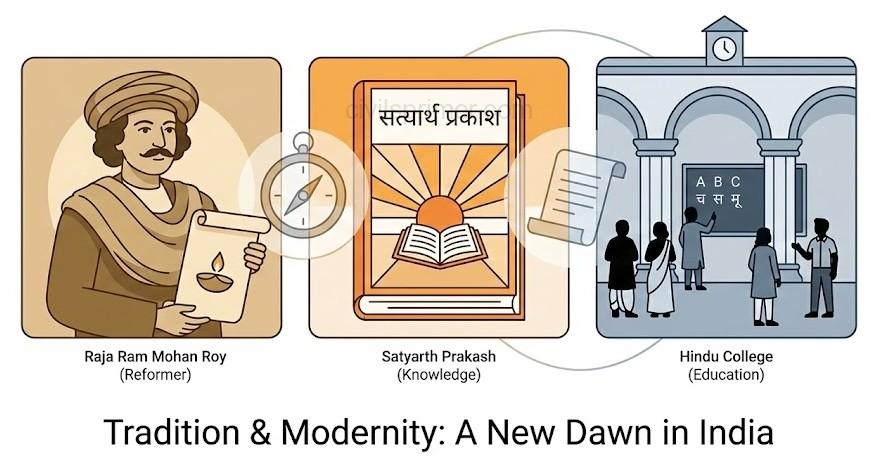
The Great Awakening: The Story of the Indian Renaissance #
Imagine India in the early 19th century. It was a time of deep contradictions. On one hand, an ancient civilization with profound philosophy; on the other, a society shackled by a “vicious web” of rigid caste hierarchies, untouchability, and the subjugation of women. Into this stagnant pool, a stone was thrown—the British conquest. While exploitative economically, the British presence inadvertently acted as a catalyst. They brought with them the printing press, English education, and the radical ideas of the European Enlightenment—rationalism, humanism, and democracy. This is the story of how India responded, not just by fighting the British politically, but by looking inward to reform itself socially and spiritually.
Part I: Raja Ram Mohan Roy –The Morning Star of Reformation #
The story begins in Bengal, the first province to feel the full impact of British rule. Here, a man of versatile genius emerged: Raja Ram Mohan Roy. He is often called the “Father of the Indian Renaissance”. Ram Mohan was a rationalist. He knew over a dozen languages, including Sanskrit, Persian, Arabic, and Hebrew. He looked at the prevalent practice of Sati—where widows were burned alive on their husbands’ pyres—and called it “murder according to every shastra”.
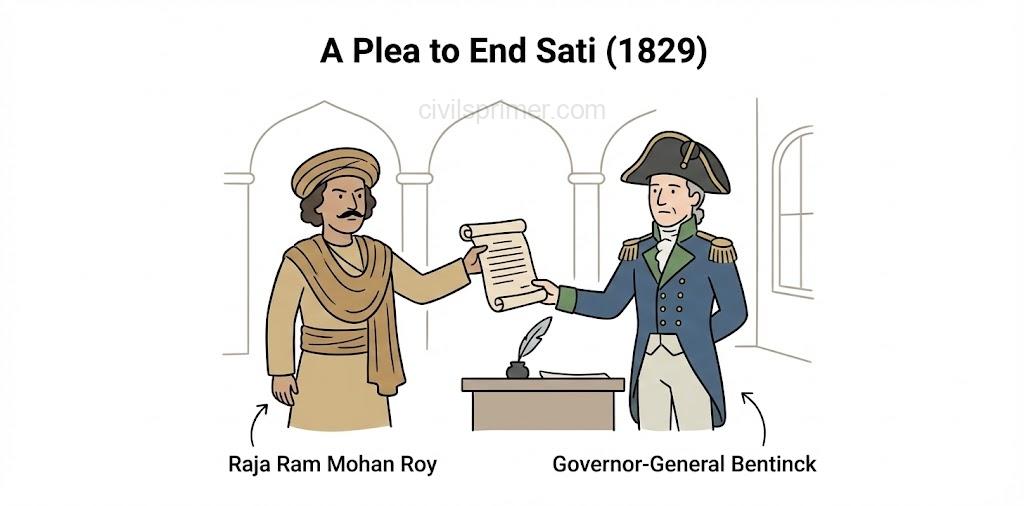
In 1814, he settled in Calcutta and started the Atmiya Sabha (Society of Friends) to campaign against idolatry and meaningless rituals. He didn’t reject the Vedas; instead, he translated them into Bengali to prove that ancient Hindu texts supported monotheism (belief in one God). He used the power of the press, publishing journals like Sambad Kaumudi and Mirat-ul-Akbar to educate the public. His greatest institutional legacy was the Brahmo Samaj, founded in 1828. It was an assembly for the worship of the eternal, unsearchable God, forbidding idol worship and sacrifices. His relentless campaigning led to the abolition of Sati in 1829 by Lord William Bentinck. Ram Mohan Roy proved that one could be modern without abandoning one’s cultural roots, aiming for a “creative and intellectual process of selecting the best from different cultures”.
Part II: Derozio and Vidyasagar – The Firebrands and the Scholar #
While Ram Mohan Roy negotiated with tradition, a younger group in Bengal wanted to blow it up. These were the students of Hindu College (established 1817), led by their brilliant, young Anglo-Indian teacher, Henry Vivian Derozio.
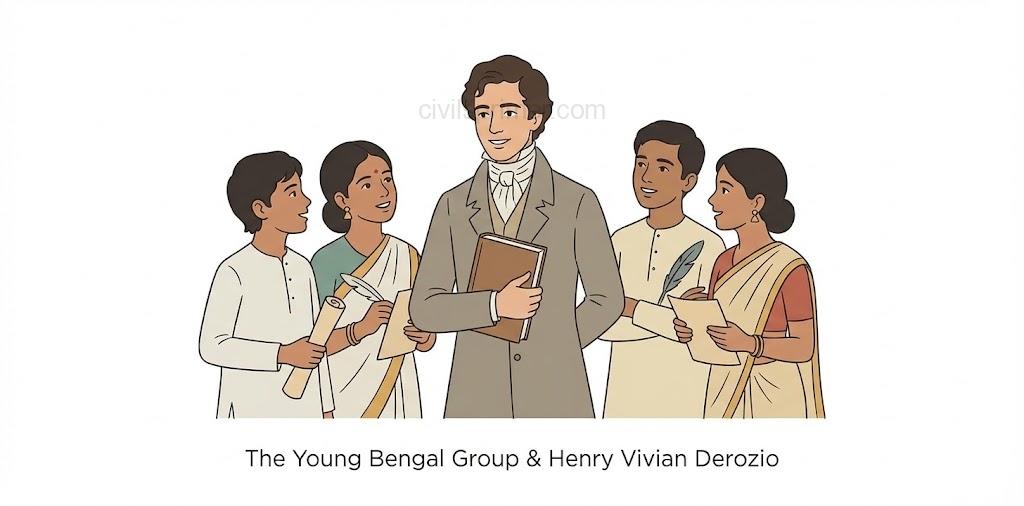
Inspired by the French Revolution, Derozio encouraged his students to think freely and question all authority. This group, known as Young Bengal, ate beef, drank wine, and criticized Hindu orthodoxy to shock the conservatives. Although they failed to build a mass base because of their radicalism, they planted the seeds of independent thinking.
Following them came a man of immense compassion—Ishwar Chandra Vidyasagar. A Sanskrit scholar and Principal of Sanskrit College, he was a humanist to the core. His heart bled for the child widows of India. Unlike Young Bengal, he didn’t just critique; he found a solution within the scriptures. He cited Vedic texts to prove that the Hindu religion sanctioned widow remarriage. His tireless efforts led to the Hindu Widows’ Remarriage Act of 1856. He was also a pioneer in female education, associating himself with the Bethune School (founded in 1849), the first fruit of the powerful movement for women’s education.
Part III: The Arya Samaj – The Roar from the North #
While Bengal looked to the West for synthesis, a wandering ascetic in Northern India looked back to the distant past. Swami Dayanand Saraswati believed that India had fallen because it had forgotten the Vedas.
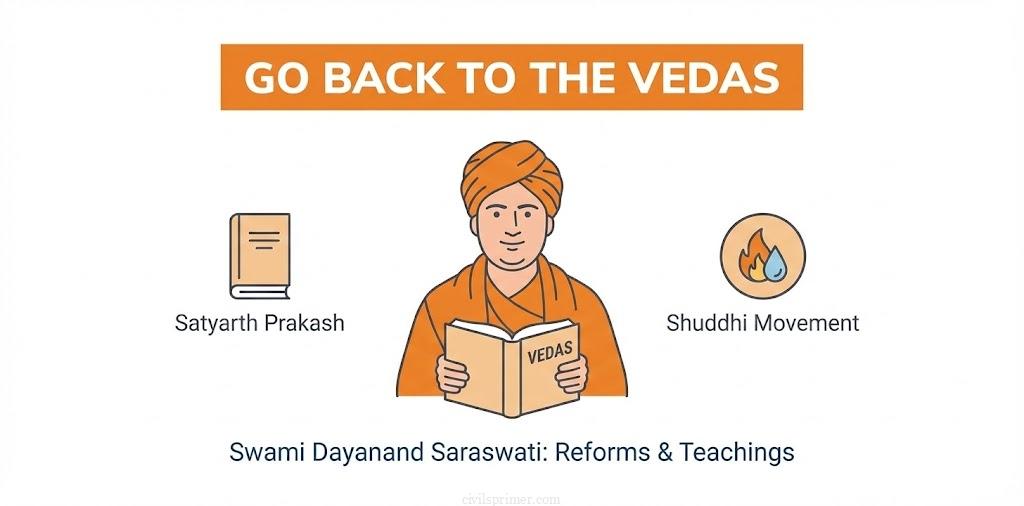
He founded the Arya Samaj in 1875 in Bombay, later shifting headquarters to Lahore. His slogan was “Go Back to the Vedas”. He claimed the Vedas contained all true knowledge, including modern science. Dayanand was aggressive. He attacked idolatry, the caste system (based on birth), and the dominance of Brahmins. He wrote Satyarth Prakash to spread his ideas. The Arya Samaj did tremendous work in education through Dayanand Anglo-Vedic (DAV) schools and the Gurukul system. However, they also launched the Shuddhi Movement to reconvert non-Hindus to Hinduism, which later contributed to communal tensions.
Part IV: Ramakrishna and Vivekananda – The Saint and the Cyclone #
In the late 19th century, a simple priest at the Dakshineswar Kali temple, Ramakrishna Paramahansa, began attracting the Western-educated elite of Calcutta. He preached a simple message: “Jiva is Shiva” (Service to man is service to God) and that all religions are different paths to the same goal. His greatest disciple was Narendranath Datta, who the world knows as Swami Vivekananda.
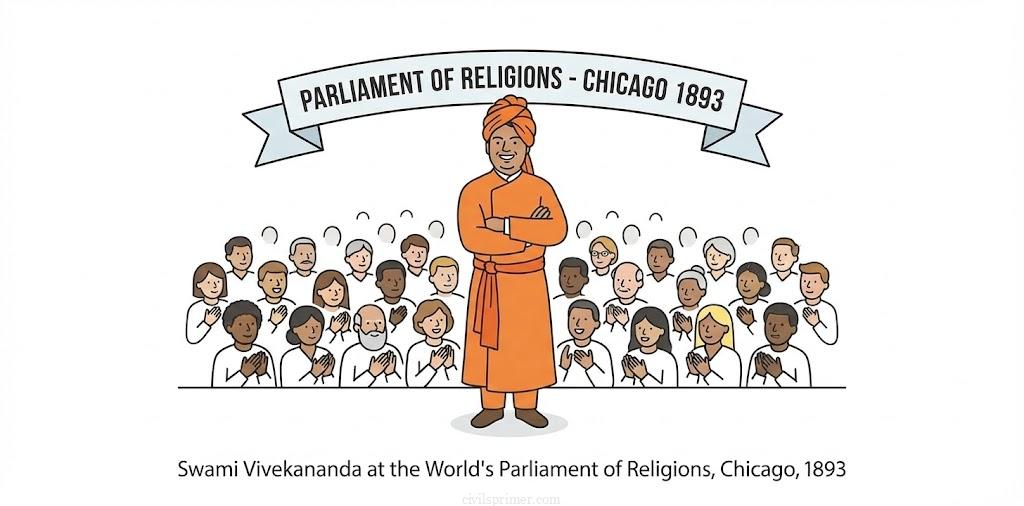
Vivekananda took his guru’s message to the world stage at the Parliament of Religions in Chicago (1893). He didn’t just preach religion; he preached “man-making.” He condemned the “touch-me-not” attitude of Hinduism and founded the Ramakrishna Mission in 1897 to carry out humanitarian relief and social work. He combined Western materialism with Eastern spiritualism, restoring self-confidence to a colonized nation.
Part V: The Awakening in Western and Southern India #
The winds of reform blew across the rest of India too.
In Maharashtra: The Prarthana Samaj was founded in 1867 by Atmaram Pandurang, but its real spirit was Mahadev Govind Ranade. Unlike the Brahmo Samaj, they didn’t break away from Hinduism but tried to reform it from within through education and persuasion. They fought against the caste system and for widow remarriage.
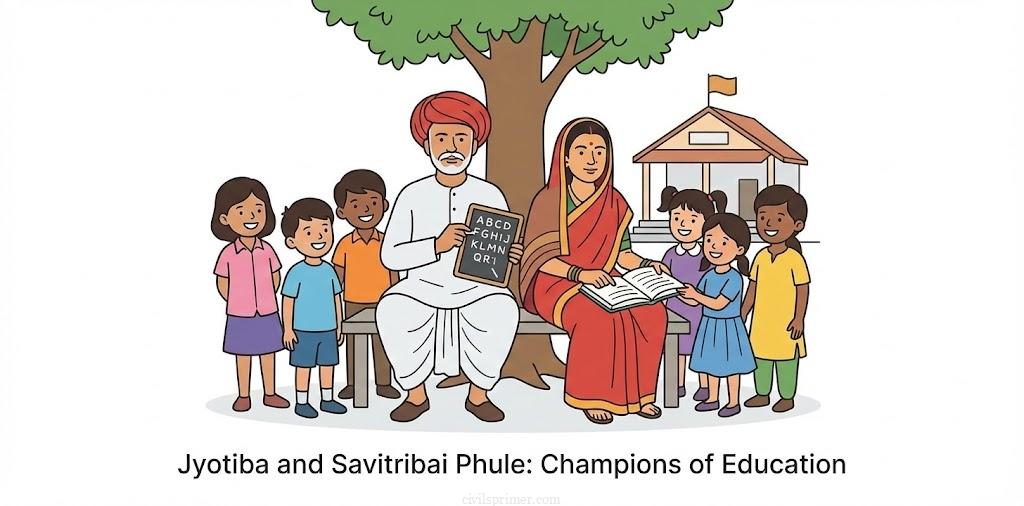
However, the most radical voice came from Jyotiba Phule. Born in a lower caste (Mali), he founded the Satyashodhak Samaj (Truth Seekers’ Society) in 1873. Phule attacked the caste system directly, calling it a tool of deception used by Brahmins to exploit the “bahujan” (masses). He and his wife, Savitribai Phule, opened the first school for girls in Pune and fought for the dignity of the lower castes and women.
In South India: The Theosophical Society, founded by Madame Blavatsky and Col. Olcott, moved its headquarters to Adyar (Madras) in 1882. Under Annie Besant, it glorified ancient Indian culture, helping Indians recover their self-respect.
A powerful movement arose in Kerala under Sree Narayana Guru. He belonged to the Ezhava caste (considered untouchable). He consecrated a Shiva idol, defying the Brahmin monopoly, and gave the famous slogan: “One Religion, One Caste, One God for Mankind”. This evolved into the SNDP Movement (Sri Narayana Guru Dharma Paripalana).
Part VI: Reform Among Muslims #
The Muslim community initially shied away from Western education, fearing it would endanger their religion. This changed with Sir Syed Ahmed Khan.
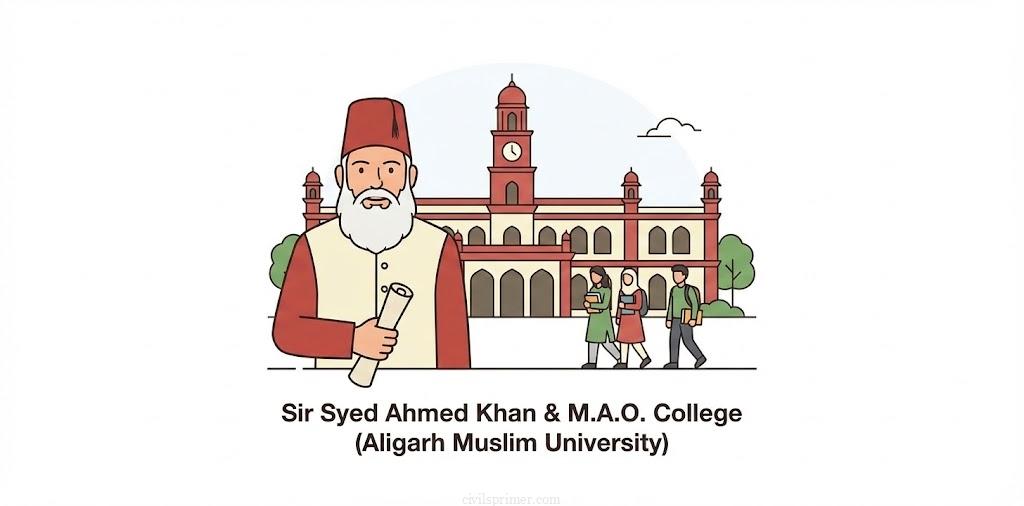
Sir Syed realized that Muslims needed to adapt to British rule to progress. He founded the Mohammedan Anglo-Oriental College at Aligarh in 1875 (which later became Aligarh Muslim University). This started the Aligarh Movement. He advocated for modern education and social reforms like the removal of purdah and polygamy, propagating his ideas through the journal Tahdhib-ul-Akhlaq.
In contrast, the Deoband Movement, founded in 1866 by orthodox Ulema like Mohammad Qasim Nanautavi, focused on spreading pure Islamic teachings and keeping alive the spirit of jihad against foreign rule, opposing the Westernizing tendencies of the Aligarh school. Other movements included the Wahabi Movement, an earlier revivalist movement led by Syed Ahmed of Rai Bareilly, which aimed to convert India from Dar-ul-Harb (land of heathens) to Dar-ul-Islam (land of Islam).
Conclusion #
By the early 20th century, these movements had fundamentally altered Indian society. They didn’t just attack Sati or child marriage; they attacked the “mental bondage” of the people. They promoted rationalism, the dignity of the individual, and the idea of a unified nation. Whether it was the “Young Bengal” asking questions, Phule demanding truth, or Vivekananda demanding strength, they all prepared the ground for the massive political struggle for freedom that was about to follow.
UPSC Mains Subjective Previous Years Questions #
- 2025 → Mahatma Jotirao Phule’s writings and efforts of social reforms touched issues of almost all subaltern classes. Discuss.
- 2023 → What was the difference between Mahatma Gandhi and Rabindranath Tagore in their approach towards education and nationalism?
- 2021 → Trace the rise and growth of socio-religious reform movements with special reference to Young Bengal and Brahmo Samaj.
- 2019 → Examine the linkages between the nineteenth century’s ‘Indian Renaissance’ and the emergence of national identity.
- 2017 → The women’s questions arose in modern India as a part of the 19th-century social reform movement. What are the major issues and debates concerning women in that period?
- 2013 → Discuss the contribution of Maulana Abul Kalam Azad to pre-and post-independent India.
- 1999 → In what way did Ramakrishna infuse a new vigour and dynamism into Hinduism?
- 1997 → ‘Swami Vivekananda might well be called the father of Indian Nationalism.’ Elucidate.
Answer Writing Minors (For Mains Answers) #
Introduction: The socio-religious reform movements of the 19th century were a creative intellectual response to the colonial presence and the cultural challenges posed by the West. Rooted in the principles of rationalism, humanism, and universalism, these movements sought to regenerate Indian society by purging it of stagnant customs like caste rigidity and gender oppression, while simultaneously rediscovering the strength of indigenous traditions.
Conclusion : Ultimately, these movements did not merely aim at religious reformation but laid the ideological foundation for the emergence of modern Indian nationalism. By attacking social divisiveness and promoting a sense of self-respect and modern scientific thinking, they created a unified consciousness that was essential for the political struggle against British imperialism that followed.
Related Latest Current Affairs #
- October, 2025: 150th Anniversary of Arya Samaj and International Arya Mahasammelan – The Prime Minister addressed the International Arya Mahasammelan to commemorate the 150th year of the Arya Samaj, founded by Swami Dayanand Saraswati in 1875. The event highlighted the organization’s contributions to social reforms, such as opposing child marriage and caste discrimination, and its role in promoting education through DAV schools,,.
- October, 2025: 132nd Anniversary of Swami Vivekananda’s Chicago Address (Digvijay Divas) – “Digvijay Divas” was observed to mark Swami Vivekananda’s historic 1893 speech at the World Parliament of Religions. The event revisited his message of “spiritual nationalism” and universal humanism, emphasizing his role in interpreting Vedanta for the modern world and fostering national integration,,.
- October, 2025: 205th Birth Anniversary of Ishwar Chandra Vidyasagar – Tributes were paid to Ishwar Chandra Vidyasagar, a pillar of the Bengal Renaissance, on his 205th birth anniversary. Discussions focused on his pivotal role in legalising widow remarriage (1856 Act), campaigning against polygamy, and championing women’s education as the Secretary of Bethune School,.
- October, 2025: Revisiting the Young Bengal Movement and Henry Vivian Derozio – In the context of evolving Indian history, the contributions of Henry Vivian Derozio and the Young Bengal Movement were recalled. Derozio inspired the youth to use reason and critical thinking to challenge social evils and reclaim Indian dignity during British rule, instilling a spirit of intellectual inquiry.
- September, 2025: Centenary of the Self-Respect Movement (1925) – The 100th anniversary of the Self-Respect Movement, launched by Periyar E.V. Ramasamy in 1925, was observed. The movement is noted for challenging Brahmanical dominance, promoting “Self-Respect Marriages” without priests, and advocating for gender rights, laying the foundation for Dravidian politics,.
- September, 2025: Legal Scrutiny of Arya Samaj Marriages – The Allahabad High Court directed an investigation into the functioning of “fake Arya Samaj societies” conducting illegal marriages. This brought attention to the Arya Marriage Validation Act, 1937, which legally recognizes inter-caste and inter-faith marriages conducted according to Arya Samaj rituals,.
- August, 2025: 200th Birth Anniversary of Mahatma Jyotiba Phule – The Prime Minister announced year-long celebrations for the 200th birth anniversary of Jyotiba Phule. Phule founded the Satyashodhak Samaj (1873) to fight caste discrimination and authored Gulamgiri to highlight the parallels between the caste system in India and slavery in America,.
- July, 2025: Renaming of NIPCCD to Savitribai Phule National Institute – The National Institute of Public Cooperation and Child Development was renamed after Savitribai Phule to honour her legacy as India’s first female teacher and a social reformer who worked alongside Jyotiba Phule to educate girls and marginalized communities,.
- July, 2025: Centenary of Historic Meeting Between Sree Narayana Guru and Mahatma Gandhi – The centenary of the 1925 conversation between Sree Narayana Guru and Mahatma Gandhi was celebrated. Narayana Guru, a key figure in the anti-caste movement in Kerala, advocated the philosophy of “One Caste, One Religion, One God” and played a crucial role in the Vaikom Satyagraha,.