
The Architects of Destiny: How India Built its Constitution #
Imagine a country roughly the size of a continent, emerging from 200 years of colonial rule, divided by religion, caste, and language, yet united by a dream of democracy. How do you write a rulebook for such a complex nation? You don’t just write it; you engineer it. This is the story of the Constituent Assembly of India—the group of men and women who spent 2 years, 11 months, and 18 days crafting the document that governs us today.
PART 1: The Blueprint (Origin and Composition) #
The Genesis of the Idea – The Constitution didn’t appear overnight. It was a demand that grew louder with time.
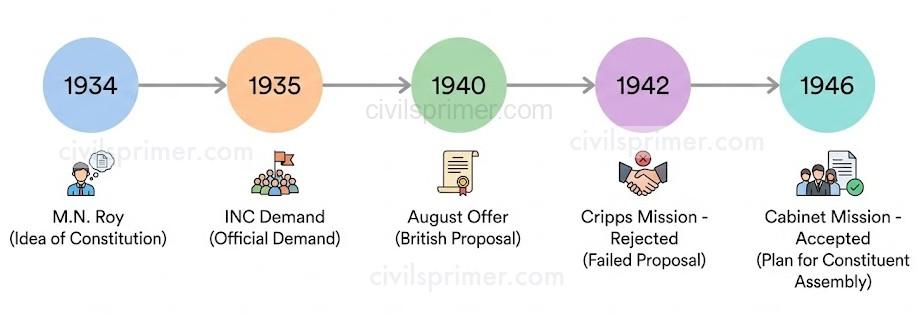
- 1934: The idea of a Constituent Assembly was first mooted by M.N. Roy, a pioneer of the communist movement in India.
- 1935: The Indian National Congress (INC) officially demanded it for the first time.
- 1940: The British finally accepted this demand in principle in the “August Offer“.
- 1946: Finally, the assembly was constituted under the scheme formulated by the Cabinet Mission Plan.
Designing the Assembly (The Logic of Numbers): The Constituent Assembly wasn’t a direct gathering of all Indians (which was impossible at the time). It was a mix of indirect election and nomination.
- Total Strength: 389 members = 296 seats from British India + 93 seats from Princely States.
- The Method
- British India: Members were elected by the Provincial Legislative Assemblies (not directly by people). The method used was Proportional Representation by means of Single Transferable Vote.
- Princely States: Representatives were nominated by the heads of the Princely States.
UPSC PRELIMS FACT → The Constituent Assembly was partly elected and partly nominated. It was NOT directly elected by the people of India on the basis of the Universal Adult Franchise.
The Partition Twist: The Muslim League, initially part of the plan, boycotted the meeting and demanded a separate state of Pakistan. Consequently, members from areas that went to Pakistan withdrew. The strength dropped to 299. On 26th November 1949, only 284 members were actually present and signed the final Constitution.
PART 2: The Assembly at Work #
The First Gathering: The stage was set. The first meeting was held on December 9, 1946.
- The Boycott: The Muslim League boycotted this meeting, insisting on Pakistan.
- The Interim President: Following the French practice, the Assembly elected the oldest member, Dr. Sachchidananda Sinha, as the temporary President.
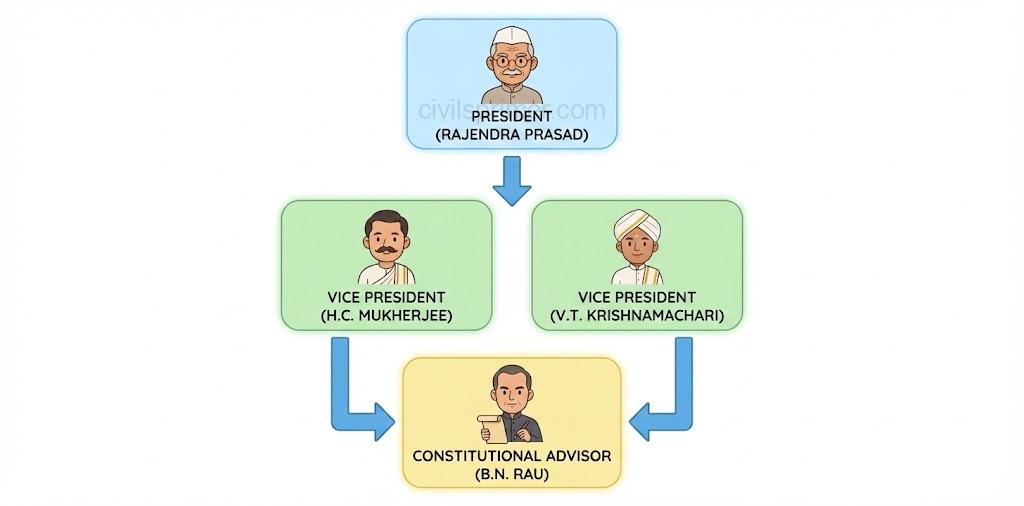
- The Permanent Captain: Later, Dr. Rajendra Prasad was elected as the President of the Assembly.
- The Vice-Captains: H.C. Mukherjee and V.T. Krishnamachari were elected as Vice-Presidents.
- The Advisor: Sir B.N. Rau was appointed as the Constitutional Advisor.
The Compass: “Objectives Resolution”: On December 13, 1946, Jawaharlal Nehru moved the historic ‘Objectives Resolution’. This was the philosophy—the soul—of what India was to become.
- It declared India as an Independent Sovereign Republic.
- It promised justice, equality, and freedom.
- Significance: This resolution was unanimously adopted on January 22, 1947, and its modified version eventually became the Preamble of the Constitution.
FREQUENTLY ASKED CONCEPT: Did Mahatma Gandhi sign the Constitution? NO. Mahatma Gandhi was not a member of the Constituent Assembly.
PART 3: The Heavy Lifting (Committees) #
The Assembly didn’t work as one giant group. It split into various committees to handle specific tasks. There were 8 Major Committees.
- The Big Three Leaders and their Portfolios (To remember this easily for Prelims, associate the leader with the topic)
- Jawaharlal Nehru (Union & States):
- Union Powers Committee
- Union Constitution Committee
- States Committee (Committee for negotiating with States).
- Sardar Patel (Provinces & Rights):
- Provincial Constitution Committee.
- Advisory Committee on Fundamental Rights, Minorities, and Tribal/Excluded Areas.
- Dr. Rajendra Prasad (Rules & Admin):
- Rules of Procedure Committee.
- Steering Committee.
- Jawaharlal Nehru (Union & States):
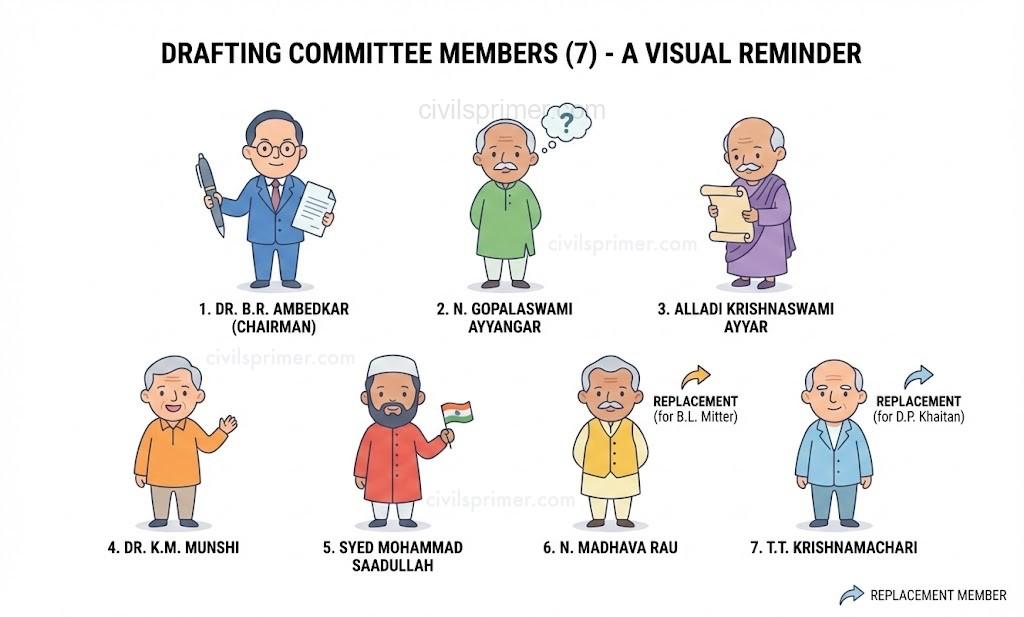
- The Most Critical One: The Drafting Committee: Set up on August 29, 1947, this committee was tasked with preparing the draft of the new Constitution. It had 7 members, with Chairman: Dr. B.R. Ambedkar (The Father of the Constitution).
- Members:
- N. Gopalaswamy Ayyangar
- Alladi Krishnaswami Ayyar
- Dr. K.M. Munshi (The only Congress member in this committee originally).
- Syed Mohammad Saadullah
- N. Madhava Rau (He replaced B.L. Mitter who resigned due to ill health).
- T.T. Krishnamachari (He replaced D.P. Khaitan who died in 1948).
- Members:
PART 4: Enactment and Enforcement #
The Final Lap: Dr. Ambedkar introduced the final draft. The Assembly held a general discussion, debated clauses, and finally, the motion was declared as passed on November 26, 1949.
- Date of Adoption: November 26, 1949.
- What came into force immediately? Provisions related to Citizenship, Elections, provisional parliament, temporary and transitional provisions (Articles 5, 6, 7, 8, 9, 60, 324, etc.) came into force on this very day.
The Date of Commencement: Why do we celebrate Republic Day on January 26? Even though the Constitution was ready in November 1949, the makers waited for January 26, 1950 to fully enforce it.
- Reason: This date was chosen to commemorate the ‘Purna Swaraj’ (Complete Independence) declaration of 1930, following the Lahore Session (Dec 1929) of the INC.
UPSC PRELIMS FACT (TRAP ALERT): November 26, 1949: Date of Adoption/Enactment. January 26, 1950: Date of Commencement (Republic Day). Ensure you check the date asked in the MCQ carefully!
PART 5: Important Facts for Prelims (The Trivia Section) #
- Symbol: The Elephant was adopted as the symbol (seal) of the Constituent Assembly.
- Constitutional Advisor: Sir B.N. Rau.
- Secretary: H.V.R. Iyengar was the Secretary to the Constituent Assembly.
- Calligrapher: Prem Behari Narain Raizada was the calligrapher of the Indian Constitution. It was handwritten, not printed.
- Criticism: It was called a “time-consuming” process. Critics called the Drafting Committee the “Drifting Committee”. However, it took this long because it had to accommodate the diverse needs of a subcontinent.
- Representation: The Assembly included all sections of Indian society—Hindus, Muslims, Sikhs, Parsis, Anglo-Indians, Indian Christians, SCs, and STs.
Summary Checklist for Revision #
1. Idea: M.N. Roy (1934) -> Cabinet Mission (1946).
2. Type: Partly elected (indirect), partly nominated.
3. Presidents: Sinha (Temp) -> Prasad (Perm).
4. Objectives Resolution: Nehru -> Preamble.
5. Drafting Committee: Ambedkar + 6 members.
6. Key Dates:
◦ Dec 9, 1946 (First Meeting).
◦ Dec 13, 1946 (Objectives Resolution moved).
◦ Aug 29, 1947 (Drafting Committee appointed).
◦ Nov 26, 1949 (Adoption).
◦ Jan 26, 1950 (Commencement).
Why does this matter for Prelims?
- Who headed which committee (Match the following).
- The chronological order of events (Cabinet mission -> Objectives Resolution -> Enactment).
- Which provisions came into force on Nov 26, 1949 vs Jan 26, 1950.
- Whether specific personalities (like Gandhi or Jinnah) were members.
UPSC Mains PYQs #
2015 → It would have been difficult for the Constituent Assembly to complete its historic task of drafting the Constitution for Independent India in just three years but for the experience gained with the Government of India Act, 1935. Discuss.
Answer Writing Minors #
Here are a common introduction and conclusion suitable for UPSC Mains answers regarding the Making of the Constitution, the Constituent Assembly, and its Committees.
- Introduction: The Indian Constitution, adopted on November 26, 1949, was not merely a legal document but the culmination of India’s long freedom struggle and the vision of the Constituent Assembly formed under the Cabinet Mission Plan of 1946. Guided by the ‘Objectives Resolution’ moved by Jawaharlal Nehru, the Assembly engaged in rigorous deliberations for nearly three years to craft a transformative document that laid the foundation for a sovereign, democratic republic.
- Conclusion: Ultimately, the enactment of the Constitution on January 26, 1950, marked the beginning of a new era, providing a resilient framework that balanced the diverse aspirations of the nation. The Constituent Assembly’s meticulous work, particularly through committees like the Drafting Committee, ensured that the Constitution remained not just a static rulebook, but a ‘living document’ capable of guiding India’s democracy through changing times.
Related Latest Current Affairs #
- (November, 2025): Indian Constitution at 76: Evolution and Global Precedence Marking the 76th anniversary of the Constitution’s adoption, discussions highlighted its progressive nature, specifically how the Constituent Assembly institutionalised affirmative action and universal adult franchise (1950) decades ahead of many Western democracies,.
- (October, 2025): Constituent Assembly Debates on Reservation Limits In the context of demands to exceed the 50% reservation cap, legal experts revisited the Constituent Assembly debates (1946-49), noting Dr. B.R. Ambedkar’s argument that reservations must remain limited to preserve the fundamental right to equality of opportunity.
- (October, 2025): Munshi-Ayyangar Formula and Official Language Debates Coinciding with Hindi Diwas celebrations, the historic “Munshi-Ayyangar formula” was recalled. This compromise, drafted by K.M. Munshi and N. Gopalaswamy Ayyangar, was adopted by the Constituent Assembly to establish Hindi as the official language of the Union while retaining English for 15 years,.
- (July, 2025): Revisiting Pre-1950 Constitutional Drafts Scholars analysed pre-independence constitutional proposals, such as the 1895 Constitution of India Bill and M.N. Roy’s 1944 draft. These early documents provided the ideological foundations for the Constituent Assembly regarding civil liberties, parliamentary democracy, and the Bill of Rights,.