
The Constitutional Odyssey: From Company Traders to a Sovereign Republic #
Imagine India in the 18th century. It was a land of immense wealth, diverse cultures, and fragmented powers. Into this landscape stepped a trading corporation, the British East India Company (EIC). Initially here to trade in spices and textiles, they stumbled into political power after obtaining the ‘Diwani’ (rights over revenue and civil justice) of Bengal, Bihar, and Orissa in 1765. But with great power came great corruption. The Company servants became rich, while the Company itself sank into debt. This forced the British Parliament to intervene, kicking off a constitutional journey that would span nearly two centuries.
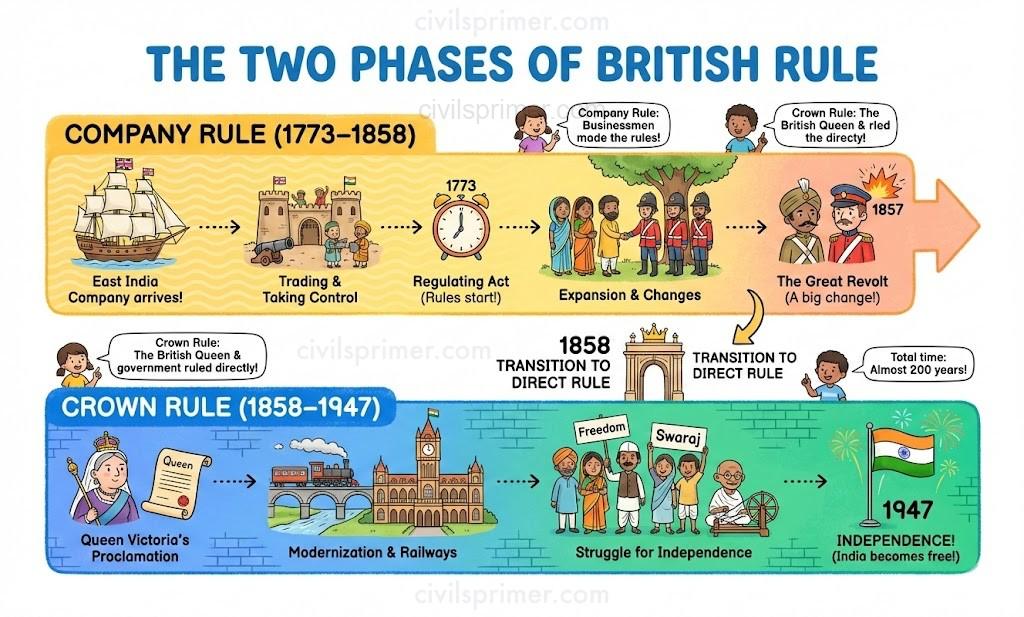
PART I: Taming the Trading Giant (Company Rule: 1773–1858) #
1. The First Step: Regulating Act of 1773: The story begins when the British Parliament decided to regulate the affairs of the EIC. This was the first time the British government recognized the Company’s political and administrative functions.
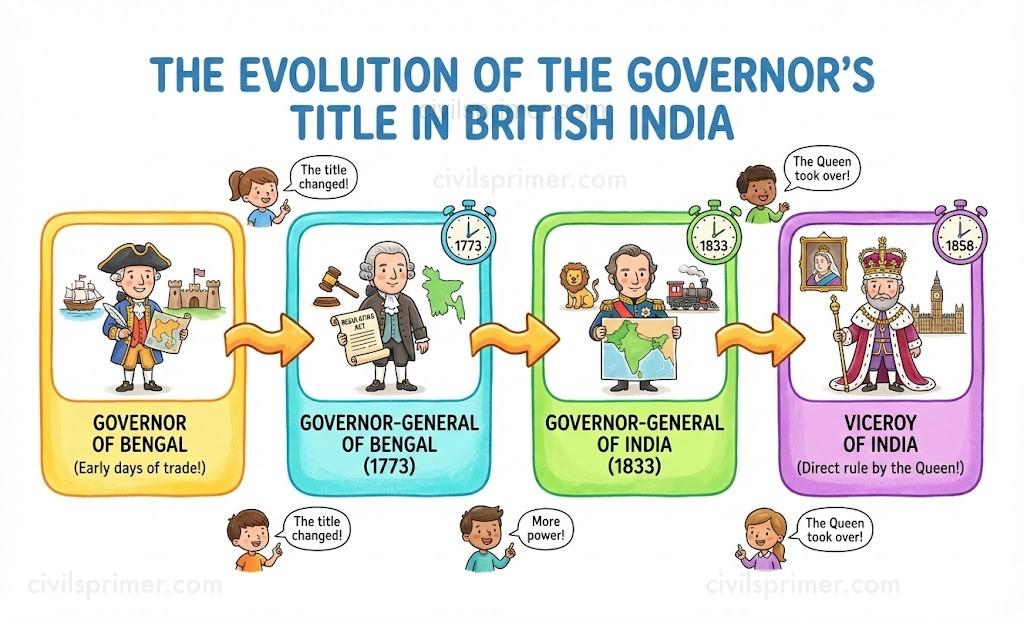
- The Change of Title: The Governor of Bengal was elevated to the Governor-General of Bengal. Warren Hastings became the first to hold this title.
- Centralization Begins: The Governors of Bombay and Madras were made subordinate to the Governor-General of Bengal, starting the trend of centralizing power.
- Justice Arrives: A Supreme Court was established at Calcutta (1774) to check legal matters.
2. Fixing the Flaws: Pitt’s India Act of 1784: The 1773 Act wasn’t enough. The Company was still a mess. Prime Minister William Pitt the Younger introduced a new act to distinguish between the Company’s commercial and political functions.
- Double Government: The Court of Directors handled commercial affairs, but a new body, the Board of Control, was created to manage political affairs. This established a system of double government.
- British Possessions: Significantly, the Company’s territories in India were called the ‘British possessions in India’ for the first time.
3. The Peak of Centralization: Charter Act of 1833: Fast forward fifty years. The Industrial Revolution is in full swing. The British wanted complete control. This Act was the final step towards centralization in British India.
- New Designation: The Governor-General of Bengal was re-designated as the Governor-General of India. Lord William Bentinck became the first to hold this office.
- Legislative Monopoly: The Governor-General of India was given exclusive legislative powers for the entire British India, taking away these powers from Bombay and Madras presidencies.
- End of an Era: The EIC ceased to be a commercial body and became a purely administrative body.
4. The Last Charter: Charter Act of 1853 – This was the last series of Charter Acts. It separated, for the first time, the legislative and executive functions of the Governor-General’s council.
- Mini Parliament: It established a separate Indian (Central) Legislative Council. It functioned like a mini-parliament, adopting procedures similar to the British Parliament.
- Meritocracy: It introduced an open competition system for the selection of civil servants, throwing it open to Indians (based on the Macaulay Committee recommendations).
PART II: The Crown Takes the Reins (Crown Rule: 1858–1947) #
The Revolt of 1857 (Sepoy Mutiny) changed everything. The British Crown realized that a trading company could no longer govern a subcontinent.
5. The Act for Good Government: Government of India Act of 1858: This Act abolished the East India Company and transferred the powers of government, territories, and revenues directly to the British Crown.
- The Viceroy: The designation of the head of administration changed from Governor-General to Viceroy of India. Lord Canning became the first Viceroy.
- Secretary of State: A new office, ‘Secretary of State for India’, was created in London, with complete authority and control over Indian administration.
6. Inclusion Begins: Indian Councils Act of 1861: The British realized they couldn’t rule India without the cooperation of Indians.
- Representation: It initiated the process of associating Indians with the law-making process. The Viceroy nominated some Indians as non-official members of his expanded council.
- Decentralization: It restored legislative powers to the Bombay and Madras Presidencies, reversing the centralizing trend of 1773 and 1833.
- Portfolio System: It gave statutory recognition to the ‘Portfolio’ system, introduced by Lord Canning.
7. Baby Steps in Democracy: Indian Councils Act of 1892: Pressure from the Indian National Congress (formed in 1885) led to this Act.
- Budget Discussion: It increased the functions of legislative councils and gave them the power to discuss the budget.
- Nomination via Recommendation: It introduced a limited and indirect provision for the use of elections to fill some non-official seats.
8. The Communal Wedge: Indian Councils Act of 1909 (Morley-Minto Reforms): Lord Morley (Secretary of State) and Lord Minto (Viceroy) brought changes that would leave a scar on Indian history.
- Separate Electorates: It introduced a system of communal representation for Muslims by accepting the concept of ‘Separate Electorate’. Under this, Muslim members were to be elected only by Muslim voters.
- Executive Association: For the first time, an Indian (Satyendra Prasad Sinha) joined the Viceroy’s Executive Council.
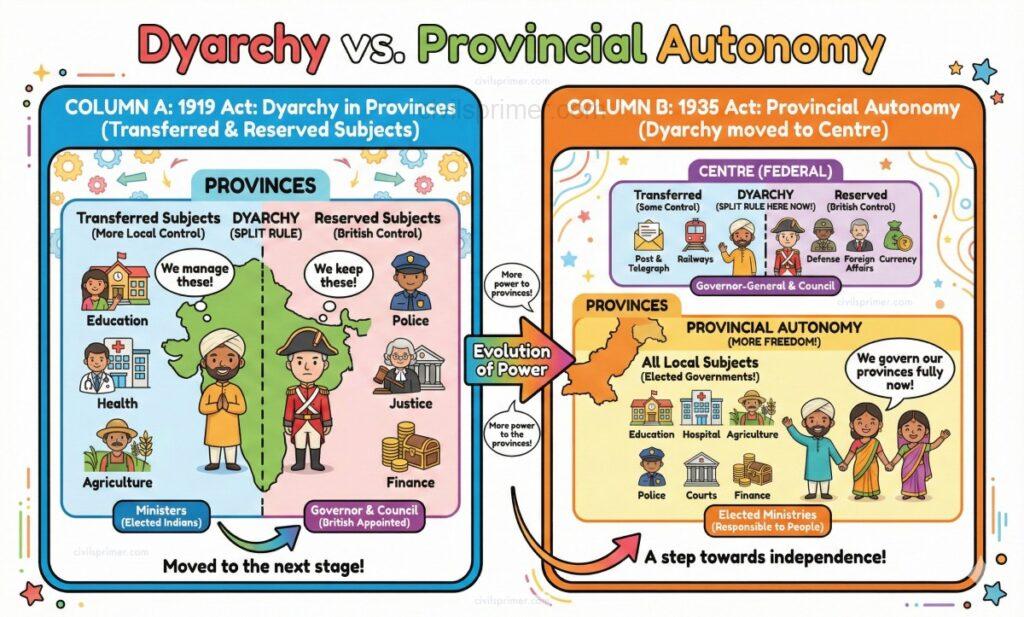
9. Introduction of Dyarchy: Government of India Act of 1919: Also known as the Montagu-Chelmsford Reforms, this Act declared that the objective was the gradual introduction of responsible government in India.
- Dyarchy in Provinces: It divided the provincial subjects into two parts—transferred and reserved. This dual scheme of governance was known as ‘Dyarchy’.
- Bicameralism: It introduced, for the first time, bicameralism (two houses) and direct elections in the country.
- Public Service Commission: It provided for the establishment of a Central Public Service Commission (set up in 1926).
10. The Blueprint of the Constitution: Government of India Act of 1935: This was a bulky and detailed document. A significant portion of the modern Indian Constitution is based on this Act.
- All-India Federation: It proposed a federation consisting of provinces and princely states as units. (However, the federation never came into being as princely states did not join).
- Three Lists: It divided powers between the Centre and units into Federal List, Provincial List, and Concurrent List.
- Provincial Autonomy: It abolished Dyarchy in the provinces and introduced ‘Provincial Autonomy’ in its place. The provinces were allowed to act as autonomous units of administration.
- Federal Court: It provided for the establishment of a Federal Court (1937).
11. The Finale: Indian Independence Act of 1947: On February 20, 1947, British Prime Minister Clement Attlee declared that British rule in India would end by June 30, 1948. However, events moved quickly.
- Two Dominions: The Act ended British rule and declared India an independent and sovereign state from August 15, 1947. It provided for the partition of India and the creation of two independent dominions of India and Pakistan.
- Constituent Assemblies: It empowered the Constituent Assemblies of the two dominions to frame and adopt any constitution for their respective nations.
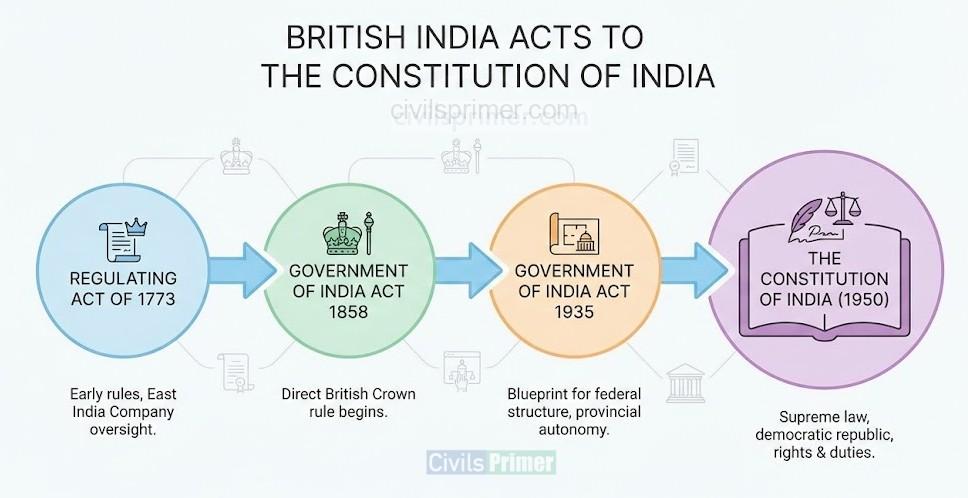
Summary for Revision #
To help you remember this long journey, think of it as a play in three acts:
1. Company Rule (1773-1858): The British check corruption (1773), separate trade and politics (1784), centralize power (1833), and separate executive/legislature (1853).
2. Crown Rule Consolidation (1858-1909): The Crown takes over (1858), starts associating Indians (1861), allows budget discussion (1892), and introduces communalism (1909).
3. Toward Independence (1919-1947): Introduction of Dyarchy/Direct elections (1919), the massive blueprint for federalism (1935), and finally, Freedom (1947).
Why does this matter? The Indian Constitution was not written in a vacuum. It was the result of this slow, painful, and complex evolution. When the Constituent Assembly met in 1946, they didn’t just write new laws; they adapted the administrative details from the 1935 Act and infused them with the values of the freedom struggle. Understanding this background explains why our Constitution is the lengthiest in the world and why we have a parliamentary system with a strong center.
Mains PYQs #
Here are the UPSC Mains subjective questions asked in previous years (specifically from 2013 onwards, following the syllabus change) related to the Historical Background of the Indian Constitution and its evolution from 1773 to 1947.
- 2016 → Did the Government of India Act, 1935 lay down a federal constitution? Discuss. [12.5 Marks]
- 2016 → Explain how the Uprising of 1857 constitutes an important watershed in the evolution of British policies towards colonial India. [12.5 Marks]
- 2015 → It would have been difficult for the Constituent Assembly to complete its historic task of drafting the Constitution for Independent India in just three years but for the experience gained with the Government of India Act, 1935. Discuss. [12.5 Marks]
- 2019 → Assess the role of British imperial power in complicating the process of transfer of power during the 1940s. [15 Marks]
Answer Writing Minors #
Here are a common introduction and conclusion suitable for UPSC Mains answers regarding the Historical Background and Evolution of the Indian Constitution (1773–1947).
- Common Introduction: The Indian Constitution is not an isolated document but the culmination of a long evolutionary process rooted in the British colonial era, beginning with the Regulating Act of 1773. These legislative developments, combined with the values forged during the nationalist freedom struggle, laid the essential administrative and political groundwork for the sovereign republic established in 1950,.
- Common Conclusion: While the structural details of independent India’s governance were significantly adapted from colonial laws like the Government of India Act, 1935, the Constitution transformed these frameworks to suit Indian aspirations,. Ultimately, this evolution represented a process of “selective adaptation” rather than mere borrowing, successfully transitioning the people of India from the status of colonial subjects to sovereign citizens.
Latest Related Current Affairs #
| (November, 2025): Indian Constitution at 76: Evolution and Relevance Marking the 76th anniversary of the Constitution’s adoption, discussions highlighted its progressive nature compared to Western models, specifically its early adoption of universal adult franchise (1950) and institutionalisation of affirmative action, unlike the phased rights in the US or Australia. |
| (October, 2025): UPSC Centenary and Historical Origins (1926-2026) The Union Public Service Commission celebrated its centenary, tracing its origins to the Government of India Act, 1919 and the Lee Commission (1924), which led to the establishment of the first Public Service Commission in 1926 to ensure merit-based recruitment,. |
| (August, 2025): Repeal of Colonial-Era Carriage of Goods by Sea Act, 1925 To modernize maritime trade laws, Parliament passed a bill repealing the 100-year-old Indian Carriage of Goods by Sea Act, 1925, aiming to align India’s shipping regulations with global standards and remove colonial legal remnants,. |
| (July, 2025): Revisiting Constitutional Dreams Before 1950 Scholars revisited pre-independence constitutional drafts like the 1895 Constitution of India Bill (Tilak), M.N. Roy’s 1944 Draft, and the Gandhian Constitution (1946), analysing their influence on the final 1950 text regarding civil liberties and decentralized governance,. |
| (July, 2025): C. Sankaran Nair and the Viceroy’s Executive Council A new film highlighted the role of Sir C. Sankaran Nair, a member of the Viceroy’s Executive Council who resigned in protest against the Jallianwala Bagh massacre, showcasing the functioning of colonial executive bodies and early constitutional dissent,. |
| (December, 2024): Railways (Amendment) Bill, 2024 Repeals 1905 Ac This bill was introduced to repeal the Indian Railway Board Act, 1905, a colonial legislation that originally established the Railway Board, thereby incorporating its provisions into the modern Railways Act, 1989. |