
Introduction: The Restless Planet #
If you look at a mountain, it seems silent and still. But if you could speed up time, you would see the Earth breathing, heaving, cracking, and crumbling. Our planet is not a dead rock; it is a dynamic playground of two colossal forces constantly at war. One force builds, and the other destroys. This constant cycle of creation and destruction that shapes the face of our planet is what we call Geomorphic Processes.
To understand this, imagine the Earth as a pottery studio. There is a potter (Endogenic Forces) who pushes clay up to make shapes, and there is a sculptor (Exogenic Forces) who chips away at those shapes to smoothen them out.

Endogenic Forces – The Architects from Below #
Deep beneath our feet, the Earth is a furnace. The energy generating this heat comes from radioactivity, rotational friction, and the primordial heat trapped since the Earth was born. This heat creates geothermal gradients and convection currents that drive the machinery of the Earth. These internal forces are called Endogenic Forces. Their main job is to build—to elevate the land and create relief irregularities.
1. The Slow Heave: Diastrophism
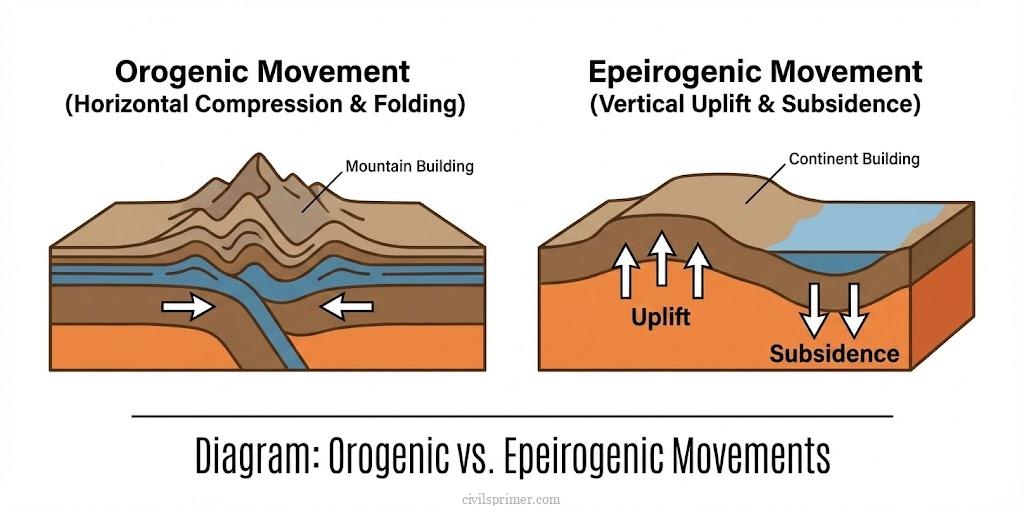
Diastrophism is the slow, silent lifting and twisting of the Earth’s crust. It doesn’t happen overnight; it takes millions of years. It includes two major movements:
1. Orogeny (The Mountain Builder): Imagine pushing a rug against a wall. It wrinkles and folds upwards. This is Orogeny. It involves severe folding and faulting of long, narrow belts of the earth’s crust to create mountain ranges like the Himalayas.
2. Epeirogeny (The Continent Builder): This is a broader, gentler movement. It involves the uplifting or warping of large parts of the earth’s crust to form continents or plateaus. It is a vertical movement.
2. Earthquakes and Volcanoes: The Sudden Fury
Note:Volcanoes and Mountains are important for UPSC Civil Services Exam, State PCS, so, covered in next chapter in required details for a beginner level aspirant.
While Diastrophism is slow, some endogenic forces are sudden and catastrophic.
The Shaking Earth (Earthquakes): Deep inside the crust, rocks are under immense stress. When this stress overcomes the friction holding the rocks together, they snap and slide past each other along a Fault. This sudden release of energy travels in all directions as Seismic Waves.
- Focus (Hypocenter): The exact point deep inside where the energy is released.
- Epicenter: The point on the surface directly above the focus.
The Fire from Below (Volcanism): Magma (molten rock) seeks a way out. When it moves toward the crust, it is called volcanism.
- Intrusive Forms: If the magma cools inside the crust, it creates forms like Batholiths (massive granite bodies), Laccoliths (dome-shaped), Dykes (vertical walls), and Sills (horizontal sheets).
- Extrusive Forms: If it breaches the surface as lava, it creates volcanoes. If the lava is basaltic (fluid), it forms Shield Volcanoes (like Hawaii) or Flood Basalt Provinces (like the Deccan Traps). If the lava is acidic and viscous, it forms steep Composite Volcanoes (like Mt. Fuji).

Exogenic Forces: The Sculptors from Above #
While the internal forces build mountains, the Exogenic Forces hate irregularities. Their goal is Gradation—to wear down the relief and fill up the depressions. Their energy comes from the Sun (which drives the climate) and Gravity. Collectively, the process of wearing down the earth is called Denudation (meaning “to strip off”).
1. Weathering: The Rotting of Rocks
Weathering is the first step. It is the breaking down of rocks in situ (meaning “on the spot”). There is very little motion involved; the rock just rots or breaks where it stands.
- Chemical Weathering (The Corroder):
- Solution: Minerals dissolve in water (like salt).
- Carbonation: Carbon dioxide mixes with rainwater to form a weak acid. This acid eats away limestone, creating caves (Karst Topography).
- Hydration: Minerals absorb water and expand, causing stress.
- Oxidation: Oxygen reacts with iron in rocks, causing them to rust and turn red/brown.
- Physical Weathering (The Smasher):
- Thermal Expansion: In deserts, rocks heat up by day and cool by night. The outer layers expand and contract faster than the inner layers, causing the rock to peel like an onion. This is called Exfoliation.
- Frost Wedging: Water enters cracks, freezes, expands, and breaks the rock apart.
- Biological Weathering: Roots of plants grow into cracks and exert pressure, breaking rocks apart. Burrowing animals and earthworms expose new rock surfaces to air.

2. Mass Wasting: The Downward Slide
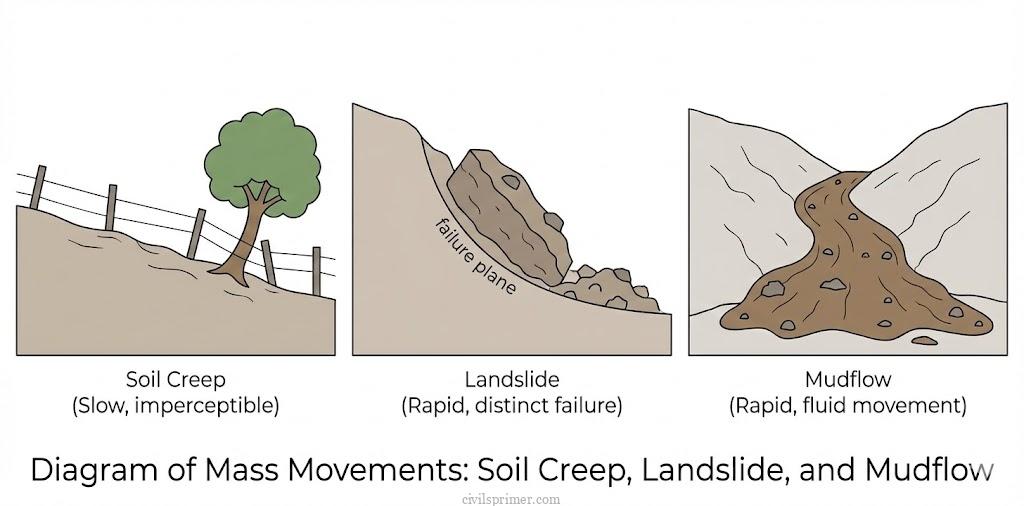
Once the rock is weathered/broken, Gravity takes over. Mass Wasting is the movement of rock debris down a slope purely due to gravity. Water aids this by lubricating the soil, but gravity is the driver.
- Rapid Movements: Landslides, Earthflow, Mudflow, and Avalanches. These happen fast and are destructive.
- Slow Movements: Creep (soil moves so slowly you can’t see it, but telephone poles tilt over years).
3. Erosion and Deposition: The Great Transport
Finally, the debris is picked up and moved by mobile agents: Wind, Running Water, Glaciers, and Waves.
- Erosion: The acquisition and transportation of rock debris. This creates erosional landforms (like Valleys and Gorges).
- Deposition: When the agents lose velocity, they drop their load. This creates depositional landforms (like Deltas and Sand Dunes).
Eventually, the mountains built by endogenic forces are worn down to a flat plain (Peneplain), only for the cycle to begin again.
UPSC Mains Subjective Previous Years Questions #
Note: Other questions will be covered in Volcanoes and Mountains Chapters.
- 2021: Differentiate the causes of landslides in the Himalayan region and Western Ghats.
- 2020: Discuss the geophysical characteristics of Circum-Pacific Zone.
Answer Writing Minors #
Introduction (3-4 Lines):“The Earth’s surface is a dynamic interface shaped by the continuous interplay between endogenic forces (originating from within the earth due to radioactivity and primordial heat) and Exogenic Forces (driven by solar energy). These geomorphic processes—ranging from Diastrophism and volcanism to weathering and erosion—continuously construct and denude the Lithosphere, defining the planetary relief.”
Conclusion (3-4 Lines): “In conclusion, the configuration of the Earth’s surface is a temporary result of the ‘balance of power’ between land-building endogenic forces and land-wearing Exogenic Forces. Understanding these geomorphic processes is not only vital for geology but also for disaster management, as they govern phenomena like earthquakes, landslides, and soil erosion that directly impact human habitation.”
Related Latest Current Affairs #
- November, 2025: Introduction of Seismic Zone VI in India
The Bureau of Indian Standards (BIS) revised the Earthquake Design Code, placing the entire Himalayan arc in a new, highest-risk Zone VI. This change acknowledges the extreme tectonic stress and rupture potential along the Indian-Eurasian plate boundary, upgrading the risk perception from the previous Zone V. - October, 2025: Delamination of the Indian Plate and Regional Seismicity
Following a 6.0 magnitude earthquake in Afghanistan, experts highlighted the process of “Delamination”—where the lower part of the Indian Lithosphere peels away and sinks into the mantle. This endogenic process alters crustal stress, contributing to frequent seismicity in the Hindu Kush-Himalaya collision zone. - September, 2025: Land Subsidence in Chamoli (Nanda Nagar)
Severe Land Subsidence (a form of Mass Wasting) was reported in Uttarakhand’s Chamoli district, damaging buildings. The sinking is driven by a combination of tectonic instability (active faults) and anthropogenic factors like unregulated construction and poor drainage in the fragile Himalayan terrain. - September, 2025: Eruption of Barren Island Volcano
India’s only active volcano, located in the Andaman Sea, witnessed mild eruptions. This stratovolcano sits on a Convergent Plate Boundary where the Indian Plate subducts under the Burmese Plate, representing active volcanism in the South Asian region. - August, 2025: Eruption of Krasheninnikov Volcano
Russia’s Krasheninnikov Volcano in the Kamchatka Peninsula erupted following a massive 8.8 magnitude earthquake. This event highlighted the connection between intense seismic activity and triggered volcanism along the Pacific Ring of Fire. - July, 2025: Erra Matti Dibbalu Included in UNESCO Tentative List
The rare red Sand Dunes (Erra Matti Dibbalu) in Andhra Pradesh were nominated for UNESCO World Heritage status. These geo-heritage sites preserve evidence of aeolian (wind) and marine deposition and paleo-climatic changes from the late Quaternary period. - July, 2025: Surge in Glacial Lake Outburst Floods (GLOFs)
A rise in GLOF events was reported in the Himalayas (e.g., Nepal, Sikkim), caused by the failure of moraine dams. This represents a catastrophic form of erosion and Mass Wasting, driven by glacial retreat due to rising temperatures.