
Syllabus Link
GS III – Internal Security (UPSC): Various Security Forces and agencies and their mandate; Indigenization of technology and developing new technology; Challenges to Internal Security.
Context: The year 2025 has been declared the “Year of Reforms” for India’s defence sector. The Combined Commanders’ Conference (CCC) 2025 held in Kolkata (Sep 2025) and the release of the Defence Procurement Manual (DPM) 2025 have accelerated the shift from “Jointness” to “Integration.”
Definitions & Core Concepts: Introduction to India’s Defence Modernisation
Introduction to India’s Defence Modernisation: The continuous process of upgrading military hardware (weaponry, platforms) and software (doctrines, command structures, training) to meet contemporary threats like hybrid warfare, cyber-attacks, and two-front wars.
Theaterisation: A shift from Service-specific commands (Army, Navy, Air Force acting separately) to Integrated Theatre Commands (ITC). In an ITC, all resources (land, air, sea) in a specific geographical theatre are placed under a single Commander to ensure unified war-fighting machinery.
Internal Security (IS): The preservation of sovereignty and domestic peace against threats like insurgency, terrorism, communalism, and cyber-subversion. The line between IS and External Defence is blurring (e.g., cross-border terrorism).
Historical Evolution & Background
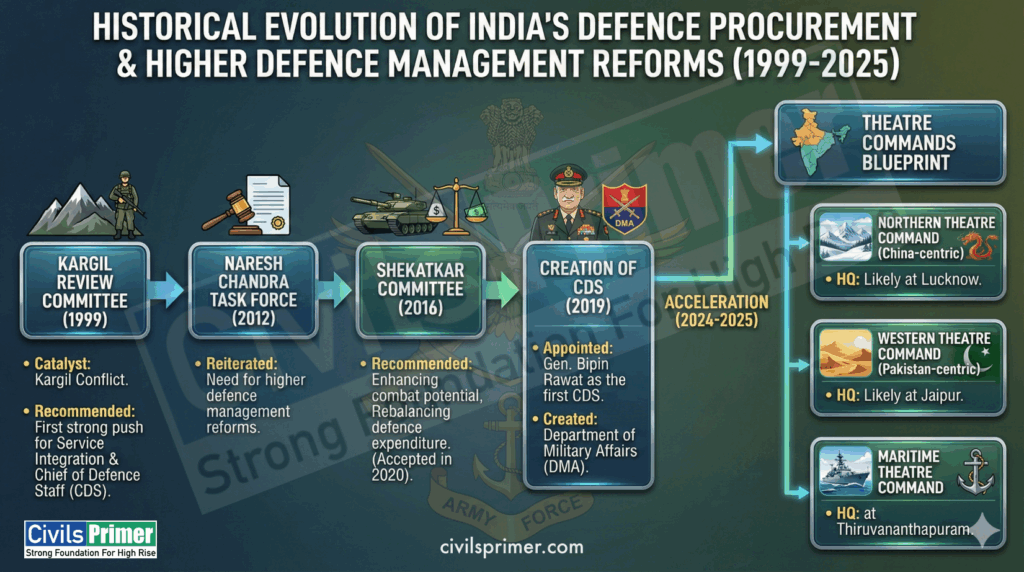
- Kargil Review Committee (1999): First strongly recommended the integration of services and a Chief of Defence Staff (CDS).
- Naresh Chandra Task Force (2012): Reiterated the need for higher defence management reforms.
- Shekatkar Committee (2016): Recommended enhancing combat potential and rebalancing defence expenditure (accepted in 2020).
- Creation of CDS (2019): Gen. Bipin Rawat appointed as the first CDS; creation of the Department of Military Affairs (DMA).
- 2024-2025 Acceleration: Formulation of the blueprint for three major Theatre Commands:
- Northern Theatre Command (China-centric): HQ likely at Lucknow.
- Western Theatre Command (Pakistan-centric): HQ likely at Jaipur.
- Maritime Theatre Command: HQ at Thiruvananthapuram.
Constitutional, Legal & Institutional Framework
| Constitutional | Article 53(2): The Supreme Command of the Defence Forces of the Union is vested in the President. Union List (Entry 1 & 2): Defence of India and Naval, military and air forces are under exclusive Central jurisdiction. |
| Legal | Currently, the three services are governed by separate Acts (Army Act 1950, Navy Act 1957, Air Force Act 1950). Gap: No “Joint Services Act” exists yet to govern personnel in Integrated Commands. |
| Institutional | Chief of Defence Staff (CDS): Principal Military Advisor to Raksha Mantri. Department of Military Affairs (DMA): Facilitates jointness in procurement, training, and staffing. Defence Acquisition Council (DAC): Highest decision-making body for capital acquisition. |
Case Studies: The Need for Modernization
- Case Study 1: Operation Sindoor (May 2025) – Success of Jointness
- What Happened: Following the Pahalgam terror attack, Indian forces launched a calibrated tri-service response. The Navy (deploying MiG-29Ks from a Carrier Battle Group) coordinated real-time with Army Special Forces and Air Force drones.
- Significance: It was a testbed for the “Integrated Response Strategy.” Unlike the siloed approach of the past, this operation demonstrated real-time data fusion and command unity.
- Lesson: Jointness significantly reduces response time and enhances lethality.
- Case Study 2: The Galwan & Tawang Skirmishes (Border Management)
- Context: Persistent friction along the LAC highlighted the need for rapid mobilization and persistent surveillance.
- Modernization Link: The procurement of Swathi Weapon Locating Radars and the 2025 contract for indigenous Air Defence Fire Control Radars (BEL) are direct responses to these high-altitude gaps.
- Lesson: “Boots on the ground” must be supplemented by “eyes in the sky” (satellites/drones) for effective border security.
Government Initiatives & Policies (2025 Updates)
Defence Procurement Manual (DPM) 2025
- Released in September 2025, this manual governs Revenue Procurement (maintenance, repairs, spares), distinct from the DAP 2020 (Capital Procurement).
- Key Reform: Liquidated Damages (LD) capped at 10% generally, but significantly reduced to 0.1% for developmental orders to encourage Startups and MSMEs without fear of heavy penalties for delays.
- Goal: To smooth the “Operations & Sustenance” of equipment and reduce downtime of tanks, ships, and jets.
Project Kusha (Indigenous Air Defence)
- Status: Accelerated development by DRDO in 2025.
- Goal: A Long-Range Surface-to-Air Missile (LR-SAM) system comparable to the S-400, capable of neutralizing stealth fighters and drones at 350 km range.
- Strategic Impact: Ends dependency on Russian imports for air defence shield
Joint Military Stations
- CCC 2025 Outcome: Announcement of three new Joint Military Stations where Army, Navy, and IAF assets will be co-located to share logistics and infrastructure, saving costs and fostering camaraderie.
Issues & Challenges in Implementation
- Budgetary Constraints: A significant portion of the defence budget goes into Pensions and Salaries (Revenue Expenditure), leaving limited fiscal space for Capital Expenditure (Modernization).
- Technological Obsolescence: While we procure new radars, a large inventory (vintage artillery, legacy Mi-series helicopters) remains outdated.
- The “Jointness” vs “Integration” Debate: The services have culturally operated in silos. The Air Force has historically expressed concerns that Theaterisation might split its limited air assets (fighters) across multiple commands, diluting air power.
- Cyber & Asymmetric Threats: Modernization is heavily hardware-focused (guns/ships). However, Internal Security threats are increasingly Cyber-Physical (e.g., AI-driven propaganda, grid hacking). India lacks a dedicated Cyber Force structure comparable to the US or China.
- Import Dependency in Sub-systems: While platforms (like Tejas) are “Made in India,” critical sub-systems (engines, sensors) often remain imported, creating a “strategic vulnerability” during global supply chain disruptions.
- Human Resource Management: Moving to Integrated Commands requires a common HR policy (promotions, rankings) which is currently different for Army, Navy, and IAF.
Way Forward & Visionary Recommendations
- Enact a Joint Services Act: To provide a legal basis for the CDS and Theatre Commanders to exercise disciplinary and administrative control over personnel from all three services.
- National Security Strategy (NSS): India needs a formal, written NSS to define its military and security objectives clearly, guiding procurement and theaterisation.
- Civil-Military Fusion in Tech: Replicate the US DARPA model. Use the Aditi Scheme (launched under iDEX) to fund deep-tech startups for solutions in quantum computing and AI for defence.
- Corporatization to Agility: The Ordnance Factory Board (OFB) corporatization was step one. Next, DPSUs must be given autonomy similar to private sector giants to speed up R&D.
- Focus on Grey Zone Warfare: Internal security forces (CAPFs) need modernization in Information Warfare to counter radicalization and narrative wars, not just better rifles.
Comparative Landscape
| Feature | India | USA | China |
| Command Structure | Transitioning to Integrated Theatre Commands (2025 status: Blueprint phase). | Unified Combatant Commands (Geographic & Functional) established decades ago. | Five Theater Commands established in 2016; highly integrated. |
| Procurement | Mixed (Import + Indigenisation). Heavy reliance on DPSUs. | Private-sector driven (Lockheed, Boeing). | State-owned but aggressive Civil-Military Fusion. |
| Cyber/Space | Agencies (DSA, DCA) exist but are small. | Dedicated Space Force and Cyber Command. | Strategic Support Force (Cyber + Space + EW combined). |
Answer-Writing & Question Mapping (Mains)
Potential Mains Question:
“The transition to Integrated Theatre Commands and the emphasis on ‘Aatmanirbharta’ in the Defence Procurement Manual 2025 mark a watershed moment in India’s defence history. Analyze the strategic imperatives behind these reforms and the challenges in their implementation.” (15 Marks, 250 Words)
Structure for Answers:
- Introduction: Cite CCC 2025 and DPM 2025 as the context. Define Theaterisation.
- Strategic Imperatives:
- Operational efficiency (Case study: Op Sindoor).
- Cost rationalization (Joint logistics).
- Self-reliance (Supply chain security).
- Challenges:
- Structural (Legal voids, command hierarchies).
- Financial (Budget skew).
- Cultural (Service silos).
- Conclusion: Emphasize that modernization must be holistic—spanning legal, technological, and organizational domains—to secure India’s rise.
Prelims Revision Facts (2025-26 Focus)
- Integrated Theatre Commands (Proposed):
- Northern: Lucknow (China focus).
- Western: Jaipur (Pakistan focus).
- Maritime: Thiruvananthapuram (IOR focus).
- Defence Procurement Manual (DPM) 2025:
- Deals with Revenue Procurement (Operating expenses), not Capital.
- Reform: 0.1% Liquidated Damages for development contracts (favors MSMEs).
- Limit: Limited Tender Enquiry limit raised to ₹50 Lakh.
- Swavalamban 2025: Annual seminar of the Naval Innovation and Indigenisation Organisation (NIIO). Focus on “Deep Tech”.
- Project Kusha: DRDO’s mission for Long Range Surface-to-Air Missile (LR-SAM) system (Range: 350 km).
- Article 53(2): Grants Supreme Command of Defence Forces to the President.
- Exercise “Tarang Shakti”: India’s largest multilateral air exercise (hosted recently).
UPSC Prelims Previous Year Questions
Question 1: Ballistic Missile Defence (Prelims 2023)
Consider the following statements:
- Ballistic missiles are jet-propelled at subsonic speeds throughout their flight, while cruise missiles are rocket-powered only in the initial phase of flight.
- Agni-V is a medium-range supersonic cruise missile, while BrahMos is a solid-fuelled intercontinental ballistic missile.
Which of the statements given above is/are correct?
(a) 1 only (b) 2 only (c) Both 1 and 2 (d) Neither 1 nor 2
Explanation
Solution: (d)
Statement 2 is Incorrect: Agni-V is an Intercontinental Ballistic Missile (ICBM) with a range of over 5,000 km. BrahMos is a supersonic cruise missile.
Explanation:
Statement 1 is Incorrect: It is the reverse. Cruise missiles are jet-propelled and can fly at subsonic, supersonic, or hypersonic speeds throughout their flight (like an airplane). Ballistic missiles are rocket-powered in the initial phase (boost phase) and then follow an unpowered, free-falling trajectory (ballistic trajectory) towards the target.
Question 2: Indigenous Aircraft Carrier (Prelims 2022)
With reference to the Indian Navy, consider the following statements:
- INS Vikrant is the first aircraft carrier built in India.
- INS Viraat was the aircraft carrier that was inducted into the Indian Navy from the UK.
Which of the statements given above is/are correct?
(a) 1 only (b) 2 only (c) Both 1 and 2 (d) Neither 1 nor 2
Explanation
Solution: (c)
Statement 2 is Correct: INS Viraat was originally the HMS Hermes of the British Royal Navy. It served the Indian Navy for nearly 30 years before being decommissioned in 2017.
Explanation:
Statement 1 is Correct: INS Vikrant (IAC-1) is indeed India’s first indigenously designed and built aircraft carrier. (Note: The original INS Vikrant was a British-built ship, but the new INS Vikrant commissioned in 2022 is indigenous).
