
Context: The geopolitical landscape of South Asia is currently witnessing a dual churn. On one side, Nepal is grappling with a democratic crisis driven by “Gen Z” protests fueled by economic stagnation and corruption, leading to executive instability. On the other, Afghanistan under the Taliban 2.0 regime is seeing a shift in India’s approach from “principled distance” to “pragmatic engagement,” evidenced by recent high-level talks.
For India, these developments test the resilience of the ‘Neighbourhood First’ Policy and the Gujral Doctrine, requiring a balance between supporting democratic values (in Nepal) and securing strategic interests (in Afghanistan).
Historical Evolution: Indo-Nepal Relations and Indo-Afgan Relations
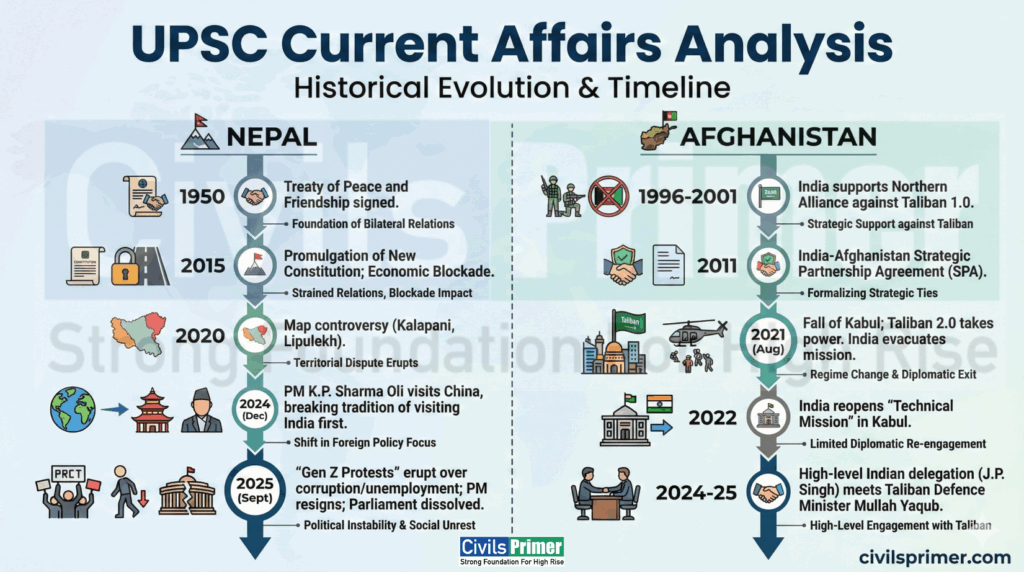
| Country | Timeline of Key Events |
| Nepal | 1950: Treaty of Peace and Friendship signed. 2015: Promulgation of New Constitution; Economic Blockade. 2020: Map controversy (Kalapani, Lipulekh). 2024 (Dec): PM K.P. Sharma Oli visits China, breaking tradition of visiting India first. 2025 (Sept): “Gen Z Protests” erupt over corruption/unemployment; PM resigns; Parliament dissolved. |
| Afghanistan | 1996-2001: India supports Northern Alliance against Taliban 1.0. 2011: India-Afghanistan Strategic Partnership Agreement (SPA). 2021 (Aug): Fall of Kabul; Taliban 2.0 takes power. India evacuates mission. 2022: India reopens “Technical Mission” in Kabul. 2024-25: High-level Indian delegation (J.P. Singh) meets Taliban Defence Minister Mullah Yaqub. |
Institutional Framework and Treaties
Nepal: The 1950 Treaty of Peace and Friendship
- Core Provision: Article 6 and 7 grant “national treatment” to citizens of both countries regarding residence, property, and trade.
- Security Clause: Both nations must inform each other of any serious friction with neighbouring countries (implied reference to China).
- Current Status: Nepal has demanded a review of this treaty, calling it “unequal” and dated.
Afghanistan: Strategic Partnership Agreement (SPA), 2011
- Significance: First such agreement Afghanistan signed with any country.
- Pillars: Political/Security cooperation, Trade & Economic cooperation, Capacity development, and Social/Cultural ties.
- Current Status: While the political leg is complicated by the Taliban regime, the humanitarian and economic pillars remain functionally active.
Case Studies: Crisis & Response
Case Study: The “Gen Z” Uprising in Nepal (2025)
- What Happened: A youth-led movement, organized largely on social media, protested against entrenched corruption, the “revolving door” politics of elderly leaders, and acute unemployment. The protests turned violent, forcing the dissolution of Parliament.
- Why it Matters: It signals the failure of traditional political parties (Nepali Congress, CPN-UML, Maoists) to meet aspirational demands. It also creates a power vacuum that external actors (China/US) might exploit.
- Lesson for India: India maintained a calculated silence, avoiding the “Big Brother” tag. This reflects a matured “Non-Interference” approach, allowing Nepal’s internal democracy to resolve the crisis.
Case Study: Pragmatism in Kabul (India-Taliban Talks)
- What Happened: An Indian delegation led by the Ministry of External Affairs (MEA) held talks with the Taliban Defence Minister.
- Why it Matters: This de-hyphenates India’s relationship with Afghanistan from Pakistan. The Taliban’s rift with Pakistan (over the Durand Line and TTP) has created a strategic wedge that India is leveraging.
- Lesson: Realpolitik triumphs over ideology. Engaging the “de facto” ruler is necessary to ensure regional security (counter-terrorism) and protect investments (Chabahar connectivity)
Government Initiatives (India’s Response)
For Nepal (Soft Power and Connectivity)
- Hydropower Cooperation: Long-term agreement to import 10,000 MW of power from Nepal over 10 years.
- Infrastructure: Extension of the Raxaul-Kathmandu railway and cross-border petroleum pipelines (Motihari-Amlekhgunj).
- Digital Linkages: UPI (Unified Payments Interface) integration in Nepal to facilitate easy transactions for Indian tourists and Nepali citizens.
For Afghanistan (Humanitarian and Development)
- Humanitarian Aid: Supply of 50,000 MT of wheat, medicines, and COVID-19 vaccines via land routes (Attari-Wagah) and Chabahar.
- Technical Team: A ‘technical team’ deployed at the Kabul Embassy to oversee aid distribution and visa processing, without formal diplomatic recognition.
- Education: Continued scholarships (ICCR) for Afghan students (via online modes or travel where permitted).
Key Issues and Challenges (UPSC Mains Exam)
| Dimension | Nepal Issues | Afghanistan Issues |
| Security | Open Borders: Use by terrorists/insurgents for infiltration into India. Fake Currency (FICN) smuggling. Refugee Crisis may open up for India on Indo-Nepal Border, specially when SIR is an ongoing issue in India. | Terrorism: Presence of LeT/JeM camps; fear of Afghan soil being used for anti-India activities. |
| Geopolitical | China Card: Nepal balancing India with China (BRI projects, Pokhara Airport loans). | Strategic Depth: Pakistan trying to control Kabul, though currently struggling due to Taliban’s autonomy. |
| Economic | Trade Deficit: Nepal’s massive trade deficit with India causes political friction. | Drug Trafficking: Golden Crescent heroin flow into Punjab/India. |
| Social | Anti-India Rhetoric: Politicians using anti-India slogans for electoral gains (nationalism). | Human Rights: Radical policies against women and minorities make formal recognition difficult for democratic India. |
Way Forward and Recommendations
Domestic/Bilateral Reforms:
- Revise the 1950 Treaty (Nepal): India should proactively offer a modern version of the treaty that addresses Nepali concerns about sovereignty while safeguarding India’s security.
- Border Management: Deploy Smart Border Management (sensors, drones) along the Nepal border to check infiltration without hindering genuine movement (“Roti-Beti” ties).
- Visa Policy (Afghanistan): Introduce a fast-track “e-Emergency X-Misc Visa” specifically for Afghan students and medical patients to maintain people-to-people goodwill.
Strategic Vision:
- Leverage the “Pakistan Wedge”: Use the Taliban’s growing animosity towards Pakistan to secure guarantees on counter-terrorism.
- Project Delivery: In Nepal, India must shed the reputation of “promising big but delivering late.” Expedite the Pancheshwar Multipurpose Project.
- Multilateral Approach: Use platforms like BIMSTEC (for Nepal) and the Moscow Format/SCO (for Afghanistan) to build regional consensus.
Previous Year Questions
UPSC Civil Services (Prelims)
Q1. Consider the following pairs: Region often mentioned in news : Country
- Panjshir Valley : Afghanistan
- Madhesi Region : Nepal
- Rakhine State : Myanmar
Which of the above pairs are correctly matched?
- (a) 1 and 2 only
- (b) 2 and 3 only
- (c) 1 and 3 only
- (d) 1, 2 and 3
Solution
(Answer: d)
Q2. The ‘Motihari-Amlekhgunj’ pipeline is related to cooperation between India and:
(a) Bangladesh (b) Nepal (c) Myanmar (d) Bhutan
Solution
(Answer: b)
UPSC Civil Services Exam (Mains)
- 2021 (GS II): “The USA is facing an existential threat in the form of China, that is much more challenging than the erstwhile Soviet Union.” Explain this in the context of the recent developments in Afghanistan.
- 2017 (GS II): “The boycott of the SAARC summit was a failure of India’s foreign policy.” Critically examine. (Relevant to India-Nepal/Pak dynamics).
- UPSC Mains Practice Question 1: “Political volatility in South Asia often forces India to choose between democratic principles and strategic pragmatism. Discuss this statement in light of the recent “Gen Z” uprising in Nepal and India’s engagement with the Taliban.” (250 words)
- UPSC Mains Practice Question 2: “Recent political instability in Nepal and the consolidation of the Taliban regime in Afghanistan present distinct security challenges for India. Analyze how India’s ‘Neighbourhood First’ policy must adapt to these changing ground realities.” (250 Words)
Prelims Revision Facts (Quick Look)
- Kalapani Dispute: Tri-junction between India (Uttarakhand), Nepal, and China.
- Durand Line: Border between Afghanistan and Pakistan (approx 2,670 km), not recognized by the Taliban.
- Susta Area: Disputed territory between India (Bihar) and Nepal.
- Loya Jirga: A traditional grand assembly in Afghanistan (Pashtun style).
- Operation Devi Shakti: India’s evacuation mission from Afghanistan (2021).
