
Syllabus Link
GS III: Conservation related issues, environmental pollution and degradation, environmental impact assessment.
Context: The International Union for Conservation of Nature (IUCN) released its World Heritage Outlook 4 (2025) report, assessing the conservation prospects of natural World Heritage sites globally. For India, the report serves as a “wake-up call.” While Khangchendzonga National Park (Sikkim) retained a “Good” outlook, key biodiversity hotspots like the Western Ghats, Manas National Park, and Sundarbans were flagged under “Significant Concern.” This report is crucial for understanding the gap between India’s international commitments (like the Kunming-Montreal Global Biodiversity Framework (KM-GBF) 2030) and the ground realities of implementation.

World Heritage Outlook – Basics
- IUCN World Heritage Outlook: The first global assessment of natural World Heritage sites, updated every three years. It evaluates three parameters:
- Current State of Values: Is the biodiversity/geology intact?
- Threats: What risks (climate, poaching, roads) does the site face?
- Protection and Management: Are laws and funding effective?
- Assessment Categories:
- Good: Values are preserved; threats are low.
- Good with Some Concerns: Minor issues, but values are safe for now.
- Significant Concern: Values are threatened; urgent action is required to prevent loss.
- Critical: Values are severely damaged; the site faces immediate risk of losing its heritage status
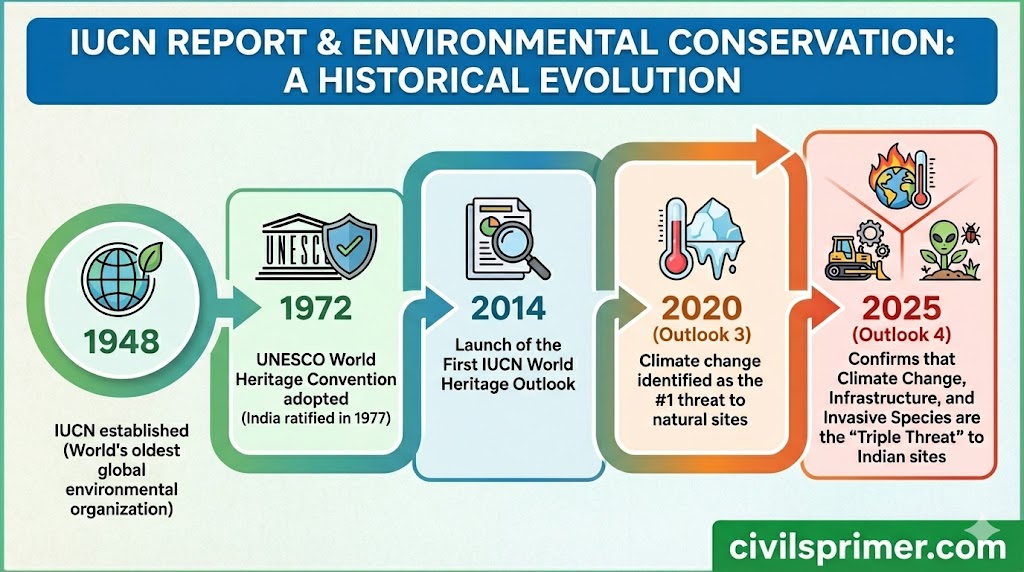
Historical Evolution: IUCN, World Heritage Outlook
Constitutional, Legal and Institutional Framework
| Component | Details |
| Constitutional | Art 48A: State shall endeavor to protect the environment. Art 51A(g): Fundamental duty of citizens to protect natural environment. |
| Legal | Wildlife (Protection) Act, 1972: Core legal basis for National Parks/Sanctuaries. Forest (Conservation) Amendment Act, 2023: Regulates diversion of forest land. Biological Diversity Act, 2002: Regulates access to genetic resources. |
| Institutional | MoEFCC: Nodal ministry. National Board for Wildlife (NBWL): Chaired by PM; approves projects in/around Protected Areas (PAs). Wildlife Crime Control Bureau (WCCB): Combats organized wildlife crime. |
Case Studies: Crisis and Lessons
Case Study 1: The Western Ghats (Significant Concern)
- The Issue: Flagged for “fragmentation.” The construction of linear infrastructure (roads, railways, power lines) has sliced through continuous forests.
- Why it Matters: It is one of the world’s 8 “Hottest Hotspots.” Fragmentation isolates species like the Lion-tailed Macaque, leading to genetic bottlenecks.
- Lesson: The delay in implementing the Gadgil or Kasturirangan Committee reports (on Eco-Sensitive Zones) has allowed unregulated development to creep into core areas.
Case Study 2: Sundarbans National Park (Climate Frontline)
- The Issue: Flagged for “Climate Change.” Rising sea levels and increasing salinity are destroying the Sundari trees and reducing freshwater availability for the Bengal Tiger.
- Why it Matters: It is the world’s largest mangrove system and a critical carbon sink.
- Lesson: Conservation here is no longer just about “anti-poaching”; it is about Climate Adaptation (e.g., planting salt-tolerant species).
Government Initiatives (Domestic Response)
- MISHTI (Mangrove Initiative for Shoreline Habitats & Tangible Incomes): Specifically targets mangrove reforestation (crucial for Sundarbans).
- Project Tiger & Project Elephant Merger (2023): To streamline funding and management for overlapping landscapes (like Manas and Western Ghats).
- Green Credit Program (GCP): Incentivizes afforestation and water conservation on degraded lands.
- Eco-Sensitive Zones (ESZ): Creating buffer zones around PAs to regulate “Red Category” industries.
Issues & Challenges
- Linear Infrastructure: Roads and railways are now a top-5 threat globally. In India, they cause roadkills and cut off migration corridors.
- Invasive Alien Species (IAS): Lantana camara and Senna spectabilis are overtaking native fodder plants in Western Ghats and Manas, reducing food for herbivores.
- Financial Deficit: Despite schemes, funds often reach parks late. The “Green Bonus” demanded by Himalayan/forest states remains unfulfilled.
- Human-Wildlife Conflict: As habitats shrink (e.g., in Manas), animals move into farmlands, leading to retaliatory killings.
- Tourism Pressure: “Over-tourism” in core areas creates noise pollution and waste management crises (plastic in forests).
- Data Deficit: We lack real-time monitoring data on “lesser-known species” (amphibians, insects) which are key indicators of ecosystem health.
Way Forward & Recommendations
- Legal Fix: Strictly enforce Section 38 of the WPA, 1972 to prevent encroachment. Give statutory teeth to the National Board for Wildlife to reject ecologically unsound projects.
- Smart Infrastructure: Mandate animal underpasses/overpasses for all linear projects passing through forests (Modeled on the NH-44 Pench Tiger Reserve success).
- Innovative Finance: Operationalize “Payment for Ecosystem Services” (PES). Downstream cities should pay upstream forest communities for water security.
- Community Stewardship: Move beyond “exclusionary conservation.” Involve local tribes as “Guardians of Heritage” (e.g., using Soliga tribes in BR Hills).
Comparative Lessons & International Landscape
- China’s Model: The IUCN report praises Mount Wuyi (China) for effective visitor management and youth engagement. India can emulate their “quota systems” for tourists to prevent overcrowding.
- Africa’s Virunga: Demonstrates how conflict-sensitive conservation works. India’s Manas (recovering from Bodoland insurgency) can learn from Virunga’s ranger welfare programs.
- Global Goal: India must align its National Biodiversity Strategy with the “30×30 Target” (protecting 30% of land/ocean by 2030) of the KM-GBF.
UPSC Prelims Pointers
- Report Name: IUCN World Heritage Outlook 4 (2025).
- Status of Indian Sites:
- Good: Khangchendzonga (Sikkim) – Only one.
- Good with Some Concerns: Great Himalayan NP, Kaziranga, Keoladeo (Bharatpur), Nanda Devi.
- Significant Concern: Western Ghats, Manas, Sundarbans.
- KM-GBF: Replaced Aichi Targets; key target is “30×30”.
- Manas NP: Transboundary (India-Bhutan); famous for Pygmy Hog and Golden Langur.
- Keoladeo NP: Being a wetland, its main threat is water shortage/invasive water hyacinth (not poaching).
Previous Year Questions (PYQs)
UPSC Civil Services Exam (Mains):
- Mains 2020 (GS III): “How does the draft Environment Impact Assessment (EIA) Notification, 2020 differ from the existing EIA Notification, 2006?” (Context: Weakening regulations impact sites like Western Ghats).
- Mains 2018 (GS III): “Define the concept of carrying capacity of an ecosystem as relevant to an environment. Explain how understanding this concept is vital while planning for sustainable development of a region.” (Context: Relevant to the ‘Tourism’ threat flagged by IUCN).
UPSC Civil Services Exam (Prelims)
Question. Which of the following National Parks is unique in being a swamp with floating vegetation that supports a rich biodiversity? (Prelims 2016)
(a) Bhitarkanika National Park (b) Keibul Lamjao National Park (c) Keoladeo Ghana National Park (d) Sultanpur National Park
Solution
Answer: (b) (Keibul Lamjao is the only floating park; relevant for unique ecosystem conservation).
