
GS Paper I (Society & Geography): Effects of Globalization; Migration (Brain Drain vs. Reverse Migration); Indian Diaspora.
GS Paper II (Governance): Government Policies for development in various sectors; Indian Diaspora (Role in Soft Power).
GS Paper III (Science & Economy): Achievements of Indians in S&T; Indigenization of technology; Mobilization of resources (R&D Funding).
Essay Topics: “Innovation is the key to Viksit Bharat,” “Brain Drain: Crisis or Opportunity?”
Context: The Government of India is reportedly finalizing a new “Star Faculty” scheme to attract high-achieving Indian-origin researchers from the US and other advanced economies. This move comes at a strategic moment when tightening US visa policies and research restrictions (potential “Trump 2.0” policies) are creating uncertainty for Indian STEM talent abroad. This initiative aligns with the Anusandhan National Research Foundation (ANRF) goals to boost India’s R&D ecosystem.
Conceptual Framework: From “Drain” to “Circulation”
| Concept | Definition | Current Relevance |
| Brain Drain | The emigration of highly trained or intelligent people from a particular country. | Historically, India lost talent to the US/Europe due to lack of infrastructure. |
| Brain Gain | The return of skilled emigrants to their home country, bringing back expertise and capital. | The goal of current schemes (Ramanujan, VAJRA). |
| Brain Circulation | A cyclical flow of talent where researchers maintain ties with home and host countries, acting as bridges. | The modern realistic goal—scientists don’t need to “permanently return” but must “engage constantly.” |
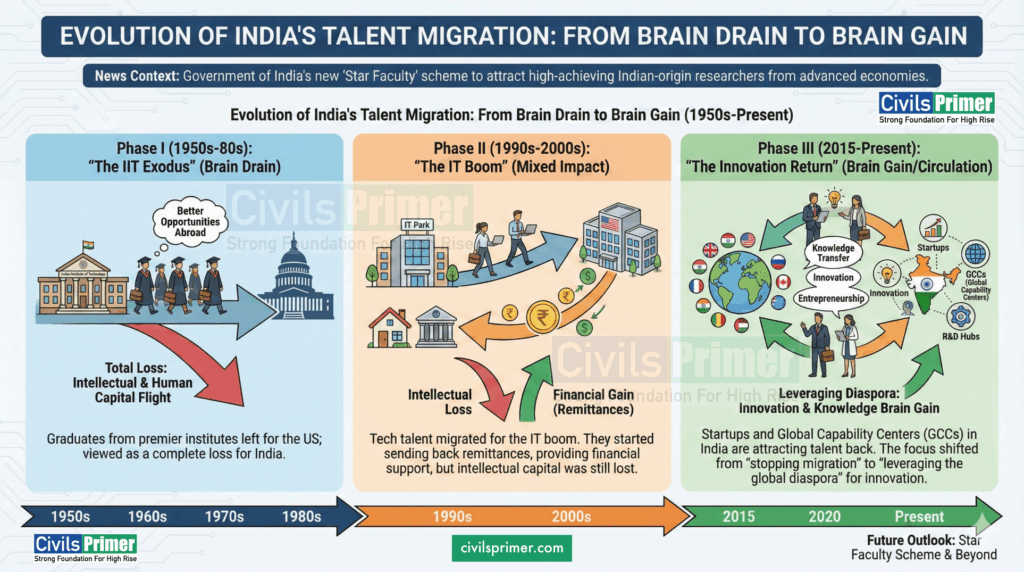
Historical Evolution
- Phase I (1950s-80s): “The IIT Exodus.” Graduates from premier institutes left for the US; viewed as a total loss.
- Phase II (1990s-2000s): “The IT Boom.” Tech talent migrated but started sending back remittances (financial gain, intellectual loss).
- Phase III (2015-Present): “The Innovation Return.” Startups and Global Capability Centers (GCCs) in India are attracting talent back. The focus shifted from “stopping migration” to “leveraging the diaspora.”
Constitutional & Institutional Framework
- Constitutional Spirit: Article 51A(h) (Fundamental Duties) urges citizens to develop the “scientific temper, humanism and the spirit of inquiry and reform.”
- Key Institutions:
- PSA (Principal Scientific Adviser): The apex advisory body coordinating this new “Star Faculty” scheme.
- ANRF (Anusandhan National Research Foundation): Established by the ANRF Act, 2023, it replaces the SERB and aims to seed research in universities and, crucially, bring private sector funding into R&D.
- DST & DBT: The Department of Science & Technology and Dept of Biotechnology execute the fellowship schemes.
Case Studies: Lessons from the Field
- Case Study 1: The “Biocare” Warning (Bureaucratic Failure)
What happened: A scheme designed to bring women scientists back to work faced severe delays. In 2024-25, reports emerged that 75 women selected for the DBT’s Biocare programme received neither sanction letters nor salaries for months due to the transition to a new accounting system (Treasury Single Account).
Lesson: “Time is the currency of science.” Even the best schemes fail if financial disbursements are delayed by red tape. A returning scientist cannot wait 6 months for equipment funds. - Case Study 2: The Biotech Boom (Sectoral Success)
What happened: The Ramalingaswami Re-entry Fellowship (DBT) has seen higher success rates than general science schemes.
Why: It targeted a specific booming sector (Biotech/Pharma) where India has industrial strength (vaccine manufacturing). Returning fellows found immediate industry absorption, not just academic posts.
Lesson: Schemes linked to industrial ecosystems (like Pharma or AI) succeed better than pure academic fellowships.
Government Initiatives & Policies (Domestic)
The government is shifting from “Fellowships” to “Institutional Transformation.”
- PROPOSED “Star Faculty” Scheme:
- Target: Top-tier researchers in 12-14 priority STEM areas (AI, Quantum, Semiconductors).
- Offer: Significant “set-up grants” (funding to build a lab from scratch) + Autonomy (freedom from rigid procurement rules).
- VAJRA (Visiting Advanced Joint Research) Faculty Scheme: Allows overseas scientists to serve as adjunct faculty for 1-3 months. (Success has been mixed due to short duration).
- Ramanujan Fellowship (DST): For brilliant scientists (below 40) to take up scientific positions in India.
- DST-INSPIRE Faculty: To attract young talent with contractual positions for 5 years.
International Landscape & Comparative Models
- China’s “Thousand Talents” (Now Qiming):
- Model: Aggressive recruitment. They offered salaries matching or exceeding US standards, plus massive housing and lab grants.
- Result: Successfully reversed the brain drain in critical tech (5G, AI), but faced espionage accusations from the US.
- South Korea: Focuses on “Industrial-Academic” clusters. Scientists are lured back not just to universities, but to massive R&D hubs of Samsung/LG supported by state grants.
- India’s Position: India cannot match the salary of the US or China ($$$). India’s USP is the “Opportunity to Solve Scale Problems” (Digital Public Infrastructure, Healthcare for billions) and the rising “Startup Ecosystem.”
Issues, Challenges & Gaps (The “Why they don’t return” list)
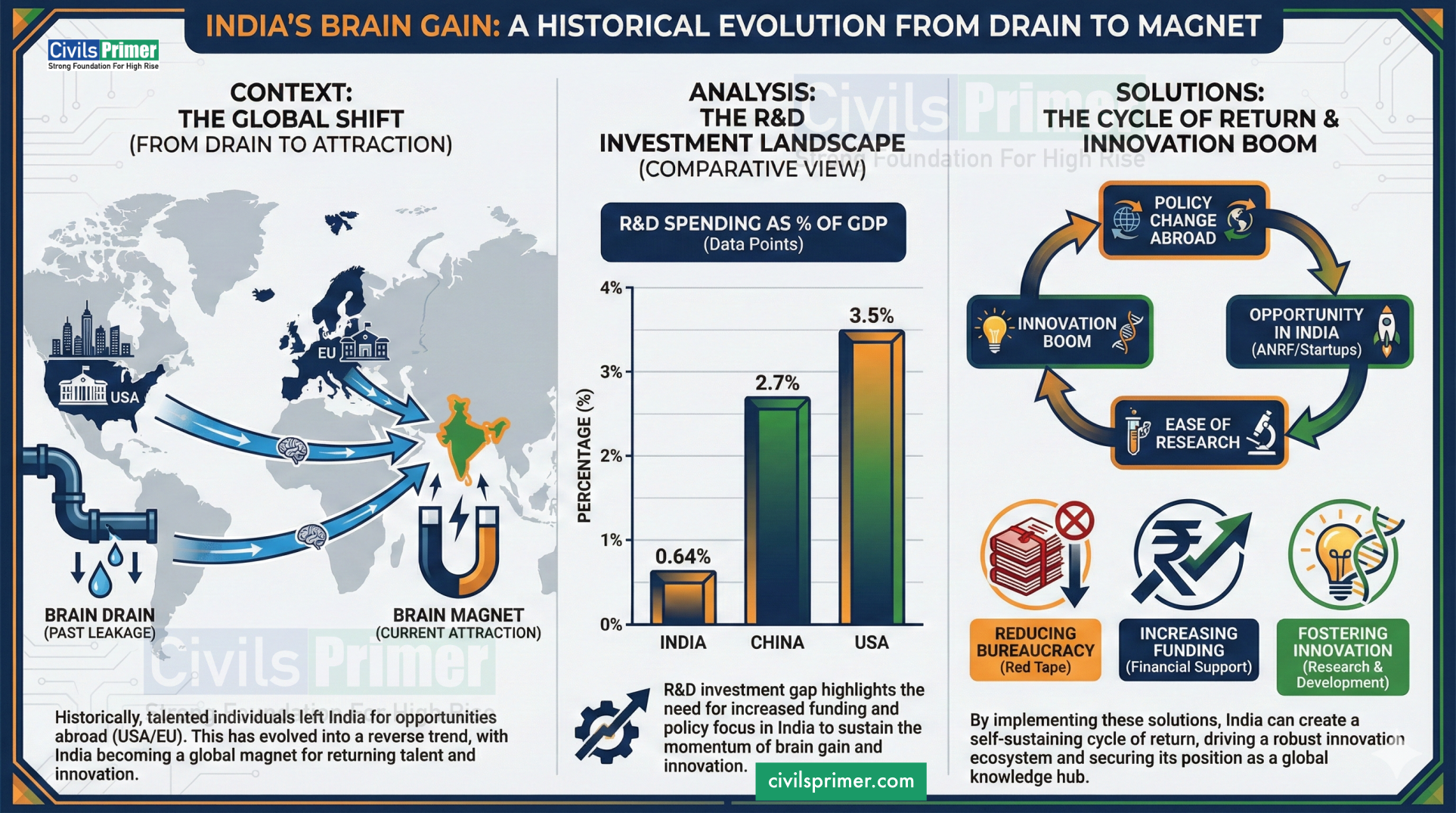
- Low R&D Expenditure: India spends 0.64% of GDP on R&D (Global average is ~1.8%; China ~2.4%; US ~3.5%).
- Bureaucratic Maze (GFR Rules): The General Financial Rules (GFR) make buying a simple microscope a months-long tender process. Scientists want “Ease of Doing Science,” not just “Ease of Doing Business.”
- The “Two-Body” Problem: Returning scientists often have spouses who also need high-quality jobs. Lack of support for spousal employment is a major deterrent.
- Feudal Academic Culture: Hierarchy in Indian universities often suppresses young returnees. “Seniority over Merit” discourages innovation.
- Funding Delays: As seen in the Biocare case, grant approvals often don’t translate to money in the bank on time.
- Lack of Private Participation: 70% of R&D funding in India is Government (Public); in the US/China, 70% is Private. The ANRF aims to fix this but it’s early days.
Way Forward & Visionary Recommendations
- Flexible “Tenure-Track” Systems: Move away from permanent government jobs to high-paying, performance-based renewable contracts (like the US model).
- “Green Channel” for Procurement: Exempt certified R&D labs from standard GFR tender rules for equipment under a certain threshold to speed up research.
- Lateral Entry in Science Ministries: Hire scientists, not generalist bureaucrats, to manage R&D funding agencies (ANRF implementation).
- Focus on “Brain Circulation”: Instead of demanding permanent return, allow “Dual Appointments” where a professor can spend 6 months in Stanford and 6 months in IIT Delhi, sharing IP and students.
Answer-Writing & Question Mapping
Prelims 2025 Revision Facts
- R&D Spend: ~0.64% of GDP.
- ANRF: Established by Act of 2023; presided over by the Prime Minister (President of the Governing Board).
- VAJRA: Implemented by SERB (now subsumed under ANRF/DST).
- Key Schemes: Ramanujan (DST), Ramalingaswami (DBT).
UPSC Civil Services (Mains) Question Bank
Q1 (GS III): “India’s R&D expenditure has remained stagnant for two decades. Discuss how the Anusandhan National Research Foundation (ANRF) aims to address the structural bottlenecks in India’s research ecosystem.”
Approach:
- Introduction: Highlight the current status of R&D expenditure and the stagnation issue using data.
- Body Paragraph 1 (Structural Bottlenecks): Identify why the ecosystem is stalling (funding, bureaucracy, industry links).
- Body Paragraph 2 (Role of ANRF): Explain specific mechanisms of ANRF designed to solve these bottlenecks.
- Conclusion: Summarize the potential impact on India’s goal of becoming a developed nation (Viksit Bharat).
Q2 (GS I/II): “The Indian diaspora is a strategic asset. Critically analyze the government’s recent efforts to convert ‘Brain Drain’ into ‘Brain Gain’ amidst changing global geopolitical dynamics.”
Solution/Model Answer
Introduction
The Indian diaspora is a formidable strategic asset, contributing to soft power, remittances, and global knowledge networks. However, the phenomenon of “Brain Drain”—the emigration of skilled professionals—remains acute. Between 2015 and 2022, 1.3 million Indians left the country, and in 2022 alone, 225,000 renounced citizenship. Recently, the government has ramped up efforts to convert this into “Brain Gain” by leveraging shifting global geopolitical dynamics.
Geopolitical Context:
The “Push” for Reverse Migration Changing global dynamics are creating an opening for India to attract its talent back:
- Policy Uncertainty in the West: Tightening immigration rules and funding cuts in research in countries like the United States (e.g., under the Trump administration) are pushing Indian-origin researchers to seek stability elsewhere.
- Visa Costs: The cost of US visas (H1B) has increased significantly, prompting a look at domestic opportunities or alternative visa routes.
Government Efforts to Induce “Brain Gain”
The government has launched multiple initiatives to attract STEM talent:
- Institutional Fellowships: Schemes like the Prime Minister’s Research Fellowship (PMRF) offer high stipends to retain talent, while the Ramanujan Fellowship and INSPIRE Faculty Scheme specifically target returnees.
- Collaborative Platforms: The VAJRA (Visiting Advanced Joint Research) scheme invites overseas scientists to collaborate with Indian institutions.
- Proposed Reforms: There is a proposal for an NRI Scientist Repatriation Scheme offering substantial set-up grants and placements in IITs.
- State-Level Models: Initiatives like Tamil Nadu’s “Tamil Talents Plan” provide competitive pay and research freedom, serving as a federal model for reversing migration.
- Strategic Missions: High-tech missions like IndiaAI and the Semiconductor Mission are creating high-value employment opportunities domestically.
Critical Analysis
Why Efforts May Fall Short Despite these schemes, structural challenges persist:
- Bureaucratic Maze: Researchers returning to India often face complex procurement rules and delays in fund releases, forcing them to spend more time on paperwork than innovation.
- Institutional Resistance: Preferential treatment and grants for returnees can breed discontent among existing faculty, leading to friction and a lack of institutional cohesion.
- Infrastructure Deficits: With R&D spending stagnant at 0.65% of GDP, access to world-class labs remains limited compared to China (2.7%) or the US (3.5%).
- Quality of Life: Issues such as air pollution, urban infrastructure, and civic services in major metros deter scientists with families from relocating permanently.
Conclusion While geopolitical shifts in the West offer a window of opportunity, reversing brain drain requires more than just monetary incentives. It demands a systemic overhaul of the “Ease of Doing Research”. India must move beyond symbolic schemes to creating an autonomous, well-funded research ecosystem where meritocracy prevails over bureaucracy. Only when scientific freedom and lifestyle match global standards will “Brain Gain” become a sustainable reality.
Likely MCQ Trap:
- Trap: Thinking ANRF is solely funded by the government.
- Reality: A major mandate of ANRF is to raise ₹36,000 crore (out of ₹50,000 crore total) from the Private Sector/Philanthropy over 5 years.
