
Syllabus Topics Linked
GS I: Urbanization, their problems and their remedies.
GS III: Infrastructure: Energy, Ports, Roads, Airports, Railways etc.
This topic is a perfect example of how UPSC intertwines economic infrastructure (GS III) with societal development (GS I). The launch of LEAPS 2025 is not just a logistical update; it represents a structural shift in how India aims to become a developed economy by 2047.
UPSC Civil Services Exam Relevance
- GS Paper I (Society & Geography): Urbanization, their problems and their remedies; Inclusive growth.
- GS Paper III (Economy & Infrastructure): Infrastructure (Ports, Roads, Railways); Investment models; Inclusive growth.
- Key Concept: The link between efficient logistics (reducing cost of living/doing business) and inclusive urbanization (ensuring the poor benefit from infrastructure).
Historical Background & Context
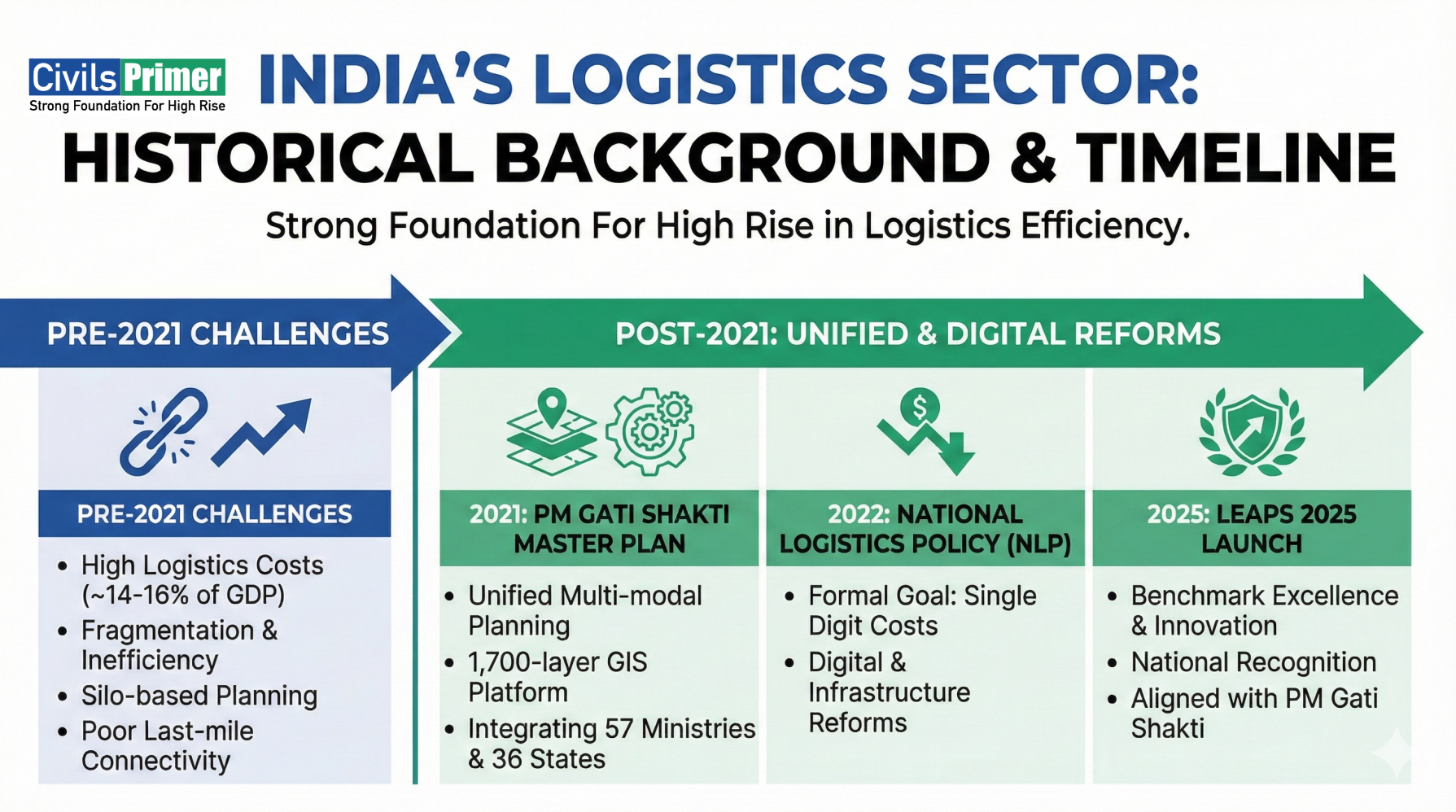
The Problem: For decades, India’s logistics cost was estimated at 13-14% of GDP, rendering Indian exports uncompetitive compared to China (~8-10%) and developed nations (8%).
The Shift (2021-2025):
- PM Gati Shakti (2021): A National Master Plan to break departmental silos and bring 16 ministries onto a digital platform for integrated planning.
- National Logistics Policy (2022): Aimed specifically at process re-engineering and digitization (ULIP).
- LEAPS 2025: The latest step, acting as a benchmarking and recognition mechanism. It is designed to incentivize the private sector to adopt the best practices established by Gati Shakti.
Institutional and Policy Framework
The transformation relies on both digital and physical reforms:
- Digital Platforms: Utilization of platforms like ULIP and Logistics Data Bank provides real-time cargo tracking and data integration, enhancing transparency.
- Physical Connectivity: Completion of Dedicated Freight Corridors (Eastern and Western corridors are 96% operational) and the establishment of Multi-modal Logistics Parks (MMLPs) are crucial for decongesting routes and promoting seamless movement across transport modes.
- The ELI Scheme: The Employment Linked Incentive (ELI) Scheme rewards firms for net job creation in labor-intensive sectors, which includes logistics and infrastructure.
Multidimensional Analysis (UPSC Mains Focus)
Economic Dimension: The Logistics Revolution
- Current Status: A landmark study by NCAER (National Council of Applied Economic Research) recently revised India’s logistics cost down to 7.97% of GDP (FY 2023-24). (This is a critical data point for your answers, challenging the old “13-14%” narrative.)
- LEAPS 2025 (Logistics Excellence, Advancement, and Performance Shield):
- Objective: To create a global benchmark for logistics performance in India.
- Mechanism: It awards and recognizes players across 13 categories (including MSMEs and Startups) who demonstrate innovation and efficiency.
- Impact: By gamifying efficiency, it pushes the industry toward the government’s target of lowering logistics costs to global standards (<8% consistently).
Social Dimension: Inclusive Urbanization
Infrastructure is often criticized for being “elitist.” The current discourse changes this by focusing on “People-Centric Smart Cities.”
- The Urban Disconnect: While logistics improve, urban inequality persists.
- Data: Census 2011 places 17.4% of urban households in slums.
- Current Reality: PLFS 2024-25 data indicates Urban Unemployment is around 6.7%, with a large section of the workforce in the informal sector (gig workers, street vendors).
- Integration: Efficient logistics (LEAPS) creates jobs for the urban low-skilled workforce (delivery partners, warehousing staff). However, without inclusive planning (housing near work, affordable transport), these workers are pushed into slums.
- Remedy: The National Urban Conclave (Nov 2025) emphasized that “Viksit Bharat” requires cities to be resilient and inclusive, integrating the informal workforce into the formal urban planning process.
Governance Dimension: Cooperative Federalism
- PM Gati Shakti is a classic example of Cooperative Federalism. It integrates data from State governments and Central ministries.
- Challenge: Urban planning is a State subject (74th Amendment), often lacking funds. Central schemes like LEAPS and Gati Shakti provide the framework, but execution depends on Urban Local Bodies (ULBs) capacity.
Issues, Challenges & Gaps in Implementation
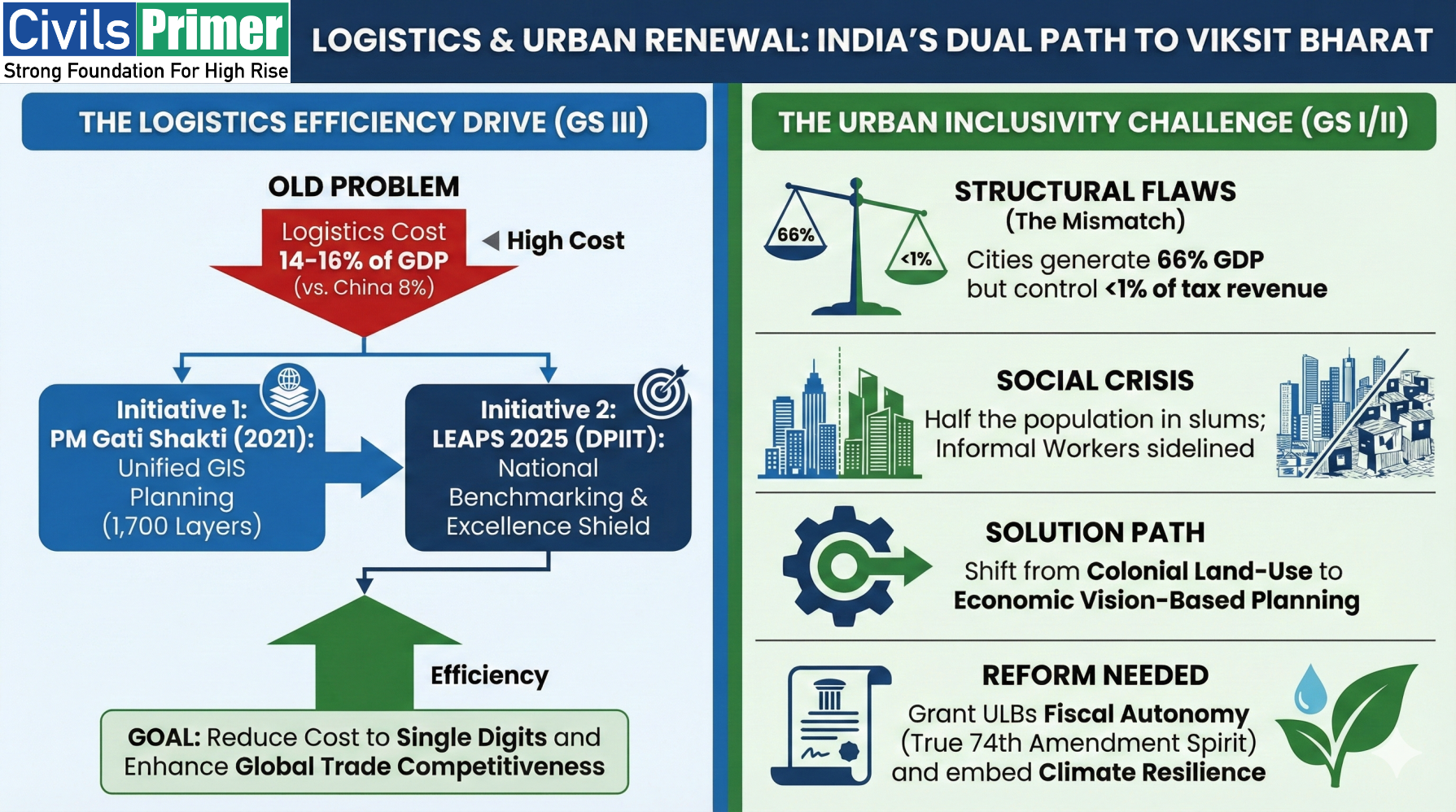
- High Logistics Cost and Global Competition: Despite Gati Shakti, logistics costs remain at 14–16% of GDP, indicating a sustained gap compared to rivals, which erodes India’s global trade competitiveness.
- Infrastructure and Skill Deficits in Logistics: The sector suffers from poor last-mile connectivity, port congestion, and a lack of trained manpower in digital supply chain management, weakening operational efficiency.
- Fiscal Centralization Post-GST: The over-centralization of taxes post-GST has amplified the revenue–responsibility mismatch, crippling city finances and hindering the spirit of the 74th Amendment.
- Exclusion of Informal Workers: Urban planning, despite the goals of the Smart Cities Mission, frequently ignores the needs of the informal workers who constitute over half the urban workforce, leading to displacement and rising costs.
- Climate and Disaster Vulnerability: Urban frameworks remain insufficient in embedding climate adaptation and disaster preparedness, despite the increasing frequency of floods and heatwaves.
- Administrative Fragmentation: Responsibilities for urban development and disaster management remain fragmented among multiple ministries and state agencies, leading to coordination delays and inconsistent policy execution
Way Forward / Visionary Recommendations
- Integrated Economic and Spatial Planning: Modernize outdated Town Planning Acts to legally integrate economic blueprints (identifying growth sectors) with physical and spatial planning.
- Fiscal Decentralization and Autonomy: Empower ULBs by legally guaranteeing predictable, untied fiscal transfers and allowing the securitization of revenue shares (e.g., GST compensation) as bond collateral to attract private financing.
- Green and Resilient Infrastructure: Embed climate-resilient frameworks and green logistics (biofuels, electric/hydrogen transport) into Gati Shakti corridors and urban master plans to meet sustainability goals.
- Skilling for Logistics: Establish national logistics universities and industry-linked training hubs to address the severe skill deficit in digital supply chain management and automation, critical for leveraging LEAPS 2025.
- Formalization and Social Protection: Design urban policies that recognize and integrate informal workers, strengthening social security coverage (Social Security Code, 2020) and providing climate-proof housing and accessible transport.
- Governance Reform: Strengthen vertical coordination between ULBs and state agencies, grant greater functional autonomy, and adopt digital tools for governance-linked credit ratings, moving beyond mere revenue metrics
Previous Year Questions (PYQs) : UPSC Prelims and Mains
Prelims
- 2023: With reference to the National Logistics Policy (2022), consider the following statements… (Focused on the objective of reducing logistics cost).
- 2022: “Gati-Shakti” is a digital platform… (Asked about the 7 engines of growth).
Mains
- GS III (2022): “Why is Public Private Partnership (PPP) required in infrastructural projects? Examine the role of PPP model in the redevelopment of Railway Stations in India.”
- GS I (2023): “Does urbanization lead to more segregation and/or marginalization of the poor in Indian metropolises?”
- GS III (2022): “Is inclusive growth possible under market economy? State the significance of financial inclusion in achieving economic growth in India.”
Mains Answer Writing Guidance
Mock Question 1: “Infrastructure development is the engine of economic growth, but inclusive urban planning is its steering wheel. Discuss this statement in the context of the recently launched LEAPS 2025 and the challenges of urbanization in India.” (15 Marks, 250 Words)
Structure of the Answer:
Introduction:
Start with the NCAER data (logistics cost at ~7.97%) and mention LEAPS 2025 as a tool to accelerate efficiency.
Define the link: Infrastructure creates wealth; Urban planning determines who shares it.
Body Paragraph 1: Infrastructure as the Engine (The Economic view)
Discuss PM Gati Shakti and LEAPS.
Explain how reducing logistics costs makes Indian manufacturing competitive (Make in India).
Key Term: “Logistics Performance Index (LPI)” – India’s rank improved to 38 (World Bank 2023).
Body Paragraph 2: Urban Planning as the Steering Wheel (The Social view)
Highlight that logistics rely on human labor.
Discuss the challenge: Slum proliferation (cite 17.4% data). If we build warehouses but not affordable housing, we create “exclusionary cities.”
Mention Sustainable Development Goal 11 (Sustainable Cities and Communities).
Body Paragraph 3: The Way Forward (Synthesis)
Multi-modal connectivity (Gati Shakti) must extend to public transport for the poor.
Housing for All (Urban) must be integrated with industrial corridors.
Conclusion: Conclude with the vision of Viksit Bharat 2047. Infrastructure provides speed (Gati), but inclusive policies provide direction (Shakti/Strength).
Mock Question 2: The twin goals of reducing logistics costs and promoting sustainable urban development are central to India’s $5 trillion economy ambition. Analyze how initiatives like PM Gati Shakti address the former, while structural flaws in urban fiscal architecture challenge the latter. (250 words)
| Answer Component | Content Points to Include |
| Introduction | Define the goal (Viksit Bharat/economic competitiveness). State the two key policy pillars: Gati Shakti (Infrastructure/GS III) and Urban Planning Reform (Inclusivity/GS I). |
| Body 1: Gati Shakti and Cost Efficiency (GS III) | Goal: Reduce logistics costs from 14–16% to single digits. Mechanism: Unified planning via 1,700-layer GIS platform. Benchmarking: LEAPS 2025 rewards efficiency. Challenge: High cost persists; need for green logistics and skill development. |
| Body 2: Urban Fiscal and Inclusivity Challenge (GS I/II) | Structural Flaw: Detail the revenue–responsibility mismatch (66% GDP vs <1% tax). Social Cost: Half the urban population lives in slums; reforms sideline informal workers. |
| Body 3: Way Forward (Institutional Fixes) | Fiscal Fix: Grant ULBs greater autonomy and legally guarantee transfers (74th Amendment spirit). Planning Fix: Shift from colonial land-use model to economic vision-based planning. Sustainability: Embed climate resilience and green infrastructure mandates. |
| Conclusion | Synthesis: Economic efficiency (logistics) must be matched by social and fiscal justice (urban planning). Resilient cities are essential engines for national competitiveness. |
Prelims Key Pointers (The “Cheat Sheet”)
| Concept | Key Fact/Definition |
| LEAPS 2025 | Full Form: Logistics Excellence, Advancement, and Performance Shield. Ministry: Ministry of Commerce & Industry (DPIIT). Goal: Benchmark and award logistics players; promote private sector efficiency. |
| PM Gati Shakti | Launched Oct 2021. 7 Engines: Roads, Railways, Airports, Ports, Mass Transport, Waterways, Logistics Infra. Powered by: BISAG-N (Bhaskaracharya National Institute for Space Applications and Geo-informatics). |
| Logistics Cost | New Data (NCAER): 7.97% of GDP (FY24). Old Estimate: 13-14%. Global Benchmark: ~8% (Developed nations). |
| Urban Stats | Slum Population: ~17.4% (Census 2011). Urban Unemployment: ~6.7% (PLFS 2024-25). 74th Amendment: Constitutional status to Urban Local Bodies (Municipalities). |
| NCAER | National Council of Applied Economic Research (Non-profit think tank). |
Important Data Points
Urban areas contribute 63% of India’s GDP (projected 75% by 2047) but Municipalities control less than 1% of total tax revenue.
India’s urbanization is rapidly accelerating, with the urban population expected to rise to 50% by 2047 and contribute 75% of GDP.
The Slum Paradox: Nearly half of India’s urban population lives in slums, lacking secure living conditions and basic services like safe drinking water and sanitation
Logistics costs in India remain 14–16% of GDP, compared to China’s 8% and the US’s 6–8%.
