
Syllabus Link
UPSC CSE GS II: Bilateral, regional and global groupings and agreements involving India and/or affecting India’s interests; Important International institutions, agencies and fora, their structure, mandate.
Definition and Core Concepts (The Static Pillar)
| Concept | Definition for UPSC Exams Clarity |
| Multilateralism | The cooperation among three or more states based on established rules and principles. India’s participation in groups like the UN, Quad, and BRICS reflects this commitment. |
| Strategic Autonomy | A nation’s ability to make sovereign foreign policy and defence decisions without being constrained by external pressures or alliances. It manifests today as Multi-alignment—engaging flexibly with multiple powers simultaneously. |
| Multipolarity | A world order where several states possess roughly comparable levels of power, offering greater fluidity and options in external relations. India aims to be an independent pole in this evolving global order. |
| ASEAN Centrality | The principle that ASEAN (Association of Southeast Asian Nations) must remain the primary driving force for regional cooperation and stability in the Indo-Pacific. India strongly supports this principle. |

Historical Evolution / Background / Timeline
- India’s engagement has evolved significantly, particularly in the post-Cold War era and with the rise of global challenges like climate change and digital transformation.
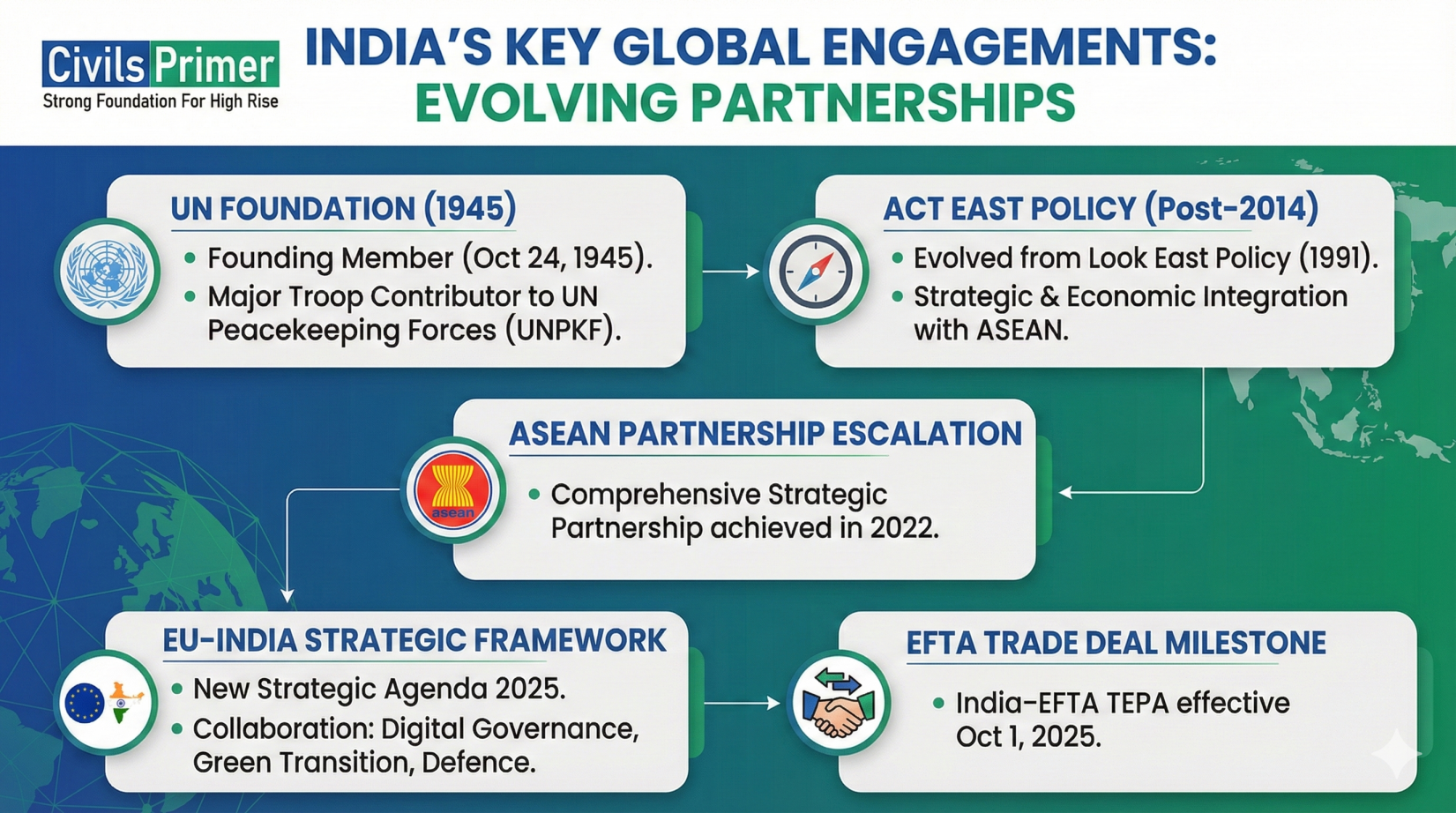
- UN Foundation (1945): India was a founding member of the UN. The UN was established on October 24, 1945, marking its 80th anniversary in 2025. India remains one of the largest and most consistent troop contributors to UN Peacekeeping Forces (UNPKF).
- Act East Policy (Post-2014): India’s earlier Look East Policy (1991) transitioned into the more action-oriented Act East Policy (2014), solidifying strategic, economic, and cultural integration with ASEAN.
- ASEAN Partnership Escalation: India’s relationship with ASEAN has continuously deepened, achieving a Comprehensive Strategic Partnership in 2022.
- EU–India Strategic Framework: The latest framework, the EU–India New Strategic Agenda 2025, builds upon the 2020 Roadmap, expanding collaboration into critical areas like digital governance, green transition, and defence.
- Trade Deal Milestone: The India–European Free Trade Association (EFTA) Trade and Economic Partnership Agreement (TEPA) came into effect on October 1, 2025
Legal / Institutional Framework of India’s Strategic Multilateralism
| Institution/Group | Framework and Recent Status | Prelims Pointers |
|---|---|---|
| UN Human Rights Council (UNHRC) | Nodal Body: UN General Assembly. Established: 2006. India re-elected unopposed for the 2026–2028 term (7th tenure). | UNHRC HQ: Geneva. India elected for 2026–28. |
| ICAO Council | Nodal Body: UN Specialized Agency. Established: 1944 (Chicago Convention). India re-elected to Part II (states contributing largest facilities for international civil air navigation) for 2025–2028 term. | India is a founding member (1944), presence uninterrupted for 81 years. |
| India–ASEAN | Governed by the Comprehensive Strategic Partnership (2022) and the ASEAN-India Plan of Action (2026–2030). The AITIGA (Trade in Goods, 2010) is currently under review. | ASEAN: 11 Members (East Timor joined 2025). |
| India–EU | Governed by the New Strategic Agenda 2025. Trade framework set by TEPA (Trade and Economic Partnership Agreement) with EFTA. | EFTA members pledged USD 100 billion investment over 15 years. |
Case Studies, Examples
- UNSC Veto Paralysis: The UN Security Council’s P5 members frequently use their veto power, crippling decision-making in major conflicts like Ukraine and Palestine. This demonstrates the UN’s structural flaws and the erosion of its credibility, forcing countries like India to rely on flexible alternatives like the G20 or BRICS.
- Carbon Border Adjustment Mechanism (CBAM) Linkage: The EU–India Strategic Agenda (2025) agreed to link India’s Carbon Credit Trading Scheme (ICM) with the EU’s CBAM. This aims to provide trade relief (carbon price deductions) for Indian exporters. However, the institutional weakness and price disparity of India’s carbon market risk non-recognition and future trade friction.
- India’s UN Peacekeeping Leadership: India hosted the UNTCC Chiefs’ Conclave 2025, using this platform to advocate for greater TCC (Troop Contributing Country) involvement in mission planning. India’s policy of “No National Caveats” ensures impartiality and strengthens its moral and strategic position as a leader in global security.
Government Initiatives & Policies (Domestic Leverage)
India consistently leverages its domestic policies to enhance its bargaining power in international forums:
- Digital Public Infrastructure (DPI): India’s success with UPI and the UPI-PayNow linkage (with Singapore) is marketed globally, positioning India as a leader in digital innovation and enhancing fintech cooperation with partners.
- Aatmanirbhar Bharat (Self-Reliance): The push for indigenization, including the development of defence equipment (e.g., Defence Procurement Manual 2025), reinforces India’s strategic autonomy by reducing dependence on external powers for critical supplies.
- Green Transition Policy: India’s commitment to the International Solar Alliance (ISA) and the goal of 1,000 GW solar capacity globally provides a foundation for green partnership expansion with the EU and Singapore.
- Infrastructure (PM Gati Shakti): Improving logistics efficiency (via initiatives like LEAPS 2025) aims to enhance export competitiveness, which is crucial for leveraging trade agreements like TEPA and the AITIGA review.
India’s multilateral pursuit faces high-impact structural and geopolitical risks: Challenges
- Risk of Geopolitical Overstretch: India’s multi-alignment strategy requires simultaneous engagement with rival blocs (US-EU on one side, Russia-China on the other), straining diplomatic bandwidth and risking isolation if great powers prioritize their interests.
- Trade Protectionism and Trade Imbalance: Review of the AITIGA is slow due to protectionist tendencies and procedural delays. Similarly, the EU’s CBAM is viewed by some as protectionist, raising political tensions at the WTO. India’s trade deficit with ASEAN remains wide.
- Domestic Readiness Gap for Global Commitments: India’s institutional weakness in areas like carbon markets (low prices, lack of binding caps under CCTS) and slow bureaucratic processes limit India’s ability to maximize external openings (e.g., maximizing the USD 100 billion investment pledged under TEPA).
- Critical Mineral and Technological Dependence: Despite securing seabed exploration contracts (e.g., Polymetallic Sulphides in Carlsberg Ridge), India remains dependent on major powers for high-end technology and critical minerals, limiting its true strategic autonomy.
- UN Accountability and TCC Voice: Despite India’s role as a major Troop Contributing Country (TCC), TCCs often lack a decisive say in mission planning, which India advocates must be reformed
Stakeholders & Their Roles
| Stakeholder | Role in India’s Multilateral Strategy |
|---|---|
| Government (MEA, MoD, Commerce Ministry) | Responsible for strategic alignment (Strategic Autonomy/Multi-alignment), negotiating trade deals (TEPA, AITIGA review), and defense partnerships (Combined Commanders’ Conference). |
| Global South/Developing Nations | India projects itself as the “voice of the Global South,” enhancing its diplomatic importance by championing issues like equitable climate finance (UNEP Adaptation Gap Report) and equitable trade policies. |
| Industry & Private Sector | Must leverage market access created by FTAs (TEPA, AITIGA) and invest in R&D and manufacturing to meet quality standards (e.g., WHO-GMP alignment for pharmaceuticals) and technology demand (AI, 6G). |
| International Organizations (UN, ICAO, UNHRC) | Provide platforms for setting global standards (safety, human rights), enforcing international law, and allowing India to exercise influence without alignment with a single bloc. |
Way Forward / Visionary Recommendations
- UN Structural Reform: Advocate for democratization within the UN, ensuring Troop Contributing Countries (TCCs) have a decisive voice in mission planning and mandate setting.
- Economic Diplomacy and Trade Fixes: Fast-track the AITIGA review and expand cooperation in services and digital trade with ASEAN. Ensure implementation of the USD 100 billion EFTA investment commitment.
- CBAM Alignment Strategy: Establish independent carbon regulators and capacity-building mechanisms to align India’s CCTS with international standards, negotiating a floor carbon price to protect exporters from double taxation.
- Strengthening Internal Agility (The “Home Reform”): Match external dynamism with internal modernization by creating autonomous research clusters and streamlining bureaucratic processes (e.g., single-window portals for research and projects) to maximize FDI uptake.
- Technological Sovereignty: Focus on joint development of critical and emerging technologies (6G, AI, quantum) with trusted partners (EU, UK) to secure digital public infrastructure and reduce dependence on any single source.
- Humanizing Global Security: Continue India’s unique blend of morality and modernity in UN peacekeeping—promoting gender and regional inclusivity (e.g., all-women contingents) and utilizing technology for safety and transparency.
Mains Question Mapping (GS II: IR, GS III: Economy)
Question Example: India’s multi-alignment strategy in a multipolar world presents both diplomatic flexibility and economic risk. Analyze this dichotomy in the context of India’s engagement with the EU and ASEAN. (250 words)
| Introduction | Define Strategic Autonomy / Multi-alignment. State the goal: balancing security and economic interests in a multipolar world (which is often less stable). |
| Body 1: Opportunities (Flexibility & Economy) | EU: Access to market and technology; TEPA (EFTA) brings USD 100 billion investment; CBAM linkage models North-South climate cooperation. ASEAN: Strategic partner in Indo-Pacific; 2026 Year of Maritime Cooperation. |
| Body 2: Challenges (Risks & Structural Gaps) | Geopolitical Overstretch: Strains diplomatic bandwidth, risks isolation. Trade Risk: Slow AITIGA review and wide trade deficit with ASEAN. Climate Risk: Indian carbon market is weak, risking future CBAM friction. UN Weakness: Veto paralysis forces reliance on unstable alternatives. |
| Body 3: Way Forward (Internal Reforms) | Need to prioritize internal administrative and institutional agility (Curricular Updates, Autonomous Research Clusters). Fast-track trade reviews and ensure domestic policy coherency (e.g., in critical minerals) to maximize external openings. |
| Conclusion | Final Statement: India must transform geopolitical flux into global leadership by matching external dynamism with decisive internal reform, thereby achieving genuine strategic autonomy. |
Prelims Crisp Pointers for UPSC CSE 2026
| Institution / Group / Agreement | Key Fact / Date / Data |
|---|---|
| ICAO Council | India re-elected to Part II (2025–2028). Founded 1944 (Chicago Convention). |
| UN Human Rights Council (UNHRC) | India elected for 2026–2028 term (7th tenure). Established 2006. |
| India–ASEAN Maritime Cooperation | 2026 designated as the “ASEAN–India Year of Maritime Cooperation”. |
| ASEAN Membership | Currently 11 member states (East Timor joined 2025). |
| EFTA–India TEPA | Came into effect October 1, 2025. EFTA committed USD 100 billion investment over 15 years. |
| China WTO Complaint | Filed against India over EV and battery subsidies (PLI). |
| UN Peacekeeping | India hosted the UNTCC Chiefs’ Conclave 2025 |
