Syllabus Link
GS III: Indian Economy and issues relating to planning, mobilization of resources, growth, development and employment; Inclusive growth and issues arising from it.
The topic sits at the intersection of GS III (Economy), GS II (Governance/Human Resources), and GS I (Society).
Introduction: The “Two-India” Paradox
India currently faces a unique paradox: The headline Unemployment Rate has dropped to a historic low of 3.2% (PLFS 2023-24), yet the Employability Crisis is peaking, with reports indicating that massive segments of the educated workforce are “unemployable.”
The central narrative for UPSC aspirants should not just be “joblessness” but “Job Mismatch” and “Overqualification.” As the Economic Survey 2024-25 notes, while we have quantity (numbers), we severely lack quality (skills), threatening to turn our Demographic Dividend (65% of population < 35 years) into a Demographic Liability.
Core Concepts & Definitions (Static)
- Labour Force Participation Rate (LFPR): The percentage of persons in the labor force (working or seeking work) in the population. (Current: 61.2% – PLFS 2023-24).
- Worker Population Ratio (WPR): The percentage of employed persons in the population.
- Structural Unemployment: A mismatch between the skills workers possess and the skills the economy needs (e.g., A history graduate applying for an AI coding job).
- Disguised Unemployment: When more people are employed than needed (common in Indian Agriculture).
- Underemployment/Overqualification: When highly educated individuals work in low-skill jobs (e.g., PhDs applying for peon posts).
The Crisis in Numbers: Latest Data Bank (UPSC Mains Fodder)
| Indicator | Statistic | Analysis |
| Unemployment Rate | 3.2% (Down from 6% in 2017) | Indicates quantity recovery, but masks low quality/unpaid work. (PLFS 2023-24) |
| Employability | 54.8% | Slight improvement, yet nearly half the workforce is not “job-ready.” (India Skills Report 2025) |
| Skill Mismatch | Only 8.25% of graduates have jobs matching their qualification. | Critical Fact: 53% of graduates are in roles below their education level. (Economic Survey 2024-25) |
| Female LFPR | 41.7% | Sharp rise, but largely driven by rural self-employment (unpaid family labor). [PLFS 2023-24] |
| Educated Unemployment | Unemployment is highest among youth (15-29) at 10%. | The “Education Penalty”: The more educated you are, the harder it is to find a suitable job. [PLFS/ILO Report] |
Constitutional / Legal / Institutional Framework
| Domain | Legal Framework | Provisions |
|---|---|---|
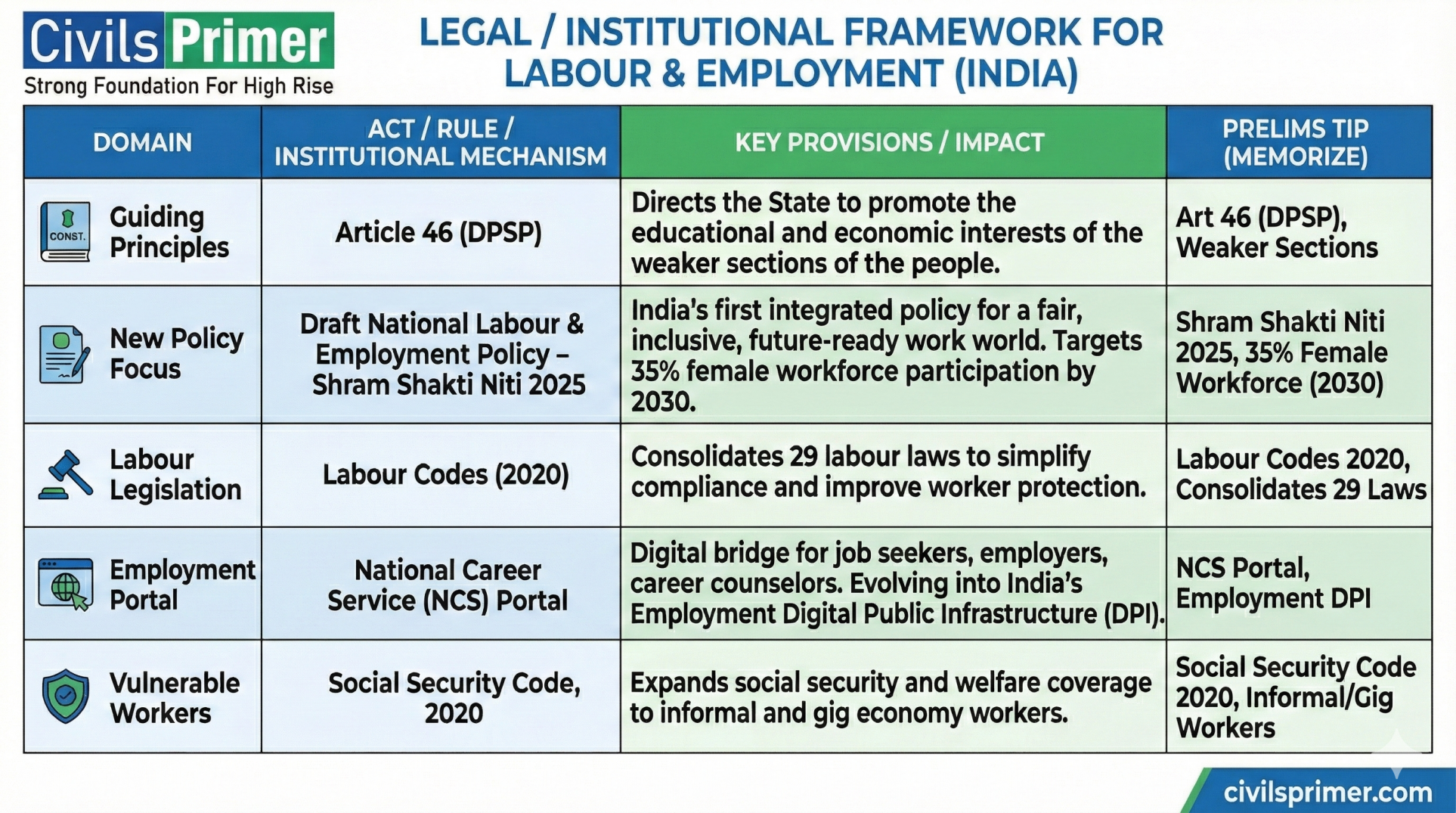
| Guiding Principles | Article 46 (DPSP) | Directs the State to promote the educational and economic interests of the weaker sections of the people. |
| New Policy Focus | Draft National Labour & Employment Policy – Shram Shakti Niti 2025 | India’s first integrated policy, aiming for a fair, inclusive, and future-ready world of work, with a target of 35% female workforce participation by 2030. |
| Labour Legislation | Labour Codes (2020) | Consolidates 29 labour laws to simplify compliance and improve worker protection. |
| Employment Portal | National Career Service (NCS) Portal | Provides a digital bridge between job seekers, employers, and career counselors, and is evolving into India’s Employment Digital Public Infrastructure (DPI). |
| Vulnerable Workers | Social Security Code, 2020 | Expands social security and welfare coverage to informal and gig economy workers |
Structural Causes & Historical Context
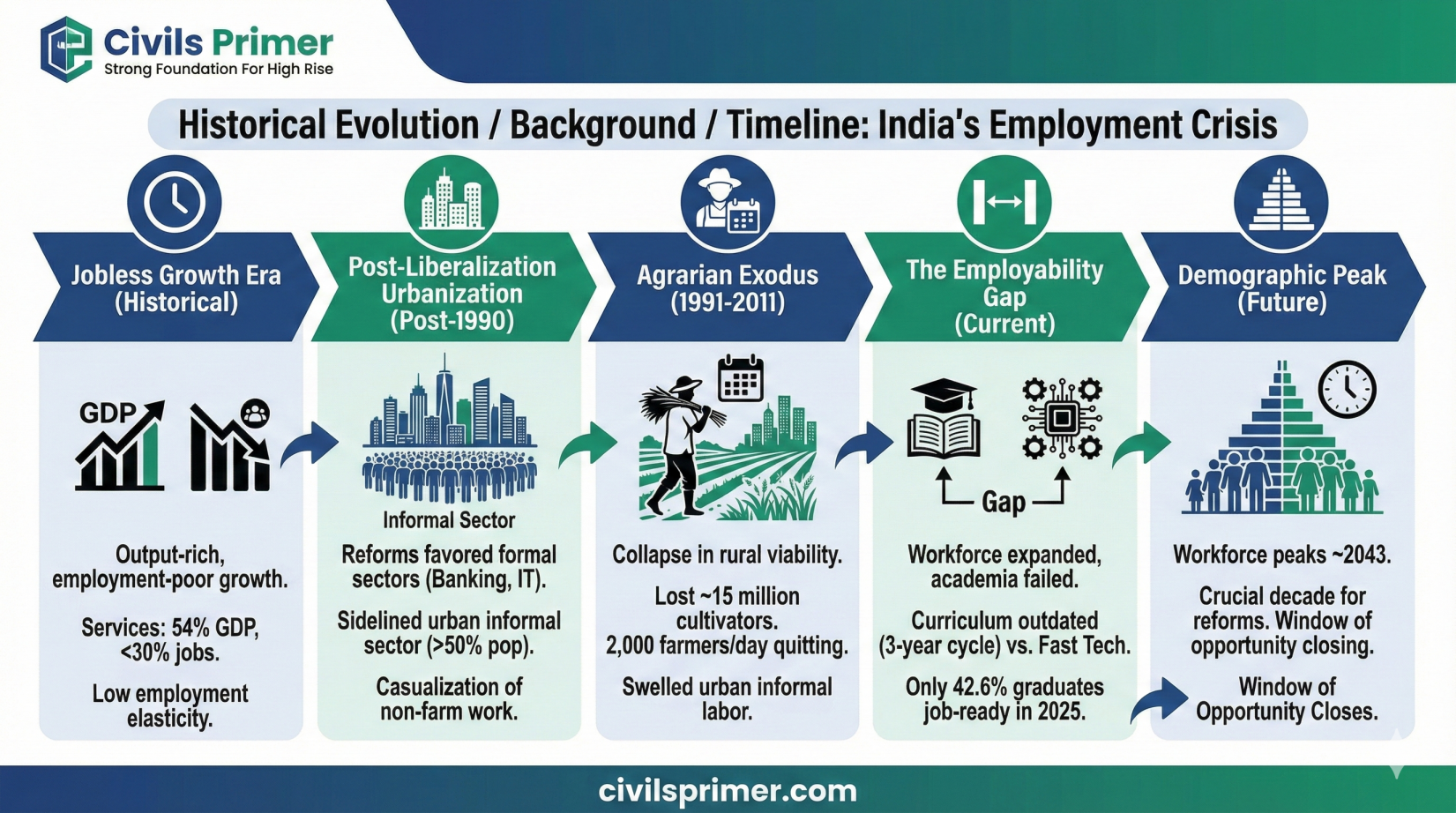
- The “Missing Middle” (Industrial Stagnation): Historically, developing nations transition from Agriculture -> Manufacturing -> Services. India skipped Manufacturing, jumping directly to High-Skill Services (IT/Banking). This created a gap where the masses leaving agriculture had no low-skill manufacturing jobs to absorb them.
- Jobless Growth (1991-2015): While GDP grew at 7-8%, employment elasticity was close to zero. Capital-intensive growth (machinery replacing men) meant higher output did not equal higher employment.
- Curriculum Stagnation: The India Skills Report highlights that while industry cycles change every 6 months (due to AI/Tech), academic curricula change every 3-5 years.
Case Studies: The Human Cost
Case Study 1: The “Overqualification” Trap (The Peon Crisis)
- Context: In recent recruitment drives in Haryana and Uttar Pradesh, thousands of Postgraduates, B.Techs, and PhDs applied for ‘Helper’ or ‘Sanitation’ roles.
- Relevance: This exemplifies the Economic Survey’s finding that 53% of graduates work below their level. It leads to frustration, wage depression, and “scarring” of human capital.
Case Study 2: The IIT Placement Shock (2024)
- Context: In 2024, nearly 30-40% of students in some older IITs remained unplaced during initial rounds.
- Relevance: Demonstrates that the crisis is no longer limited to Tier-2/3 colleges; even the “cream” of the workforce faces demand-side sluggishness due to global headwinds and AI automation.
Case Study 3: Suicides Among Unemployed Youth
- NCRB data from 2023 reported 14,000 suicides among unemployed youth. Lesson: Joblessness fuels significant social discontent and mental health issues, highlighting the severe human cost of the crisis and the link between economic failure and social instability
Government Initiatives (The Policy Response)
A. Employment Linked Incentive (ELI) Scheme (Budget 2024-25)
A game-changer aimed at formalizing jobs.
- Scheme A (First Timers): 1-month wage subsidy (up to ₹15,000) for new entrants in the formal workforce (EPFO registered).
- Scheme B (Manufacturing): Incentives for job creation specifically in the manufacturing sector.
- Scheme C (Support to Employers): Reimbursement of employers’ EPFO contribution for additional employment.
B. Skilling & Education
- PMKVY 4.0: Focuses on “Industry 4.0” skills like AI, Drone Technology, and Coding.
- PM-SETU (Proposed): Upgrading ITIs via a Hub-and-Spoke model to standardize quality across districts.
- Skill India Digital Hub: A unified portal to find training, credit, and jobs.
C. Proposed Frameworks
- Draft National Policy on Employment (Shram Shakti Niti): A proposed holistic roadmap targeting social security for gig workers and linking skilling directly to local industrial clusters.
Key Issues & Challenges (Critical Analysis)
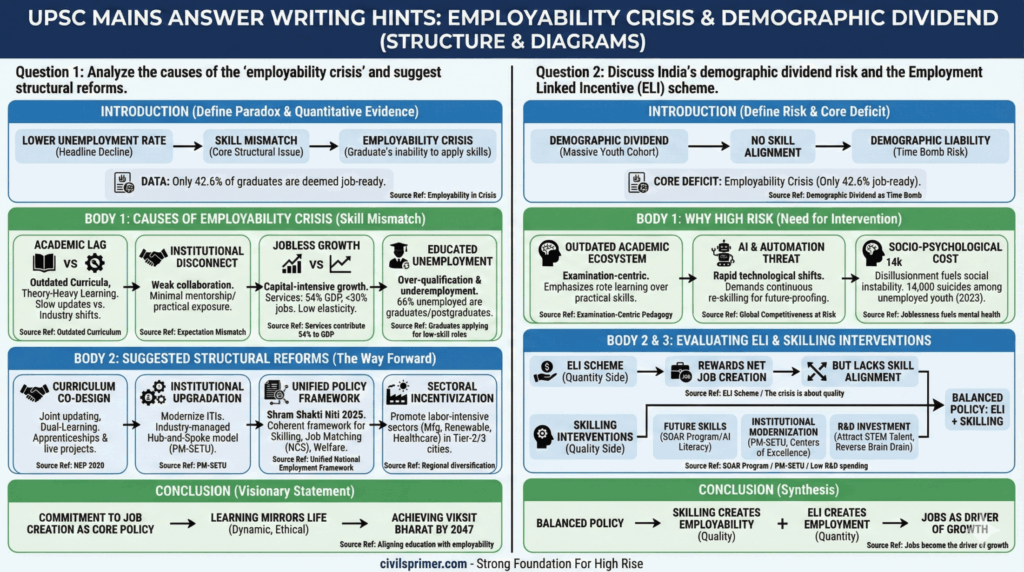
- Skill Mismatch and Curricula Lag (Employability Crisis): Only 42.6% of graduates are deemed job-ready, and 33% cite their skills as misaligned with industry needs. This is driven by outdated curricula and bureaucratic inertia in updating academic syllabi.
- AI & Automation Threat: The World Economic Forum warns that clerical and BPO jobs—India’s entry-level staples—are most at risk from Generative AI
- The “Paper Degree” Syndrome: Indian degrees often signal “time spent” rather than “skills acquired.” The unemployability of engineers (often cited at >60%) is a failure of the AICTE/UGC regulatory framework.
- Educated Unemployment: Graduates and postgraduates form 66% of India’s unemployed. The phenomenon of over-qualification (e.g., highly qualified individuals applying for peon jobs) wastes potential and creates fiscal strain on public job schemes.
- Jobless Growth and Informality: Despite high growth in Gross Value Added (GVA), capital-intensive modern services generate limited formal jobs. Consequently, over 80% of India’s workforce remains informal, lacking social protection and labor rights.
- Persistent Gender Disparity: The Female Labour Force Participation Rate (FLFPR) remains below 35%, reflecting structural barriers like safety concerns, limited transport support, and social constraints that restrict educated women from seeking private sector jobs.
- Fragmented Implementation of Skilling Missions: Programs like PMKVY, Skill India, and SANKALP often function in silos, weakening coordination and policy outcomes. Furthermore, the private sector often views academia as outdated, leading to minimal collaboration.
- Regional and Sectoral Imbalance: Job growth is concentrated geographically in metros and sectorally in low-wage traditional services. Educated unemployment in states like Bihar and Jharkhand exceeds 35%. High-quality jobs are clustered in 5-6 metros (Bangalore, Hyderabad, NCR, Pune). The youth in the “Hindi Heartland” (Bihar, UP) are forced into distress migration.
- The “K-Shaped” Recovery: Corporate profits have soared to a 15-year high (Economic Survey), but real rural wages have remained stagnant. Growth is visible in balance sheets, not in paychecks.
- Socio-Psychological Costs: The mismatch between youth expectations and reality fuels youth disillusionment and social instability. This crisis is linked to rising suicide rates among the unemployed.
- Data Deficiency: Fragmented and outdated employment statistics (e.g., issues with PLFS metrics) obstruct evidence-based policymaking, leading to policy coherence challenges
Way Forward: Visionary Solutions
- Apprenticeship as a Right: Move from “Right to Education” to “Right to Apprenticeship”. Mandate that every graduate degree must have a 6-month industry-graded internship (Germany Model).
- Localize Jobs (ODOP): Leverage One District One Product (ODOP) to create micro-manufacturing hubs in Tier-2/3 cities, absorbing local youth near their homes.
- Care Economy: Invest heavily in the Care Economy (Geriatric care, Childcare). It is labor-intensive, cannot be automated by AI, and supports increasing Female LFPR.
- Rebrand “Vocational”: Destigmatize vocational education. Integrate it into mainstream schooling (as per NEP 2020) so a carpenter is respected as a skilled professional, not a dropout.
UPSC Civil Services 2026 Prelims Facts (Don’t Miss)
- Data Trap: If a statement says “Unemployment is steadily rising,” it is False. It has declined to 3.2% (PLFS). The issue is quality, not rate.
- Agency: NSO (National Statistical Office) releases the PLFS.
- Scheme: ELI is under the Ministry of Labour & Employment (budgetary announcement), while PMKVY is under Ministry of Skill Development.
- Gig Workers: The Code on Social Security, 2020 is the first law to define and recognize “Gig Workers” and “Platform Workers”.
UPSC Mains Question Bank
- “While the headline unemployment rate in India has declined, the data on ‘skill mismatch’ presents a worrying picture. Analyze the causes of the ’employability crisis’ and suggest structural reforms.”
- “India’s demographic dividend is at risk of becoming a demographic liability without urgent skilling interventions. Discuss in the light of the Employment Linked Incentive (ELI) scheme.”