
The Earth’s Fury and Majesty: A Tale of Fire and Stone #
Imagine the Earth not as a solid rock, but as a pot of thick soup boiling on a stove. The “soup” is the semi-molten rock in the Mantle (specifically the Asthenosphere), and the “crust” we live on is just a thin layer of dry skin floating on top. Occasionally, this soup boils over, or the skin wrinkles and cracks. These movements of the earth’s interior—the Endogenic Forces—are the authors of the two most spectacular features on our planet: Volcanoes (the fire) and Mountains (the stone).
Part 1: Volcanoes – The Fire Breathers #
The Escape Artist: Magma vs. Lava Deep inside the Earth, it is hot. When rocks melt, they become Magma. This magma is restless; it wants to rise because it is lighter than the solid rocks around it. When it finally breaks through the crust and reaches the surface, it changes its name to Lava. A volcano is simply the vent or fissure through which this lava, along with ash and gases (like Nitrogen, Sulphur, and Carbon dioxide), escapes.
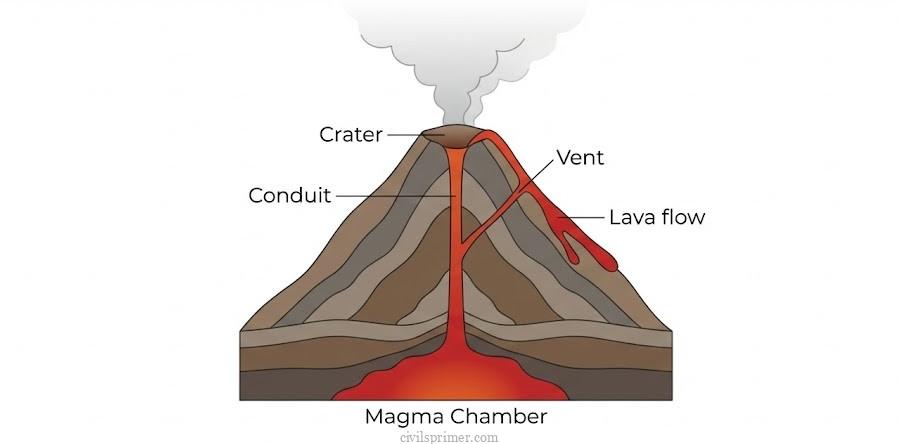
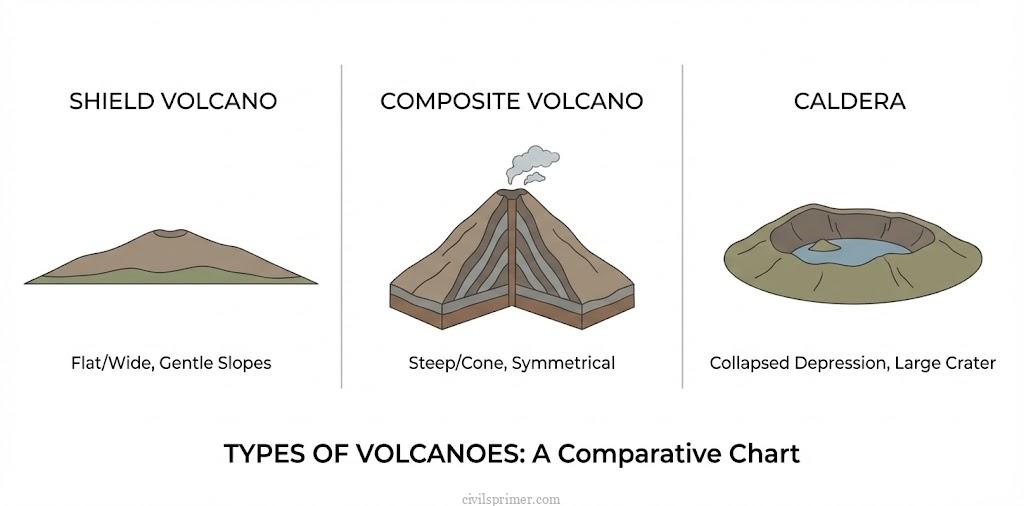
Types of Volcanoes: Not all volcanoes behave the same way. Their personality depends on the “thickness” (viscosity) of their lava, which is determined by Silica content.
- Shield Volcanoes (The Gentle Giants): Imagine pouring water on a table. It spreads out fast and far. This is Basaltic Lava (low silica). It is very fluid and hot. Volcanoes formed by this lava are not very steep but are huge and spread out, looking like a warrior’s shield lying on the ground. Famous Example: Mauna Loa in Hawaii. These eruptions are rarely explosive unless water gets into the vent.
- Composite/Strato Volcanoes (The Angry Cones): Now imagine squeezing thick toothpaste. It piles up and doesn’t flow far. This is Andesitic/Acidic Lava (high silica). It is viscous and sticky. It creates steep, tall, conical mountains. Because the lava plugs the vent, pressure builds up until—BOOM!—it explodes violently. Famous Examples: Mt. Fuji (Japan), Mt. Vesuvius (Italy), Mt. Stromboli (The Lighthouse of the Mediterranean).
- Calderas (The Collapsed Monsters): Sometimes, a volcano erupts so much magma so quickly that the ground underneath it becomes empty. The whole mountain collapses into this empty chamber, forming a massive depression called a Caldera. These are the most explosive volcanoes on Earth. Example: Lake Toba in Indonesia (a supervolcano).
- Flood Basalt Provinces (The Carpet Layers): Sometimes, lava doesn’t come out of a single hole but pours out of long cracks (fissures) in the ground. It floods the land, layer after layer, for millions of years, creating thick plateaus. Star Example: The Deccan Traps in India (covering Maharashtra). It was formed by the Reunion Hotspot volcanic activity.
- Mid-Ocean Ridges (The Hidden Builders): The longest chain of volcanoes isn’t on land; it is underwater, stretching 70,000 km through the ocean basins. Here, plates pull apart, and lava rises to create new ocean floor.
Part 2: Mountains – The Earth Wrinkles #
While volcanoes build up by piling lava, mountains are often built by the Earth’s crust smashing together.
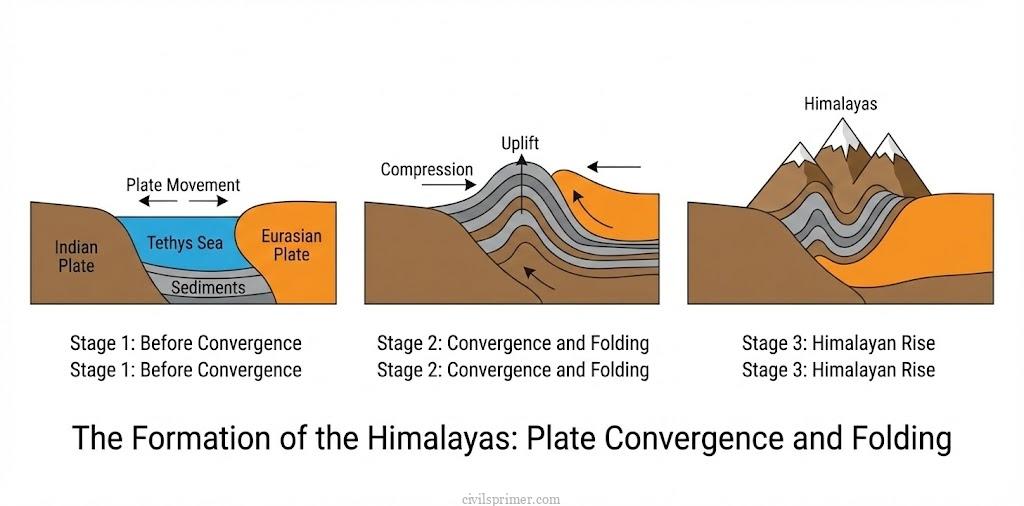
1. Fold Mountains( The Crumpled Rugs): Imagine pushing a rug from both ends towards the center. It wrinkles up. This is exactly how Fold Mountains are born. They form when two tectonic plates collide (Compressional Force).
- The Young Ones (Alpine Fold Mountains): These are young, rugged, and very high.
- The Himalayas: Formed when the Indian Plate crashed into the Eurasian Plate (Continent-Continent collision). The sediments of the ancient Tethys Sea were squeezed up to form these peaks.
- The Andes & Rockies: Formed when oceanic plates crashed into continental plates (Continent-Ocean Convergence).
- The Old Ones: These are ancient mountains, now worn down and rounded by erosion. Examples: The Aravallis (India), the Appalachians (USA), and the Urals (Russia).
2. Block Mountains (The Broken Blocks) Imagine holding a block of cheese and pulling it apart. It cracks. In geology, when the crust cracks (faults) due to tension, some blocks go up and some go down.
- Horst: The block that stays up (The Mountain).
- Graben: The block that drops down (The Rift Valley).
- Examples: The Vosges mountains (Horst) and the Rhine Valley (Graben) in Europe. In India, the Satpura ranges are block mountains, while the Narmada flows in a rift Valley.
3. The Leftovers (Residual/Relict Mountains) These are mountains that have been worn down by wind, rain, and ice for millions of years. They are the “remainders” of huge ancient mountains. Example: The Aravalli Hills in India and the Highlands of Scotland.
Part 3: The Indian Saga #
Let’s zoom into India.
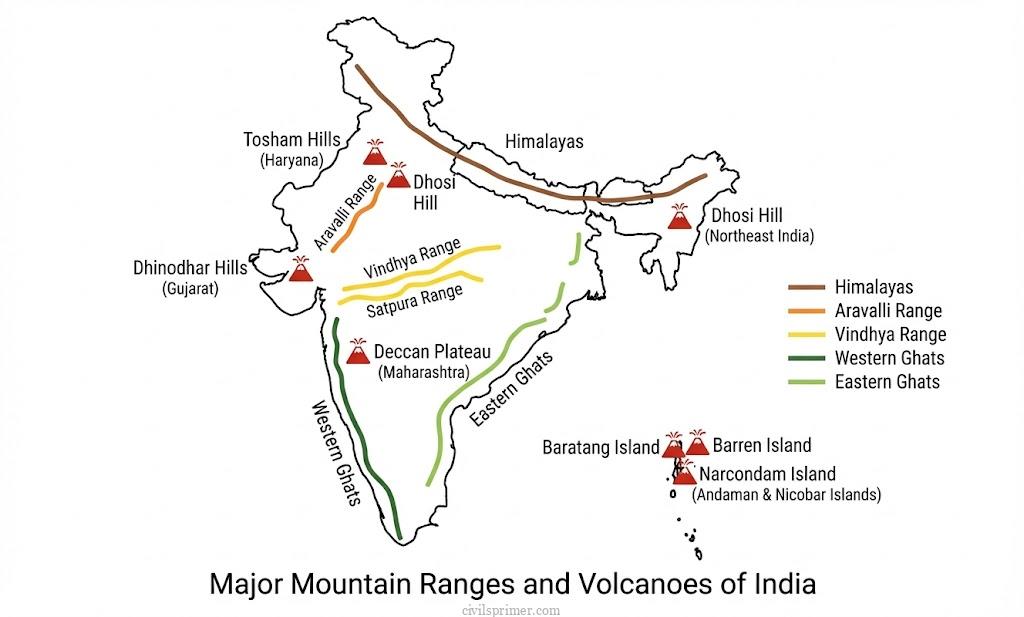
- Himalayas: A series of parallel ranges—Himadri (Great Himalayas), Himachal (Middle Himalayas), and Shiwalik (Outer Himalayas). They are still rising and are unstable.
- Deccan Plateau: Formed by the outpouring of lava (Flood Basalts) millions of years ago, covering western India in thick layers of black basalt rock.
- The Island Volcanoes: India has the only active volcano in South Asia—Barren Island in the Andaman & Nicobar group. It erupted recently in 2017. Narcondam is an extinct volcano nearby.
And so, through the fiery eruptions of volcanoes and the slow, crushing dance of tectonic plates, the magnificent landscapes of our world were born.
UPSC Prelims Pointers #
- Magma vs. Lava:
Magma is underground; Lava is on the surface. Acidic magma (high silica) = Explosive; Basic magma (low silica) = Fluid. - Volcanic Forms:
◦ Dykes: Vertical intrusions. Sills: Horizontal intrusions.
◦ Caldera: The most explosive type; a collapsed depression (e.g., Lake Toba). - Specific Peaks:
◦ Mt. Aconcagua: Highest peak outside Asia (Andes).
◦ Mauna Kea: Highest mountain from the ocean base (Hawaii).
◦ Ojos del Salado: Highest active volcano (Andes).
UPSC Mains Previous Years Questions #
- 2021 → Discuss the geophysical characteristics of Circum-Pacific Zone.
- 2019 → Define mantle plume and explain its role in plate tectonics.
- 2018 → Why are the world’s fold mountain systems located along the margins of continents? Bring out the association between the global distribution of Fold Mountains and the earthquakes and volcanoes.
- 2014 → Explain the formation of thousands of islands in Indonesian and Philippines archipelagos.
Answer Writing Minors #
- Introduction: “The Earth’s Lithosphere is continuously shaped by endogenic forces acting from within, primarily driven by radioactive heat and mantle convection. These tectonic processes manifest as volcanism and Orogeny (mountain building), creating relief features like the Circum-Pacific Belt, Mid-Oceanic Ridges, and the Himalayan Fold Mountains, which govern the planet’s geomorphology.”
- Conclusion: “Conclusively, the distribution of volcanoes and mountains is not random but intimately linked to plate tectonics, marking the boundaries of convergent and divergent plates. Understanding these geological structures is vital not only for deciphering Earth’s evolutionary history but also for disaster management in seismically active zones like the Himalayas and the Ring of Fire.”
Related Latest Current Affairs #
- November 2025: Eruption of Hayli Gubbi Volcano (Ethiopia)
The Hayli Gubbi volcano in Ethiopia’s Afar Region erupted for the first time in nearly 10,000 years. It is a shield volcano located in the Afar Depression, a triple junction where the Nubian, Somali, and Arabian tectonic plates are diverging. - November 2025: Himalayan Arc Placed in Seismic Zone VI
India updated its Earthquake Design Code, placing the entire Himalayan arc (from J&K to Arunachal Pradesh) in the newly created highest-risk Zone VI. This underscores the extreme tectonic stress created by the ongoing collision of the Indian and Eurasian plates. - October 2025: Eruption of Mount Semeru (Indonesia)
Mount Semeru, an active stratovolcano on Java Island, erupted violently with pyroclastic flows. Located on the Pacific Ring of Fire, it is formed by the subduction of the Indo-Australian Plate beneath the Eurasian Plate. - September 2025: Eruptions at Barren Island Volcano (India)
India’s only active volcano, Barren Island in the Andaman Sea, witnessed mild eruptions. It is a stratovolcano emerging from the convergent boundary of the Indian and Burmese tectonic plates. - August 2025: Eruption of Krasheninnikov Volcano (Russia)
The Krasheninnikov Volcano in the Kamchatka Peninsula erupted for the first time in 600 years. It is a complex stratovolcano located in a seismically active zone known as the Ring of Fire. - August 2025: Scaling of Mount Elbrus (Russia)
Mountaineers successfully scaled Mount Elbrus, the highest peak in Europe. Located in the Caucasus Mountains, it is a dormant stratovolcano formed 2.5 million years ago. - July 2025: Seven Sites Added to UNESCO Tentative List
India added seven sites to the UNESCO Tentative List, including the Deccan Traps (volcanic basaltic lava flows) and St. Mary’s Island (columnar basalt). These sites showcase India’s diverse geological history, including volcanic and coastal geomorphology. - June 2025: Massive Eruption of Mount Etna (Italy)
Mount Etna, Europe’s tallest active stratovolcano, erupted with lava flows. Located in Sicily at the boundary of the African and Eurasian plates, it is known for its frequent Strombolian eruptions. - June 2025: New Definition for Aravalli Hills Protection A new 100-metre height definition for the Aravalli Hills removed 90% of the range from legal protection. The Aravallis are one of the world’s oldest fold mountain ranges, formed in the Proterozoic era.
- February 2025: Methane Plumes from Mount Fentale (Ethiopia) Mount Fentale, a stratovolcano in the East African Rift Valley, released massive methane plumes. This unusual emission suggests deep-seated geological activity associated with continental rifting.
- January 2025: Eruption of Klyuchevskoy Volcano (Russia) Klyuchevskoy, the tallest active volcano in Eurasia, erupted following an earthquake. It is a steep stratovolcano on the Kamchatka Peninsula, driven by the subduction of the Pacific Plate.