
Part I: The Pinch of Salt that Shook an Empire (1930–1934) #
The year was 1930. The Indian National Congress had just declared Purna Swaraj (Complete Independence) on the banks of the river Ravi. The nation was restless, waiting for a signal. Mahatma Gandhi, looking for a symbol that would unite the prince and the pauper, found it in the humblest of ingredients: Salt.
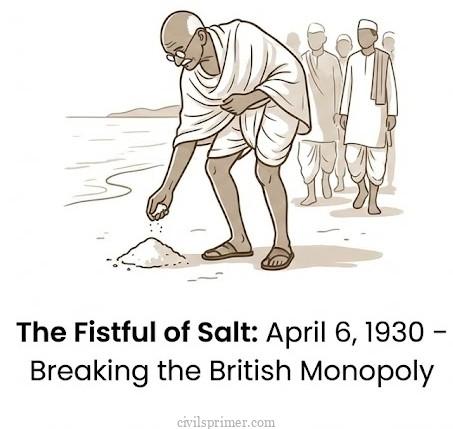
The March to Dandi The British held a monopoly on salt production and levied a tax on it—something Gandhi called “the most inhuman poll tax”. On March 12, 1930, Gandhi, aged 61, stepped out of Sabarmati Ashram with 78 followers.
He was not marching to Delhi to storm the Viceroy’s palace; he was walking to the sea. For 24 days, the group walked through Gujarat’s villages. By the time they reached Dandi on April 6, the march had become a pilgrimage. Gandhi bent down, picked up a lump of natural salt, and technically broke the law. This signal sparked a nationwide fire.
- Tamil Nadu: C. Rajagopalachari marched from Trichinopoly to Vedaranniyam.
- North-West: Khan Abdul Ghaffar Khan, the “Frontier Gandhi,” led the Khudai Khidmatgars (Red Shirts) in a non-violent uprising in Peshawar.
- North-East: 13-year-old Rani Gaidinliu raised the banner of revolt in Nagaland.
The Truce and The Trap The British response was brutal—lathi charges and over 90,000 arrests. But the government soon realized it could not rule by force alone. In a significant shift, Viceroy Lord Irwin invited Gandhi for talks—placing the “seditionist” on equal footing with the King’s representative.
On March 5, 1931, the Gandhi-Irwin Pact was signed. Gandhi agreed to suspend the movement and attend the Second Round Table Conference in London. In return, the British agreed to release political prisoners (excluding revolutionaries like Bhagat Singh) and allow salt making for personal use.
Many youth were disappointed. Bhagat Singh, Sukhdev, and Rajguru were executed just days before the Karachi Session of Congress in March 1931. Despite the gloom, this session was historic; it adopted a resolution on Fundamental Rights and National Economic Programme, outlining for the first time what “Swaraj” would mean for the common man.
The Round Table Disappointment Gandhi went to London for the Second Round Table Conference (1931) as the sole Congress representative. It was a failure. The British government, now dominated by Conservatives, was obsessed with the “minority question” rather than freedom. The conference deadlocked over separate electorates, not just for Muslims, but now demanded for the Depressed Classes (Dalits) as well. Gandhi returned empty-handed, famously saying, “I have returned with empty hands, but I have not compromised the honour of my country.”
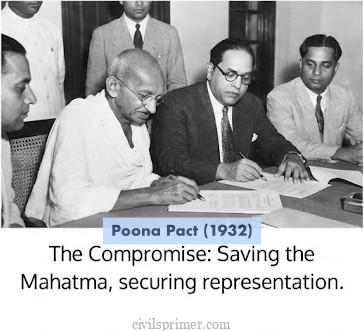
The Communal Award and Poona Pact (1932) Back in India, the British announced the Communal Award in August 1932, granting separate electorates to the Depressed Classes. Gandhi saw this as a ploy to permanently sever Dalits from the Hindu fold. From Yeravda Jail, he announced a fast unto death. The nation panicked. Dr. B.R. Ambedkar, who had advocated for the rights of the Dalits, faced immense pressure to save Gandhi’s life. The result was the Poona Pact (1932). Ambedkar agreed to abandon separate electorates; in exchange, the depressed classes received reserved seats in the general electorate—more than double what the British had offered.
Part II: The Illusion of Power (1935–1939) #
The Blueprint: Government of India Act, 1935 Exhausted by the mass movements, the British played their next card: The Government of India Act, 1935.
- Provincial Autonomy: It abolished Dyarchy in the provinces and introduced responsible government.
- All India Federation: It proposed a federation of British provinces and Princely States (which never came into existence because the Princes refused to join).
- Safeguards: The Governor-General retained massive veto powers, leading Nehru to call the Act “a car with all brakes and no engine”,.
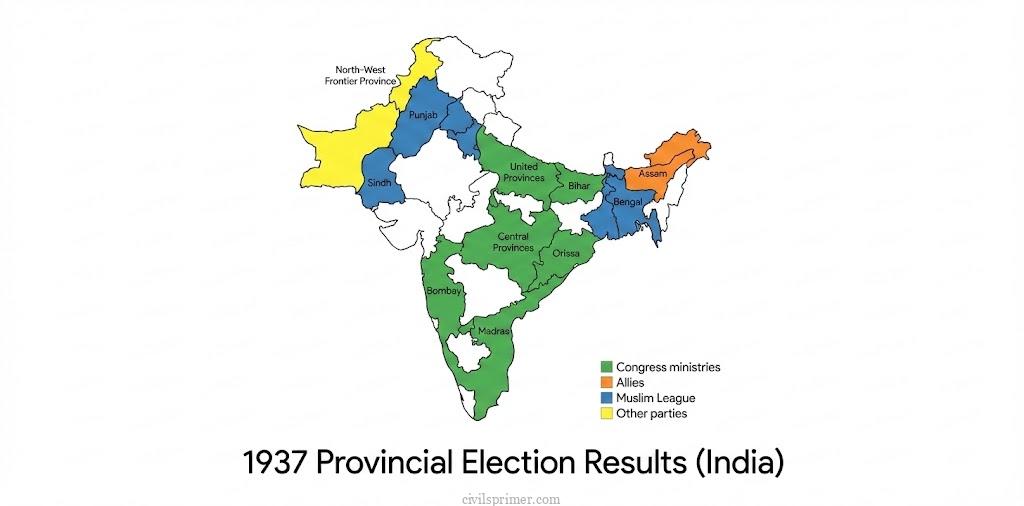
The 1937 Elections: Testing the Waters Congress decided to contest the 1937 elections, not to work the Act, but to wreck it from within. The results were a landslide. Congress formed ministries in 8 provinces (including Madras, Bombay, and UP). For 28 months, Indians ruled Indians. They eased censorship, released prisoners, and tried to effect agrarian reforms. However, the lack of financial power and the need to placate landlords limited their success.
The Resignation In 1939, World War II broke out. Viceroy Linlithgow declared India a party to the war without consulting Indian leaders. In protest, the Congress ministries resigned en masse in October 1939, declaring that India could not fight for freedom while being denied its own.
Part III: The War and the “Do or Die” Moment (1940–1945) #
The August Offer & Individual Satyagraha (1940) Desperate for Indian cooperation in the war, the British made the August Offer—proposing “Dominion Status” as the long-term goal. Congress rejected it. To register protest without hampering the war effort, Gandhi launched the Individual Satyagraha. Vinoba Bhave was the first Satyagrahi; Jawaharlal Nehru was the second. They simply walked from village to village, declaring it wrong to help the British war effort.
- The Cripps Mission (1942) By 1942, Japanese forces were knocking on India’s doors (Rangoon had fallen). The British sent Sir Stafford Cripps to negotiate. He offered Dominion Status after the war and a Constituent Assembly.
- The Dealbreaker: The proposal allowed provinces to secede (a blueprint for Pakistan) and offered no immediate transfer of power. Gandhi termed it “a post-dated cheque on a crashing bank”,. The mission failed.
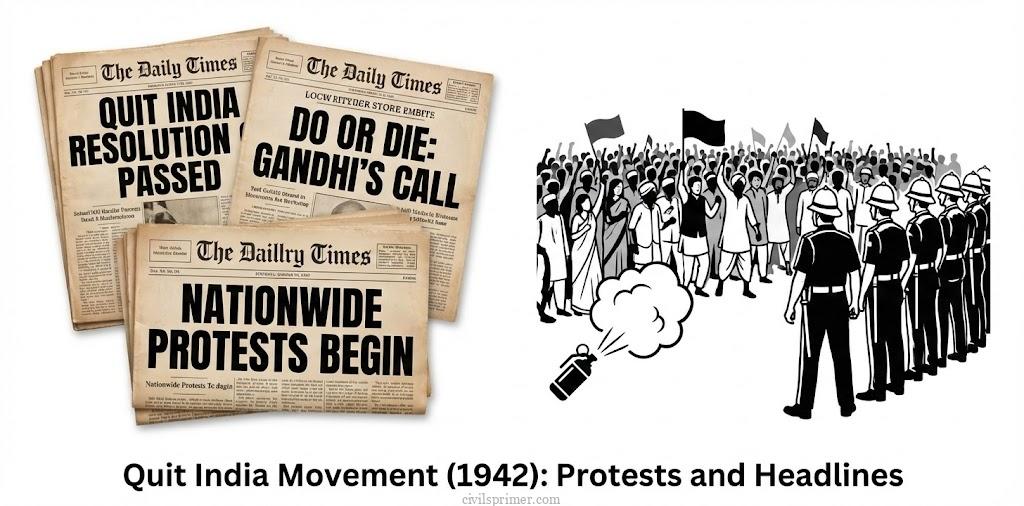
Quit India: The August Revolution (1942) Patience had run out. On August 8, 1942, at the Gowalia Tank Maidan in Bombay, Gandhi gave the ultimate call: “Do or Die.” He demanded an orderly British withdrawal. The British response was swift. Before the sun rose on August 9, Gandhi and the entire Congress leadership were arrested. The movement became leaderless and violent. Peasants attacked police stations, cut telegraph lines, and blew up bridges. In places like Ballia, Tamluk, and Satara, parallel governments (Prati Sarkars) were set up. Underground radio stations (run by Usha Mehta) kept the fire burning. It was the greatest challenge to the Raj since 1857.
The Tiger of Bengal: INA While Gandhi fought non-violently, Subhash Chandra Bose took a different path. Escaping house arrest in Calcutta in 1941, he reached Germany and then Japan. He revived the Indian National Army (Azad Hind Fauj) with Indian prisoners of war. With the slogan “Delhi Chalo,” the INA marched towards India alongside Japanese forces. Though militarily defeated, the Red Fort Trials of INA prisoners (Hindu, Muslim, and Sikh officers tried together) in 1945 united the country in a frenzy of patriotism.
Part IV: The Painful Parting (1946–1947) #
The Cabinet Mission (1946) Post-WWII, Britain was exhausted. The Cabinet Mission arrived to transfer power.
- The Plan: It rejected Pakistan. Instead, it proposed a loose union with a weak center and grouped provinces into three sections (A, B, C).
- The Failure: Congress and the Muslim League interpreted the “grouping” clause differently. Trust evaporated,.
Direct Action and The Great Killing Frustrated, Muhammad Ali Jinnah declared August 16, 1946, as “Direct Action Day” to win Pakistan. Communal riots erupted in Calcutta, leaving thousands dead. The violence spread like wildfire to Noakhali, Bihar, and Punjab.
The Mountbatten Plan (June 3, 1947) Lord Mountbatten arrived as the last Viceroy to execute the surgery. He realized unity was impossible. His plan:
- Partition: India and Pakistan would be two separate dominions.
- Boundary Commission: Sir Cyril Radcliffe would draw the line.
- Date: August 15, 1947.
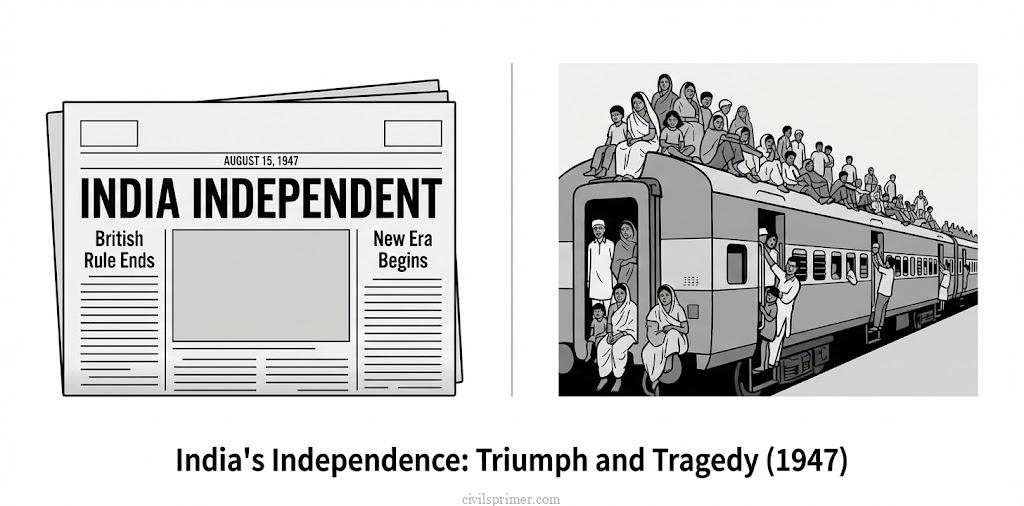
Independence On August 15, 1947, India awoke to freedom. But the celebration was marred by the blood of Partition. While Nehru spoke of his “Tryst with Destiny” in Delhi, the Father of the Nation, Mahatma Gandhi, was not there. He was in Calcutta, fasting to stop the communal madness, trying to heal a fractured land.
UPSC Mains Subjective Previous Years Questions #
- (2024) What were the events that led to the Quit India Movement? Point out its results.
- (2022) The political and administrative reorganization of states and territories has been a continuous ongoing process since the mid-nineteenth century. Discuss with examples.
- (2021) Bring out the constructive programs of Mahatma Gandhi during the Non-Cooperation Movement and Civil Disobedience Movement.
- (2021) Assess the main administrative issues and socio-cultural problems in the integration process of Indian Princely States.
- (2019) Assess the role of British imperial power in complicating the process of transfer of power during the 1940s.
- (2016) Highlight the difference in the approach of Subhash Chandra Bose and Mahatma Gandhi in the struggle for freedom.
- (2015) How different would have been the achievement of Indian independence without Mahatma Gandhi? Discuss.
- (2015) Mahatma Gandhi and Dr. B. R. Ambedkar, despite having divergent approaches and strategies, had a common goal of amelioration of the downtrodden. Elucidate.
- (2015) It would have been difficult for the Constituent Assembly to complete its historic task of drafting the Constitution for Independent India in just three years but for the experience gained with the Government of India Act, 1935. Discuss.
- (2014) In what ways did the naval mutiny prove to be the last nail in the coffin of British colonial aspirations in India?.
- (2013) Discuss the contribution of Maulana Abul Kalam Azad to pre-and post-independent India.
Answer Writing Minors #
Here is a comprehensive Introduction and Conclusion pair suitable for UPSC Mains questions regarding the period “Towards Independence (1930–1947)”.
Introduction: The period from 1930 to 1947 marked the decisive phase of the Indian freedom struggle, escalating from the demand for Purna Swaraj in the Civil Disobedience Movement to the “Do or Die” spirit of the Quit India agitation. This era was characterised by a multi-pronged challenge to British authority, combining unprecedented mass mobilisation with complex constitutional negotiations like the Round Table Conferences and the Cabinet Mission, effectively dismantling the colonial administrative apparatus.
Conclusion: Ultimately, the cumulative impact of these mass upsurges, coupled with the erosion of loyalty within the army and bureaucracy post-World War II, rendered the continuation of the British Raj politically and militarily untenable. While the Indian Independence Act of 1947 realised the long-cherished dream of sovereignty, it was a bittersweet triumph, as the birth of a democratic republic was accompanied by the tragic partition of the subcontinent.
Related Latest Current Affairs #
- November, 2025: Red Fort Blast Recalls History of INA Trials (1945–46) Following a blast near the Red Fort, its historical significance was revisited, specifically its role as the venue for the Indian National Army (INA) trials in 1945–46. These trials symbolized the final phase of the freedom struggle and intensified public sentiment against British rule just prior to independence,.
- October, 2025: Sardar Patel’s Role in 1931 Karachi Session and Integration (1947) Commemorations for Sardar Vallabhbhai Patel’s 150th birth anniversary highlighted his presidency of the 1931 Karachi Session, which endorsed the Gandhi-Irwin Pact. The events also celebrated his diplomatic skill in securing the Instrument of Accession (1947) from over 560 princely states,,.
- September, 2025: Debate on Direct Action Day (1946) and Gopal ‘Paantha’ Mukherjee The film Bengal Files reignited debate over the Great Calcutta Killing on August 16, 1946 (Direct Action Day), called by the Muslim League. Discussions focused on Gopal ‘Paantha’ Mukherjee, who mobilized groups to protect neighbourhoods during the communal riots, resisting Mahatma Gandhi’s later call to surrender arms in 1947,.
- January, 2025: Revisiting Pre-Independence Constitutional Drafts (1944–1946) Scholars revisited constitutional proposals made during the World War II and Transfer of Power phase, such as M.N. Roy’s 1944 Draft and the Gandhian Constitution of 1946. These documents offered alternative visions for independent India’s governance before the final Constitution was drafted,.
- January, 2025: Parakram Diwas and the Azad Hind Government (1943) Parakram Diwas was observed to honour Netaji Subhas Chandra Bose, focusing on his split from the Congress (1939) and the establishment of the Azad Hind Government (1943). His call to arms, “Give me blood, and I will give you freedom,” galvanized the Indian National Army (INA) to fight British forces during World War II,.
- December, 2024: C. Rajagopalachari’s Salt Satyagraha and 1944 Formula Tributes to C. Rajagopalachari highlighted his leadership of the Salt Satyagraha (part of Civil Disobedience Movement, 1930) in the Madras Presidency. The events also recalled the Rajaji Formula (1944), a proposed framework to resolve the deadlock between the Congress and the Muslim League regarding partition,.