The Essay Paper in the UPSC Civil Services (Mains) Examination plays a decisive role in determining the final merit rank. An in-depth analysis of Essay Previous Year Questions (PYQ) helps aspirants understand the evolving nature of UPSC essay topics, recurring themes, and the balance between philosophical, social, economic, and governance-related issues.
By studying Essay PYQ UPSC Mains in a topic-wise and trend-based manner, candidates can develop a structured thought process, improve content relevance, and align their essay preparation with the actual demands of the examination.
This article provides a comprehensive trend analysis of UPSC Essay PYQs, categorising questions topic-wise to help aspirants prepare strategically and write high-scoring essays.
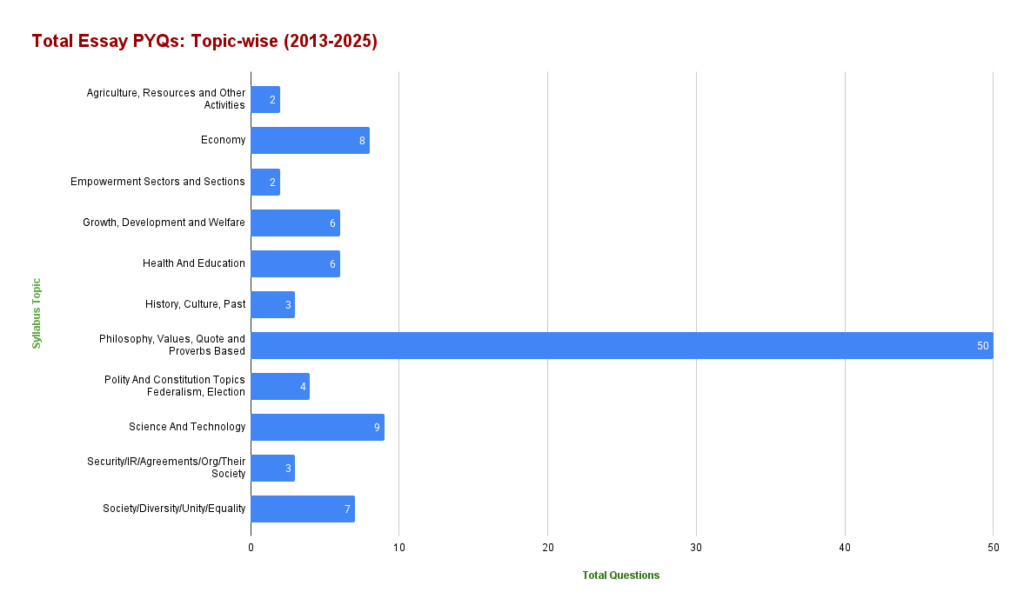
Total Essay Questions by Primary Syllabus Topic (2013-2025)
Essay Questions Trend Analysis for UPSC Civil Services Mains Exam Last 10 Years
The chart reveals the distribution of essay topics across the major syllabus areas:
Society/Diversity/Unity/Equality and History, Culture, Past have been the most frequently asked topics, each accounting for 12 questions.
Science And Technology and Economy/Globalization are also highly represented with 11 questions each.
The topics of Philosophy, Abstract, Quotes and Environment, Ecology, Disaster have the lowest count, each with 7 questions.
2022
History is a series of victorious won by the scientific man over the romantic man
2021
History repeats itself, first as a tragedy, second as a farce.
2020
Culture is what we are, civilisation is what we have.
2023
Girls are weighed down by restrictions, boys with demands – two equally harmful disciplines.
2023
A society that has more justice is a society that needs less charity.
2020
There can be no social justice without economic prosperity, but economic prosperity without social justice is meaningless.
2020
Patriarchy is the least noticed yet the most significant structure of social inequality.
2019
Best for an individual is not necessarily best for society.
2017
Fulfillment of ‘new woman’ in India is a myth.
2013
Is the colonial mentality hindering India’s success?
2018
Poverty anywhere is a threat to prosperity everywhere
2016
If development is not engendered, it is endangered.
2016
Innovation is the key determinant of economic growth and social welfare.
2015
Dreams which should not let India sleep.
2014
Is the growing level of competition good for the youth?
2014
Was it the policy paralysis or the paralysis of implementation which slowed the growth of our country?
2014
Fifty Golds in Olympics: Can this be a reality for India?
2014
Tourism: Can this be the next big thing for India?
2019
Biased media is a real threat to Indian democracy.
2017
We may brave human laws but cannot resist natural laws.
2016
Cooperative federalism: Myth or reality
2014
Is sting operation an invasion on privacy?
2023
Education is what remains after one has forgotten what one has learned in school
2021
What is research, but a blind date with knowledge!
2019
Neglect of primary health care and education in India are reasons for its backwardness.
2017
Destiny of a nation is shaped in its classrooms.
2015
Education without values, as useful as it is, seems rather to make a man more clever devil.
2019
South Asian societies are woven not around the state, but around their plural culture and plural identities.
2018
Management of Indian border disputes – a complex task.
2017
Has the Non-Alignment Movement (NAM) lost its relevance in a multipolar world?
2017
Farming has lost the ability to be a source of subsistence for the majority of farmers in India.
2016
Water disputes between states in federal India.
2024
Forests precede civilizations and deserts follow them.
2022
Forests are the best-case studies for economic excellence.
2017
Impact of the new economic measures on fiscal ties between the union and states in India.
2016
Near jobless growth in India: An anomaly or an outcome of economic reforms.
2016
Digital economy: A leveller or a source of economic inequality.
2015
Crisis faced in India – moral or economic.
2015
Can capitalism bring inclusive growth?
2013
GDP (Gross Domestic Product) along with GDH (Gross Domestic Happiness) would be the right indices for judging the well-being of a country.
2024
The doubter is a true man of science
2021
The process of self-discovery has now been technologically outsourced.
2020
Technology as the silent factor in international relations.
2019
Rise of Artificial Intelligence: The threat of jobless future or better job opportunities through reskilling and upskilling.
2018
Alternative technologies for a climate change resilient India.
2017
Social media is inherently a selfish medium.
2016
Cyberspace and internet: Blessing or curse to the human civilization in the long run.
2015
Technology cannot replace manpower.
2013
Science and Technology is the panacea for the growth and security of the nation.
2025
Truth knows no color.
2025
The supreme art of war is to subdue the enemy without fighting.
2025
Thought finds a world and creates one also.
2025
The best lessons are learnt through bitter experiences
2025
Muddy water is best cleared by leaving it alone.
2025
The years teach much which the days never know.
2025
It is best to see life as a journey, not as a destination.
2025
Contentment is natural wealth; luxury is artificial poverty.
2024
The empires of the future will be the empires of the mind.
2024
There is no path to happiness; Happiness is the path.
2024
All ideas having large consequences are always simple.
2024
Nearly all men can stand adversity, but to test the character, give him power.
2024
Social media is triggering ‘Fear of Missing Out’ amongst the youth, precipitating depression and loneliness.
2024
The cost of being wrong is less than the cost of doing nothing.
2023
Mathematics is the music of reason.
2023
Inspiration for creativity springs from the effort to look for the magical in the mundane.
2023
Not all who wander are lost.
2023
Visionary decision-making happens at the intersection of intuition and logic.
2023
Thinking is like a game, it does not begin unless there is an opposite team.
2022
Just because you have a choice, it does not mean that any of them has to be right.
2022
A smile is the chosen vehicle for all ambiguities.
2022
You cannot step twice in the same river.
2022
The time to repair the roof is when the sun is shining.
2022
A ship in harbor is safe, but that is not what a ship is for.
2022
Poets are the unacknowledged legislators of the world.
2021
There are better practices to “best practices”.
2021
Hand that rocks the cradle rules the world.
2021
The real is rational and the rational is real.
2021
Philosophy of wantlessness is Utopian, while materialism is a chimera.
2021
Your perception of me is a reflection of you; my reaction to you is an awareness of me.
2020
Simplicity is the ultimate sophistication.
2020
Ships do not sink because of water around them, ships sink because of water that gets into them.
2020
Mindful manifesto is the catalyst to a tranquil self.
2020
Life is a long journey between human being and being humane.
2019
Courage to accept and dedication to improve are two keys to success.
2019
Values are not what humanity is, but what humanity ought to be.
2019
Wisdom finds truth.
2018
Reality does not conform to the ideal, but confirms it.
2018
A people that values its privileges above its principles loses both.
2018
The past’ is a permanent dimension of human consciousness and values.
2018
Customary morality cannot be a guide to modern life.
2018
A good life is one inspired by love and guided by knowledge.
2017
Joy is the simplest form of gratitude.
2016
Need brings greed, if greed increases it spoils breed.
2015
Character of an institution is reflected in its leader.
2015
Quick but steady wins the race.
2015
Lending hands to someone is better than giving a dole.
2014
Words are sharper than the two-edged sword.
2014
With greater power comes greater responsibility.
2013
Be the change you want to see in others – Gandhiji.
What can we conclude from the PYQs data analysis?
The topic-wise analysis of Essay PYQs from 2013 to 2025 clearly demonstrates that the UPSC Essay paper is heavily skewed towards abstract, philosophical, and value-based themes. With 50 questions drawn from Philosophy, Values, Quotes, and Proverbs, this category overwhelmingly dominates the Essay paper, highlighting UPSC’s emphasis on ethical reasoning, critical thinking, and conceptual clarity over factual narration.
Among conventional GS-aligned themes, Science & Technology (9 questions) and Economy (8 questions) emerge as the most frequently asked areas, indicating the importance of understanding contemporary developments and their societal implications. Society, Diversity, Unity, and Equality (7 questions) along with Health & Education and Growth, Development, and Welfare (6 questions each) reflect UPSC’s consistent focus on social justice, human development, and inclusive growth.
In contrast, relatively fewer essays have been asked from Polity and Constitution (4), History and Culture (3), Security and International Relations (3), and Agriculture and Empowerment-related sectors (2 each). This data confirms that while static GS subjects are relevant, they are often tested indirectly through philosophical framing or interdisciplinary linkage rather than as standalone factual topics.
Overall, this Essay PYQ trend analysis underscores that aspirants must prioritize:
Strong command over philosophical and ethical dimensions
Ability to link abstract ideas with current affairs and GS topics
Multidimensional essay structuring backed by real-world examples
A preparation strategy grounded in data-driven Essay PYQ analysis enables candidates to focus on high-yield themes, avoid random topic coverage, and align essay practice with UPSC’s long-term questioning pattern—significantly improving performance in the UPSC Civil Services (Mains) Essay paper.