
The General Studies Paper III (GS3) of the UPSC Civil Services Mains Examination is one of the most dynamic and analytical papers, covering critical areas such as the Indian Economy, Agriculture, Environment, Internal Security, Science & Technology, and Disaster Management. Due to its current-oriented and issue-based nature, a clear understanding of GS3 Previous Year Questions (PYQ) trends is essential for effective preparation.
A trend analysis of GS3 PYQs from 2013 to 2025 reveals the actual weightage UPSC assigns to different subjects within the GS3 syllabus. Rather than preparing GS3 in isolation or relying on assumptions, aspirants who analyze PYQs gain clarity on high-priority areas, recurring themes, and evolving focus. This analysis presents a data-driven GS3 PYQ trend report, helping aspirants align their preparation strategy with UPSC’s long-term questioning pattern.
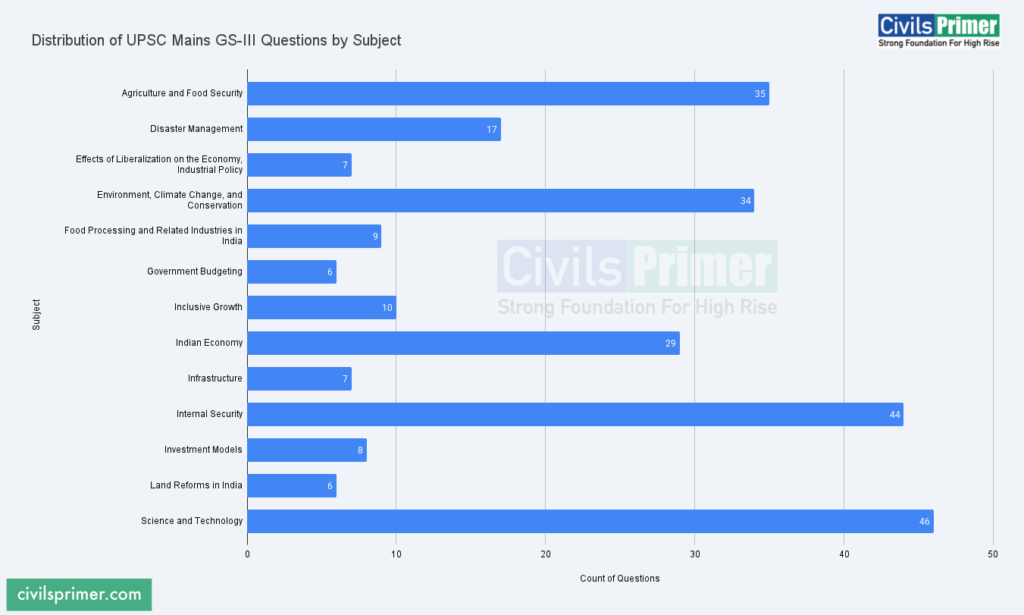
Topic-wise PYQs: UPSC Mains GS3 (2013-2025)
| Globalization, Protectionism, Bilateralism, Challenges | 2025 | What are the challenges before the Indian economy when the world is moving away from free trade and multilateralism to protectionism and bilateralism? How can these challenges be met? (10 M) |
| Fiscal Health Index (FHI), State Fiscal Performance | 2025 | Explain how the Fiscal Health Index (FHI) can be used as a tool for assessing the fiscal performance of states in India. In what way would it encourage the states to adopt prudent and sustainable fiscal policies? (15 M) |
| Production Linked Incentive (PLI) Scheme | 2025 | Discuss the rationale of the Production Linked Incentive (PLI) scheme. What are its achievements? In what way can the functioning and outcomes of the scheme be improved? (15 M) |
| Public Expenditure on Social Services, Inclusive Growth | 2024 | Examine the pattern and trend of public expenditure on Social Services in the post-reforms period in India. To what extent this has been in consonance with achieving the objective of inclusive growth? (10 M) |
| High Food Inflation, RBI Monetary Policy | 2024 | What are the causes of persistent high food inflation in India? Comment on the effectiveness of the monetary policy of RBI to control this type of inflation. (10 M) |
| MSMEs, Manufacturing Sector in GDP | 2023 | Faster economic growth requires increased share of the manufacturing sector in GDP, particularly of MSMEs. Comment on the present policies of the Government in this regard. (10 M) |
| Digitalization in Indian Economy (Status, Problems, Suggestions) | 2023 | What is the status of digitalization in the Indian economy? Examine the problems faced in this regard and suggest improvements. (10 M) |
| Structural Unemployment, Computation Methodology | 2023 | Most of the unemployment in India is structural in nature. Examine the methodology adopted to compute unemployment in the country and suggest improvements. (15 M) |
| Care Economy vs Monetized Economy, Women Empowerment | 2023 | Distinguish between ‘care economy’ and ‘monetized economy’. How can care economy be brought into monetized economy through women empowerment? (15 M) |
| Economic Growth, Labour Activity, Job Creation | 2021 | Economic growth in the recent past has been led by increase in labour activity. Explain this statement. Suggest the growth pattern that will lead to creation of more jobs without compromising labour productivity. (15 M) |
| V-shaped Recovery | 2021 | Do you agree that Indian economy has recently experienced V-shaped recovery? Give reasons in support of their answer. (15 M) |
| GDP Computation Methodology (Pre-2015 vs Post-2015) | 2021 | Explain the difference between computing methodology of India’s Gross Domestic Product (GDP) before the year 2015 and after the year 2015. (10 M) |
| GST (Compensation to States) Act 2017, COVID-19 Impact | 2020 | Explain the rationale behind the Goods and Services Tax (Compensation to States) Act of 2017. How has COVID-19 impacted the GST compensation fund and created new federal tensions? (15 M) |
| Indirect Taxes Subsumed in GST, Revenue Implications | 2019 | Enumerate the indirect taxes which have been subsumed in the goods and services tax (GST) in India. Also, comment on the revenue implications of the GST introduced in India since July 2017. (10 M) |
| GDP Growth and Low Inflation (Indian Economy’s Shape) | 2019 | Do you agree with the view that steady GDP growth and low inflation have left the Indian economy in good shape? Give reasons in support of your arguments. (10 M) |
| NITI Aayog vs Erstwhile Planning Commission | 2018 | How are the principles followed by NITI Aayog different from those followed by the erstwhile planning commission in India? (15 M) |
| Protectionism and Currency Manipulations, Macroeconomic Stability | 2018 | How would the recent phenomena of protectionism and currency manipulations in world trade affect macroeconomic stability of India? (15 M) |
| Savings Rate and Other Factors for India’s Potential Growth | 2017 | Among several factors for India’s potential growth, savings rate is the most effective one. Do you agree? What are the other factors available for growth potential? (10 M) |
| Globalization, Formal Sector Employment Reduction | 2016 | How has globalization led to the reduction of employment in the formal sector of the Indian economy? Is increase in formalization detrimental to the development of the country? (12.5 M) |
| FDI (Need, Gap between MOUs and Actual FDI, Remedial Steps) | 2016 | Justify the need for FDI for the development of the Indian economy. Why is there a gap between MOUs signed and actual FDIs? Suggest remedial steps to be taken for increasing actual FDIs in India. (12.5 M) |
| Jobless Growth | 2015 | The nature of economic growth in India in recent times is often described as jobless growth. Do you agree with this view? Give arguments in favour of your answer. (12.5 M) |
| Gold Monetization Scheme, BOP, Rupee Value | 2015 | Craze for gold in India has led to a surge in import of gold in recent years and put pressure on balance of payments and external value of the rupee. In view of this, examine the merits of the Gold Monetization Scheme. (12.5 M) |
| Shift from Agriculture to Services, Strong Industrial Base | 2014 | Normally countries shift from agriculture to industry and then later to services, but India shifted directly from agriculture to services. What are the reasons for the huge growth of services vis-à-vis industry in the country? Can India become a developed country without a strong industrial base? (12.5 M) |
| Demographic Dividend, Employability, Job Creation | 2014 | “While we flaunt India’s demographic dividend, we ignore the dropping rates of employability.” What are we missing while doing so? Where will the jobs that India desperately needs come from? Explain. (12.5 M) |
| Companies Bill 2013, CSR (Mandatory Obligation) | 2013 | With a consideration towards the strategy of inclusive growth, the new Companies Bill, 2013 has indirectly made CSR a mandatory obligation. Discuss the challenges expected in its implementation in right earnest. Also discuss other provisions in the Bill and their implications. (10 M) |
| FRBM Act, 2003 (Reasons, Features, Effectiveness) | 2013 | What were the reasons for the introduction of the Fiscal Responsibility and Budget Management (FRBM) Act, 2003? Discuss critically its salient features and their effectiveness. (10 M) |
| Tax Expenditure’, Influence on Budgetary Policies (Housing Sector) | 2013 | What is the meaning of the term ‘tax expenditure’? Taking the housing sector as an example, discuss how it influences the budgetary policies of the government. (10 M) |
| Food Security Bill (Apprehensions in Implementation, WTO Concerns) | 2013 | The Food Security Bill is expected to eliminate hunger and malnutrition in India. Critically discuss various apprehensions in its effective implementation along with the concerns it has generated in WTO. (10 M) |
| GST Rationale, Reasons for Delay in Roll-out | 2013 | Discuss the rationale for introducing the Goods and Services Tax (GST) in India. Bring out critically the reasons for the delay in roll-out for its regime. (10 M) |
| HDI vs IHDI, IHDI as Indicator of Inclusive Growth | 2025 | Distinguish between the Human Development Index (HDI) and the Inequality-adjusted Human Development Index (IHDI) with special reference to India. Why is the IHDI considered a better indicator of inclusive growth? (10 M) |
| Inclusive Growth in Market Economy, Financial Inclusion | 2022 | Is inclusive growth possible under market economy? State the significance of financial inclusion in achieving economic growth in India. (10 M) |
| Intra-generational and Inter-generational Equity, Sustainable Development | 2020 | Explain intra-generational and inter-generational issues of equity from the perspective of inclusive growth and sustainable development. (10 M) |
| Inclusive Growth and Sustainability | 2019 | It is argued that the strategy of inclusive growth is intended to meet the objectives of inclusiveness and sustainability together. Comment on this statement. (15 M) |
| Access to Affordable Energy, SDGs | 2018 | “Access to affordable, reliable, sustainable and modern energy is the sine qua non to achieve Sustainable Development Goals (SDGs).” Comment on the progress made in India in this regard. (10 M) |
| Salient Features, India’s Experience, Measures | 2017 | What are the salient features of ‘inclusive growth’? Has India been experiencing such a growth process? Analyze and suggest measures for inclusive growth. (15 M) |
| PMJDY, Financial Inclusion | 2016 | Pradhan Mantri Jan-Dhan Yojana (PMJDY) is necessary for bringing unbanked to the institutional finance fold. Do you agree with this for financial inclusion of the poorer section of the Indian society? Give arguments to justify your opinion. (12.5 M) |
| Smart Cities’, Rural-Urban Differences, ‘Smart Villages’ (PURA/RURBAN) | 2016 | What are ‘Smart Cities’? Examine their relevance for urban development in India. Will it increase rural-urban differences? Give arguments for ‘Smart Villages’ in the light of PURA and RURBAN Mission. (12.5 M) |
| Challenges (Careless/Useless Manpower), Measures | 2016 | Comment on the challenges for inclusive growth which include careless and useless manpower in the Indian context. Suggest measures to be taken for facing these challenges. (12.5 M) |
| Capitalism and Inclusive Growth in India | 2014 | Capitalism has guided the world economy to unprecedented prosperity. However, it often encourages short-sightedness and contributes to wide disparities between the rich and the poor. In this light, would it be correct to believe and adopt capitalism for bringing inclusive growth in India? Discuss. (12.5 M) |
| Capital Budget vs Revenue Budget (Components) | 2021 | Distinguish between Capital Budget and Revenue Budget. Explain the components of both these Budgets. (10M) |
| Potential GDP (Meaning, Determinants, Inhibiting Factors) | 2020 | Define potential GDP and explain its determinants. What are the factors that have been inhibiting India from realizing its potential GDP? (10 M) |
| Public Expenditure Management (Post-liberalization) | 2019 | The public expenditure management is a challenge to the Government of India in the context of budget making during the post-liberalization period. Clarify it. (15 M) |
| Long-term Capital Gains Tax (LCGT) and Dividend Distribution Tax (DDT) in Budget 2018-19 | 2018 | Comment on the important changes introduced in respect of the Long-term Capital Gains Tax (LCGT) and Dividend Distribution Tax (DDT) in the Union Budget for 2018-2019. (10 M) |
| Union Budget 2017-18 (Transform, Energize, Clean India) | 2017 | One of the intended objectives of Union Budget 2017-18 is to ‘transform, energize and clean India.’ Analyze the measures proposed in the Budget 2017-18 to achieve the objective. (15 M) |
| Gender Budgeting (Requirements and Status) | 2016 | Women empowerment in India needs gender budgeting. What are the requirements and status of gender budgeting in the Indian context? (12.5 M) |
| Factors Influencing Selection of High Value Crops | 2025 | Explain the factors influencing the decision of the farmers on the selection of high value crops in India. (10 M) |
| Role of Millets (Health and Nutritional Security) | 2024 | Explain the role of millets for ensuring health and nutritional security in India. (10 M) |
| Buffer Stocks (Importance, Storage Challenges) | 2024 | Elucidate the importance of buffer stocks for stabilizing agricultural prices in India. What are the challenges associated with the storage of buffer stock? (15 M) |
| Indian Irrigation System (Challenges, Management Measures) | 2024 | What are the major challenges faced by the Indian irrigation system in recent times? State the measures taken by the government for efficient irrigation management. (15 M) |
| e-Technology (Production and Marketing) | 2023 | How does e-Technology help farmers in production and marketing of agricultural produce? Explain it. (10 M) |
| Agricultural Subsidies (Direct/Indirect), WTO Issues | 2023 | What are the direct and indirect subsidies provided to the farm sector in India? Discuss the issues raised by the World Trade Organization (WTO) in relation to agricultural subsidies. (10 M) |
| Cropping Pattern (Consumption/Marketing Changes) | 2023 | Explain the changes in cropping pattern in India in the context of changes in consumption pattern and marketing conditions. (10 M) |
| Integrated Farming System (IFS) (Help to Small/Marginal Farmers) | 2022 | What is Integrated Farming System? How is it helpful to small and marginal farmers in India? (15 M) |
| Public Distribution System (PDS) (Challenges, Effectiveness) | 2022 | What are the major challenges of the Public Distribution System (PDS) in India? How can it be made effective and transparent? (10 M) |
| Crop Diversification (Challenges, Emerging Technologies) | 2021 | What are the present challenges before crop diversification? How do emerging technologies provide opportunities for crop diversification? (15 M) |
| Micro-irrigation (India’s Water Crisis) | 2021 | How and to what extent would micro-irrigation help in solving India’s water crisis? (10 M) |
| National Food Security Act, 2013 (Features, Impact on Hunger) | 2021 | What are the salient features of the National Food Security Act, 2013? How has the Food Security Bill helped in eliminating hunger and malnutrition in India? (15 M) |
| Constraints in Transport and Marketing of Agricultural Produce | 2020 | What are the main constraints in transport and marketing of agricultural produce in India? (10 M) |
| Rice-Wheat System (Success Factors, Becoming a Bane) | 2020 | What are the major factors responsible for making the rice-wheat system a success? In spite of this success, how has this system become a bane in India? (15 M) |
| Water Storage and Irrigation Systems (Improvement Measures) | 2020 | Suggest measures to improve water storage and irrigation systems to make its judicious use under the depleting scenario. (15 M) |
| Integrated Farming System (IFS) (Sustaining Production) | 2019 | How far is Integrated Farming System (IFS) helpful in sustaining agricultural production? (10 M) |
| National Watershed Project (Impact on Agricultural Production) | 2019 | Elaborate on the impact of the National Watershed Project in increasing agricultural production from water-stressed areas. (10 M) |
| Food Grain Distribution System (Reformative Steps) | 2019 | What are the reformative steps taken by the Government to make the food grain distribution system more effective? (15 M) |
| Emphasis on Crops, Changes in Cropping Patterns (Millets) | 2018 | How has the emphasis on certain crops brought about changes in cropping patterns in recent past? Elaborate on the emphasis on millets production and consumption. (15 M) |
| Minimum Support Price (MSP) (Meaning, Low-Income Trap) | 2018 | What do you mean by Minimum Support Price (MSP)? How will MSP rescue the farmers from the low-income trap? (10 M) |
| National Horticulture Mission (NHM) (Role, Success) | 2018 | Assess the role of the National Horticulture Mission (NHM) in boosting the production, productivity, and income of horticulture farms. How far has it succeeded in increasing the income of farmers? (15 M) |
| Declining Rice/Wheat Yield, Crop Diversification | 2017 | What are the major reasons for declining rice and wheat yield in the cropping system? How is crop diversification helpful to stabilize the yield of the crop in the system? (15 M) |
| Agricultural Revolutions (Poverty Alleviation, Food Security) | 2017 | Explain various types of revolutions that took place in agriculture after Independence in India. How have these revolutions helped in poverty alleviation and food security in India? (10 M) |
| Subsidies (Effects on Cropping Pattern/Economy), Importance of Insurance/MSP/Food Processing | 2017 | How do subsidies affect the cropping pattern, crop diversity, and economy of farmers? What is the significance of crop insurance, minimum support price, and food processing for small and marginal farmers? (15 M) |
| Water-use Efficiency, Micro-irrigation | 2016 | What is water-use efficiency? Describe the role of micro-irrigation in increasing the water-use efficiency. (12.5 M) |
| Allelopathy (Role in Cropping Systems) | 2016 | What is allelopathy? Discuss its role in major cropping systems of irrigated agriculture. (12.5 M) |
| Crop Insurance, PMFBY (Need, Salient Features) | 2016 | Given the vulnerability of Indian agriculture to vagaries of nature, discuss the need for crop insurance and bring out the salient features of the Pradhan Mantri Fasal Bima Yojana (PMFBY). (12.5 M) |
| Contract Farming and Land Leasing (Pros and Cons) | 2015 | In view of the declining average size of land holdings in India, which has made agriculture non-viable for a majority of farmers, should contract farming and land leasing be promoted in agriculture? Critically evaluate the pros and cons. (12.5 M) |
| Livestock Rearing (Non-farm Employment, Promotion Measures) | 2015 | Livestock rearing has a big potential for providing non-farm employment and income in rural areas. Discuss, suggesting suitable measures to promote this sector in India. (12.5 M) |
| Digital India Program (Farm Productivity, Income) | 2015 | How can the Digital India program help farmers improve farm productivity and income? What steps has the government taken in this regard? (12.5 M) |
| Price Subsidy Replacement with DBT | 2015 | In what way could the replacement of price subsidy with Direct Benefit Transfer (DBT) change the scenario of subsidies in India? Discuss. (12.5 M) |
| APMCs (Impact on Agriculture Development, Food Inflation) | 2014 | There is also a point of view that Agricultural Produce Market Committees (APMCs) set up under the State Acts have not only impeded the development of agriculture but also have been the cause of food inflation in India. Critically examine. (12.5 M) |
| Cooperative Society (Agricultural Finance, Constraints, Technology) | 2014 | “In the villages itself, no form of credit organization will be suitable except the cooperative society.” – All India Rural Credit Survey. Discuss this statement in the background of agricultural finance in India. What constraints and challenges do financial institutions supplying agricultural finance face? How can technology be used to better reach and serve rural clients? (12.5 M) |
| Agricultural Subsidies (Types, Distortions) | 2013 | What are the different types of agricultural subsidies given to farmers at the national and state levels? Critically analyze the agricultural subsidy regime with reference to the distortions created by it. (10 M) |
| Pink Revolution (Nutrition and Health) | 2013 | India needs to strengthen measures to promote the pink revolution in the food industry for ensuring better nutrition and health. Critically elucidate the statement. (10 M) |
| Supply Chain Management (Agricultural Commodities) | 2025 | Elaborate the scope and significance of supply chain management of agricultural commodities in India. (10 M) |
| Food Processing Industries (Scope, Employment Generation Measures) | 2025 | Examine the scope of the food processing industries in India. Elaborate the measures taken by the government in the food processing industries for generating employment opportunities. (15 M) |
| Food Processing Industry (Scope and Significance) | 2022 | Elaborate the scope and significance of the food processing industry in India. (10 M) |
| Bottlenecks in Upstream and Downstream Marketing | 2022 | What are the main bottlenecks in the upstream and downstream process of marketing of agricultural products in India? (15 M) |
| Food Processing Sector (Challenges, Opportunities, Farmer Income) | 2020 | What are the challenges and opportunities of the food processing sector in the country? How can the income of farmers be substantially increased by encouraging food processing? (10 M) |
| Policy to Meet Food Processing Challenges | 2019 | Elaborate the policy taken by the Government of India to meet the challenges of the food processing sector. (15 M) |
| Supermarkets in Supply Chain Management | 2018 | Examine the role of supermarkets in supply chain management of fruits, vegetables, and food items. How do they eliminate the number of intermediaries? (10 M) |
| Small Processing Units (Poor Acceptance), Uplifting Farmers | 2017 | What are the reasons for the poor acceptance of cost-effective small processing units? How will food processing units be helpful in uplifting the socio-economic status of poor farmers? (10 M) |
| Impediments in Marketing/Supply Chain, e-commerce | 2015 | What are the impediments in marketing and supply chain management in developing the food processing industry in India? Can e-commerce help in overcoming this bottleneck? (12.5 M) |
| Factors for Successful Implementation of Land Reforms | 2024 | What were the factors responsible for the successful implementation of land reforms in some parts of the country? Elaborate. (10 M) |
| Land Reforms (Objectives, Measures, Land Ceiling Policy) | 2023 | State the objectives and measures of land reforms in India. Discuss how the land ceiling policy on landholding can be considered an effective reform under economic criteria. (10 M) |
| Land Reforms, Socio-economic Conditions of Farmers | 2021 | How did land reforms in some parts of the country help to improve the socio-economic conditions of marginal and small farmers? (10 M) |
| Land Reforms (Role in Agriculture, Success Factors) | 2016 | Discuss the role of land reforms in agricultural development. Identify the factors that were responsible for the success of land reforms in India. (12.5 M) |
| LARR Act, 2013 (Key Issues, Implications on Industrialization/Agriculture) | 2014 | The Right to Fair Compensation and Transparency in Land Acquisition, Rehabilitation and Resettlement Act, 2013 has come into effect from 1st January 2014. What are the key issues which would get addressed with the Act in place? What implications would it have on industrialization and agriculture in India? (12.5 M) |
| Land Reforms, Agricultural Productivity, Poverty Elimination (Difficulties) | 2013 | Establish the relationship between land reforms, agricultural productivity, and elimination of poverty in the Indian economy. Discuss the difficulties in designing and implementing agriculture-friendly land reforms in India. (10 M) |
| Semiconductor Manufacturing Hub (Challenges, India Semiconductor Mission) | 2025 | India aims to become a semiconductor manufacturing hub. What are the challenges faced by the semiconductor industry in India? Mention the salient features of the India Semiconductor Mission. (15 M) |
| Four Labour Codes (Merits and Demerits, Progress) | 2024 | Discuss the merits and demerits of the four Labour Codes in the context of labour market reforms in India. What has been the progress so far in this regard? (15 M) |
| Manufacturing Sector (Failure in Labour-intensive Exports), Measures | 2017 | Account for the failure of the manufacturing sector in achieving the goal of labour-intensive exports rather than capital-intensive exports. Suggest measures for more labour-intensive rather than capital-intensive exports. (10 M) |
| Industrial Growth Rate (Post-reform), Changes in Industrial Policy | 2017 | “Industrial growth rate has lagged behind in the overall growth of Gross Domestic Product (GDP) in the post-reform period.” Give reasons. How far are the recent changes in Industrial Policy capable of increasing the industrial growth rate? (15 M) |
| Make in India, Skill India, Labour Reforms | 2015 | “Success of the Make in India program depends on the success of the Skill India programme and radical labour reforms.” Discuss with logical arguments. (12.5 M) |
| Special Economic Zones (SEZs) (Issues Plaguing Success) | 2015 | There is a clear acknowledgment that Special Economic Zones (SEZs) are a tool of industrial development, manufacturing, and exports. Recognizing this potential, the whole instrumentality of SEZs requires augmentation. Discuss the issues plaguing the success of SEZs with respect to taxation, governing laws, and administration. (12.5 M) |
| Liberalization Impact on Indian Companies (Competition with MNCs) | 2013 | Examine the impact of liberalization on companies owned by Indians. Are they competing with MNCs satisfactorily? Discuss. (10 M) |
| Regional Air Connectivity, UDAN Scheme (Need, Achievements) | 2024 | What is the need for expanding regional air connectivity in India? In this context, discuss the government’s UDAN Scheme and its achievements. (15 M) |
| 50% Energy Needs from Renewable Energy by 2030 (Subsidies Shift) | 2022 | Do you think India will meet 50 percent of its energy needs from renewable energy by 2030? Justify your answer. How will the shift of subsidies from fossil fuels to renewable help achieve the above objective? Explain. (15 M) |
| Investment in Infrastructure (Rapid and Inclusive Growth) | 2021 | “Investment in infrastructure is essential for more rapid and inclusive economic growth.” Discuss in the light of India’s experience. (15 M) |
| Renewable Energy Status/Targets, National Programme on LEDs | 2016 | Give an account of the current status and the targets to be achieved pertaining to renewable energy sources in the country. Discuss in brief the importance of the National Programme on Light Emitting Diodes (LEDs). (12.5 M) |
| Solar Energy Cost/Tariff Fall (Factors, Implications for Thermal Power) | 2015 | To what factors can the recent dramatic fall in equipment cost and tariff of solar energy be attributed? What implications does the trend have for thermal power producers and related industry? (12.5 M) |
| National Urban Transport Policy (‘Moving People’), Strategies Success | 2014 | National Urban Transport Policy emphasizes on ‘moving people’ instead of ‘moving vehicles.’ Discuss critically the success of the various strategies of the Government in this regard. (12.5 M) |
| India’s Green Energy Corridor | 2013 | Write a note on India’s green energy corridor to alleviate the problem of conventional energy. (10 M) |
| PPP in Infrastructural Projects, Role in Railway Station Redevelopment | 2022 | Why is Public Private Partnership (PPP) required in infrastructural projects? Examine the role of the PPP model in the redevelopment of Railway Stations in India. (10 M) |
| Investment, Capital Formation, Concession Agreement (Public/Private Entity) | 2020 | Explain the meaning of investment in an economy in terms of capital formation. Discuss the factors to be considered while designing a concession agreement between a public entity and a private entity. (15 M) |
| Airports Development (PPP Model), Challenges | 2017 | Examine the development of Airports in India through Joint Ventures under the Public-Private Partnership (PPP) model. What are the challenges faced by the authorities in this regard? (10 M) |
| PPP (Long Gestation Infrastructure), Transfer of Unsustainable Liabilities | 2014 | Explain how Public-Private Partnership arrangements, in long gestation infrastructure projects, can transfer unsustainable liabilities to the future. What arrangements need to be put in place to ensure that successive generations’ capacities are not compromised? (12.5 M) |
| FDI in Defence Sector (Influence on Defence and Economy) | 2014 | Foreign Direct Investment (FDI) in the defence sector is now set to be liberalized. What influence is this expected to have on Indian defence and economy in the short and long run? (12.5 M) |
| FDI in Multi-trade Retail (Supply Chain Management) | 2013 | Discuss the impact of FDI entry into the multi-trade retail sector on supply chain management in the commodity trade pattern of the economy. (5 M) |
| FDI in Multi-brand Retail (Reasons for not picking up) | 2013 | Though India allowed Foreign Direct Investment (FDI) in what is called multi-brand retail through the joint venture route in September 2012, the FDI, even after a year, has not picked up. Discuss the reasons. (5 M) |
| PPP Model (Pros and Cons, Criticism) | 2013 | Adoption of the PPP model for infrastructure development in the country has not been free of criticism. Critically discuss the pros and cons of the model. (10 M) |
| Fusion Energy, ITER, Global Energy Implications | 2025 | The fusion energy programme in India has steadily evolved over the past few decades. Mention India’s contributions to the international fusion energy project – International Thermonuclear Experimental Reactor (ITER). What will be the implications of the success of this project for the future of global energy? (10 M) |
| Energy Independence by 2047 (Clean Technology, Biotechnology Role) | 2025 | How can India achieve energy independence through clean technology by 2047? How can biotechnology play a crucial role in this endeavour? (10 M) |
| Nanotechnology in Agriculture, Uplifting Farmers | 2025 | How does nanotechnology offer significant advancements in the field of agriculture? How can this technology help to uplift the socio-economic status of farmers? (15 M) |
| Intellectual Property Rights (Life Materials), Patent Commercialization | 2024 | What is the present world scenario of intellectual property rights with respect to life materials? Although India is second in the world to file patents, still only a few have been commercialized. Explain the reasons behind this less commercialization. (10 M) |
| Asteroids (Threat, Prevention Strategies) | 2024 | What are asteroids? How real is the threat of them causing extinction of life? What strategies have been developed to prevent such a catastrophe? (15 M) |
| Electronic Toll Collection (Technology, Advantages, Limitations, Hazards) | 2024 | What is the technology being employed for electronic toll collection on highways? What are its advantages and limitations? What are the proposed changes that will make this process seamless? Would this transition carry any potential hazard? (10 M) |
| Digital Personal Data Protection Act 2023 (Context and Salient Features) | 2024 | Describe the context and salient features of the Digital Personal Data Protection Act 2023. (10 M) |
| Microorganisms (Meeting Current Fuel Shortage) | 2023 | Discuss several ways in which microorganisms can help in meeting the current fuel shortage. (10 M) |
| India’s Third Moon Mission (Main Task, Subsystems, Virtual Launch Control Centre) | 2023 | What is the main task of India’s third moon mission which could not be achieved in its earlier mission? List the countries that have achieved this task. Introduce the subsystems in the spacecraft launched and explain the role of the ‘Virtual Launch Control Centre’ at the Vikram Sarabhai Space Centre which contributed to the successful launch from Sriharikota. (15 M) |
| Artificial Intelligence (AI) in Clinical Diagnosis (Privacy Threat) | 2023 | Introduce the concept of Artificial Intelligence (Al). How does Al help clinical diagnosis? Do you perceive any threat to privacy of the individual in the use of Al in healthcare? (10 M) |
| Increased Life Expectancy, Newer Health Challenges | 2022 | The increase in life expectancy in the country has led to newer health challenges in the community. What are those challenges and what steps need to be taken to meet them? (10 M) |
| Cellulose Deposit, Natural Processes (Carbon Cycle) | 2022 | Each year a large amount of plant material, cellulose, is deposited on the surface of Planet Earth. What are the natural processes this cellulose undergoes before yielding carbon dioxide, water, and other end products? (10 M) |
| James Webb Space Telescope (Features, Goals, Benefits) | 2022 | Launched on 25th December 2021, the James Webb Space Telescope has been much in the news since then. What are its unique features which make it superior to its predecessor Space Telescopes? What are the key goals of this mission? What potential benefits does it hold for the human race? (15 M) |
| Vaccine Development (Principle, Working, COVID-19 Approaches) | 2022 | What is the basic principle behind vaccine development? How do vaccines work? What approaches were adopted by Indian vaccine manufacturers to produce COVID-19 vaccines? (15 M) |
| Blue LEDs Invention (Impact on Everyday Life) | 2021 | The Nobel Prize in Physics of 2014 was jointly awarded to Akasaki, Amano, and Nakamura for the invention of Blue LEDs in the 1990s. How has this invention impacted the everyday life of human beings? (15 M) |
| S-400 Air Defense System (Technical Superiority) | 2021 | How is the S-400 air defense system technically superior to any other system presently available in the world? (10 M) |
| Applied Biotechnology (R&D Achievements, Uplifting Poorer Sections) | 2021 | What are the research and developmental achievements in applied biotechnology? How will these achievements help to uplift the poorer sections of society? (15 M) |
| Science in Our Lives, Agriculture (Science-based Technologies) | 2020 | How is science interwoven deeply with our lives? What are the striking changes in agriculture triggered by science-based technologies? (10 M) |
| Technology in COVID-19 Pandemic Management | 2020 | COVID-19 pandemic has caused unprecedented devastation worldwide. However, technological advancements are being availed readily to win over the crisis. Give an account of how technology was sought to aid the management of the pandemic. (15 M) |
| Nanotechnology and Health Sector | 2020 | What do you understand by nanotechnology and how is it helping in the health sector? (10 M) |
| India’s Own Space Station (Plan, Benefits) | 2019 | What is India’s plan to have its own space station and how will it benefit our space program? (10 M) |
| Sir M. Visvesvaraya and Dr. M. S. Swaminathan (Contributions, Benefits) | 2019 | How has India benefited from the contributions of Sir M. Visvesvaraya and Dr. M. S. Swaminathan in the fields of water engineering and agricultural science, respectively? (10 M) |
| Protecting Traditional Knowledge of Medicine from Patenting | 2019 | How is the Government of India protecting traditional knowledge of medicine from patenting by pharmaceutical companies? (15 M) |
| Biotechnology (Improving Living Standards of Farmers) | 2019 | How can biotechnology help to improve the living standards of farmers? (15 M) |
| Bose-Einstein Statistics’, Revolutionized Physics | 2018 | Discuss the work of ‘Bose-Einstein Statistics’ done by Prof. Satyendra Nath Bose and show how it revolutionized the field of Physics. (10 M) |
| Biotechnology Activity in India (Benefit to Biopharma) | 2018 | Why is there so much activity in the field of biotechnology in our country? How has this activity benefited the field of biopharma? (15 M) |
| Nuclear Energy Program (Facts and Fears) | 2018 | With growing energy needs, should India keep on expanding its nuclear energy program? Discuss the facts and fears associated with nuclear energy. (15 M) |
| Stem Cell Therapy (Description, Advantages) | 2017 | Stem cell therapy is gaining popularity in India to treat a wide variety of medical conditions, including leukemia, Thalassemia, damaged cornea, and several burns. Describe briefly what stem cell therapy is and what advantages it has over other treatments. (10 M) |
| Nuclear Science and Technology Growth (Fast Breeder Reactor) | 2017 | Give an account of the growth and development of nuclear science and technology in India. What is the advantage of the fast breeder reactor program in India? (15 M) |
| Unmanned vs Manned Space Missions (Critical Explanation) | 2017 | India has achieved remarkable successes in unmanned space missions, including Chandrayaan and the Mars Orbiter Mission, but has not ventured into manned space missions, both in terms of technology and logistics. Explain critically. (10 M) |
| Space Science and Technology (Achievements, Socio-economic Development) | 2016 | Discuss India’s achievements in the field of Space Science and Technology. How has the application of this technology helped India in its socio-economic development? (12.5 M) |
| Nanotechnology (Key Technology), India’s Mission (Features, Scope) | 2016 | Why is nanotechnology one of the key technologies of the 21st century? Describe the salient features of India’s Government Mission on Nanoscale Science and Technology and the scope of its application in the development process of the country. (12.5 M) |
| Traditional Knowledge Digital Library (TKDL) (Pros and Cons of Public Availability) | 2015 | India’s Traditional Knowledge Digital Library (TKDL), which has a database containing formatted information on more than 2 million medicinal formulations, is proving a powerful weapon in the country’s fight against erroneous patents. Discuss the pros and cons of making the database publicly available under open-source licensing. (12.5 M) |
| Standard/Precision Positioning System (GPS), IRNSS Program | 2015 | What do you understand by “Standard Positioning System” and “Precision Positioning System” in the GPS era? Discuss the advantages India perceives from its ambitious IRNSS program employing just seven satellites. (12.5 M) |
| Robots (Prohibitive Labor), Research Initiatives | 2015 | What are the areas of prohibitive labor that can be sustainably managed by robots? Discuss the initiatives that can propel research in premier research institutes for substantive and gainful innovation. (12.5 M) |
| Cloud Hosting vs In-house Hosting (Advantages, Security Implications) | 2015 | Discuss the advantages and security implications of cloud hosting of servers vis-a-vis in-house machine-based hosting for government business. (12.5 M) |
| Scientific Research in Indian Universities (Decline) | 2014 | Scientific research in Indian universities is declining because a career in science is not as attractive as business professions, engineering, or administration, and universities are becoming consumer-oriented. Critically comment. (12.5 M) |
| Antibiotic Overuse, Drug-resistant Diseases (Mechanisms for Monitoring/Control) | 2014 | Can overuse and free availability of antibiotics without a doctor’s prescription be contributors to the emergence of drug-resistant diseases in India? What are the available mechanisms for monitoring and control? Critically discuss the various issues involved. (12.5 M) |
| Intellectual Property Rights (Copyrights, Patents, Trade Secrets) | 2014 | In a globalized world, Intellectual Property Rights assume significance and are a source of litigation. Broadly distinguish between the terms -Copyrights, Patents, and Trade Secrets. (12.5 M) |
| Indian Patent Law 1970 (Section 3(d) Amendment), Novartis Patent | 2013 | Bringing out the circumstances in 2005 which forced an amendment to section 3(d) in the Indian Patent Law, 1970, discuss how it has been utilized by the Supreme Court in its judgment rejecting Novartis’ patent application for ‘Glivec. Discuss briefly the pros and cons of the decision. (10 M) |
| Fixed Dose Drug Combinations (FDCs) (Meaning, Merits, Demerits) | 2013 | What do you understand by Fixed Dose Drug Combinations (FDCs)? Discuss their merits and demerits. (10 M) |
| Umpire Decision Review System (Components, Silicone Tape) | 2013 | What do you understand by the Umpire Decision Review System in cricket? Discuss its various components. Explain how silicone tape on the edge of a bat may fool the system. (10 M) |
| Digital Signature (Meaning, Authentication, Features) | 2013 | What is a digital signature? What does its authentication mean? Give various salient built-in features of a digital signature. (5 M) |
| 3D Printing Technology (Working, Advantages, Disadvantages) | 2013 | How does 3D printing technology work? List out the advantages and disadvantages of the technology. (5 M) |
| FRP Composite Material (Meaning, Manufacture, Application in Aviation/Automobile) | 2013 | What is an FRP composite material? How is it manufactured? Discuss its application in the aviation and automobile industries. (5 M) |
| Run-of-River Hydroelectricity Project (Difference from other projects) | 2013 | What do you understand by a Run-of-River hydroelectricity project? How is it different from any other hydroelectricity project? (5 M) |
| Carbon Capture, Utilization and Storage (CCUS) (Role in Climate Change) | 2025 | What is Carbon Capture, Utilization and Storage (CCUS)? What is the potential role of CCUS in tackling climate change? (10 M) |
| Seawater Intrusion (Causes, Remedial Measures) | 2025 | Seawater intrusion in the coastal aquifers is a major concern in India. What are the causes of seawater intrusion and the remedial measures to combat this hazard? (10 M) |
| Groundwater Depletion (Factors, Government Steps) | 2025 | Examine the factors responsible for depleting groundwater in India. What are the steps taken by the government to mitigate such depletion of groundwater? (15 M) |
| India’s Climate Commitments (Paris, COP26, NDC Update 2022) | 2025 | Write a review on India’s climate commitments under the Paris Agreement (2015) and mention how these have been further strengthened in COP26 (2021). In this direction, how has the first Nationally Determined Contribution intended by India been updated in 2022? (15 M) |
| Mining (Environmental Hazard, Remedial Measures) | 2025 | Mineral resources are fundamental to the country’s economy and these are exploited by mining. Why is mining considered an environmental hazard? Explain the remedial measures required to reduce the environmental hazard due to mining. (15 M) |
| Industrial Pollution of River Water (Mitigation, Government Initiative) | 2024 | Industrial pollution of river water is a significant environmental issue in India. Discuss the various mitigation measures to deal with this problem and also the government’s initiative in this regard. (10 M) |
| Environmental NGOs/Activists (Role in EIA Outcomes) | 2024 | What role do environmental NGOs and activists play in influencing Environmental Impact Assessment (EIA) outcomes for major projects in India? Cite four examples with all important details. (10 M) |
| Freshwater Shortage (Technologies, Merits, Demerits) | 2024 | The world is facing an acute shortage of clean and safe alternative freshwater. What are the technologies which can solve this crisis? Briefly discuss any three such technologies, citing their key merits and demerits. (15 M) |
| Oil Pollution (Impact on Marine Ecosystem, Harm for India) | 2023 | What is oil pollution? What are its impacts on the marine ecosystem? In what way is oil pollution particularly harmful for a country like India? (10 M) |
| Electric Vehicles (Reducing Carbon Emissions, Key Benefits) | 2023 | The adoption of electric vehicles is rapidly growing worldwide. How do electric vehicles contribute to reducing carbon emissions and what are the key benefits they offer compared to traditional combustion engine vehicles? (15 M) |
| National Wetland Conservation Programme, Ramsar Sites | 2023 | Comment on the National Wetland Conservation Programme initiated by the Government of India and name a few of India’s wetlands of international importance included in the Ramsar Sites. (15 M) |
| IPCC Sea Level Rise Prediction (Impact in India/Indian Ocean Region) | 2023 | The Intergovernmental Panel on Climate Change (IPCC) has predicted a global sea level rise of about one metre by AD 2100. What would be its impact in India and the other countries in the Indian Ocean region? (15 M) |
| Global Warming (Effects, Control Measures, Kyoto Protocol) | 2022 | Discuss global warming and mention its effects on the global climate. Explain the control measures to bring down the level of greenhouse gases which cause global warming, in the light of the Kyoto Protocol, 1997. (15 M) |
| Photochemical Smog (Formation, Effects, Mitigation), Gothenburg Protocol | 2022 | Discuss in detail photochemical smog emphasizing its formation, effects, and mitigation. Explain the 1999 Gothenburg Protocol. (10 M) |
| COP26 Outcomes (India’s Commitments) | 2021 | Describe the major outcomes of the 26th session of the Conference of Parties (COP) to the United Nations Framework Convention on Climate Change (UNFCCC). What are the commitments made by India in this conference? (15 M) |
| WHO Global Air Quality Guidelines (AQGs), NCAP Changes | 2021 | Describe the key points of the revised Global Air Quality Guidelines (AQGs) recently released by the World Health Organisation (WHO). How are these different from its last update in 2005? What changes in India’s National Clean Air Programme are required to achieve these revised standards? (10 M) |
| Green Grid Initiative (Purpose, ISA Context) | 2021 | Explain the purpose of the Green Grid Initiative launched at the World Leaders Summit of the COP26 UN Climate Change Conference in Glasgow in November 2021. When was this idea first floated in the International Solar Alliance (ISA)? (10 M) |
| Draft Environment Impact Assessment (EIA) Notification, 2020 vs 2006 | 2020 | How does the draft Environment Impact Assessment (EIA) Notification, 2020 differ from the existing EIA Notification, 2006? (10 M) |
| Jal Shakti Abhiyan (Salient Features) | 2020 | What are the salient features of the Jal Shakti Abhiyan launched by the Government of India for water conservation and water security? (10 M) |
| National Clean Air Programme (NCAP) (Key Features) | 2020 | What are the key features of the National Clean Air Programme (NCAP) initiated by the Government of India? (15 M) |
| Coastal Sand Mining (Impact, Examples) | 2019 | Coastal sand mining, whether legal or illegal, poses one of the biggest threats to our environment. Analyze the impact of sand mining along the Indian coasts, citing specific examples. (10 M) |
| Carrying Capacity of an Ecosystem (Sustainable Development) | 2019 | Define the concept of carrying capacity of an ecosystem as relevant to the environment. Explain how understanding this concept is vital while planning for the sustainable development of a region. (15 M) |
| Solid Waste Disposal, Toxic Waste Removal | 2018 | What are the impediments in disposing of the huge quantities of discarded solid wastes which are continuously being generated? How do we safely remove the toxic wastes that have been accumulating in our habitable environment? (10 M) |
| Wetland, Ramsar ‘Wise Use’ Concept, Ramsar Sites in India | 2018 | What is a wetland? Explain the Ramsar concept of ‘wise use’ in the context of wetland conservation. Cite two examples of Ramsar sites from India. (10 M) |
| Sikkim (First ‘Organic State’), Benefits | 2018 | Sikkim is the first ‘Organic State’ in India. What are the ecological and economic benefits of an Organic State? (10 M) |
| Biodiversity in India, Biological Diversity Act, 2002 (Conservation) | 2018 | How does biodiversity vary in India? How is the Biological Diversity Act, 2002 helpful in the conservation of flora and fauna? (15 M) |
| River Linking (Advantages, Environmental Impact) | 2017 | Not many years ago, river linking was a concept, but it is becoming a reality in the country. Discuss the advantages of river linking and its possible impact on the environment. (10 M) |
| Climate Change (Impact on India, Himalayan/Coastal States) | 2017 | Climate Change’ is a global problem. How will India be affected by climate change? How will Himalayan and coastal states of India be affected by climate change? (15 M) |
| Rehabilitation of Human Settlements, Mitigating Impact (Major Projects) | 2016 | Rehabilitation of human settlements is one of the important environmental impacts which always attracts controversy while planning major projects. Discuss the measures suggested for mitigating this impact while proposing major developmental projects. (12.5 M) |
| Namami Gange, NMCG (Causes of Mixed Results, Quantum Leaps) | 2015 | Discuss the Namami Gange and National Mission for Clean Ganga (NMCG) programmes and the causes of mixed results from the previous schemes. What quantum leaps can help preserve the river Ganga better than incremental inputs? (12.5 M) |
| Carbon Credits, CDM, India’s Energy Needs | 2014 | Should the pursuit of carbon credits and clean development mechanisms set up under UNFCCC be maintained even though there has been a massive slide in the value of a carbon credit? Discuss with respect to India’s energy needs for economic growth. (12.5 M) |
| EIA Studies, Coal-fired Thermal Plants (Environmental Impacts) | 2014 | Environmental Impact Assessment studies are increasingly undertaken before a project is cleared by the Government. Discuss the environmental impacts of coal-fired thermal plants located at coal pitheads. (12.5 M) |
| Illegal Mining (Consequences), GO and NO-GO Zones (Coal Mining) | 2013 | What are the consequences of illegal mining? Discuss the Ministry of Environment and Forest’s concept of GO and NO-GO zones for the coal mining sector. (10 M) |
| National Water Policy, River Ganges Pollution Control, Hazardous Wastes (Legal Provisions) | 2013 | Enumerate the National Water Policy of India. Taking river Ganges as an example, discuss the strategies that may be adopted for river water pollution control and management. What are the legal provisions for the management and handling of hazardous wastes in India? (10 M) |
| Urban Flooding (Causes, Major Floods, Policies/Frameworks) | 2024 | Flooding in urban areas is an emerging climate-induced disaster. Discuss the causes of this disaster. Mention the features of two such major floods in the last two decades in India. Describe the policies and frameworks in India that aim at tackling such floods. (15 M) |
| Disaster Resilience (Meaning, Determination, Resilience Framework, Sendai Targets) | 2024 | What is disaster resilience? How is it determined? Describe various elements of a resilience framework. Also mention the global targets of Sendai Framework for Disaster Risk Reduction (2015-2030). (15 M) |
| Dam Failures (Causes, Examples) | 2023 | Dam failures are always catastrophic, especially on the downstream side, resulting in a colossal loss of life and property. Analyse the various causes of dam failures. Give two examples of large dam failures. (10 M) |
| Cloudbursts (Mechanism, Occurrence, Recent Examples) | 2022 | Explain the mechanism and occurrence of cloudbursts in the context of the Indian subcontinent. Discuss two recent examples. (10 M) |
| Coastal Erosion (Causes, Effects, Coastal Management Techniques) | 2022 | Explain the causes and effects of coastal erosion in India. What are the available coastal management techniques for combating the hazard? (15 M) |
| Landslides (Causes, Effects), National Landslide Risk Management Strategy | 2021 | Describe the various causes and effects of landslides. Mention the important components of the National Landslide Risk Management Strategy. (15 M) |
| India’s Vulnerability to Earthquakes, Major Disasters | 2021 | Discuss the vulnerability of India to earthquake-related hazards. Give examples including the salient features of major disasters caused by earthquakes in different parts of India during the last three decades. (10 M) |
| Disaster Management (Shift from Reactive to Proactive Approach) | 2020 | Discuss the recent measures initiated in disaster management by the Government of India departing from the earlier reactive approach. (15 M) |
| Vulnerability to Disasters (Characterization, Types) | 2019 | Vulnerability is an essential element for defining disaster impacts and its threat to people. How and in what ways can vulnerability to disasters be characterized? Discuss different types of vulnerability with reference to disasters. (10 M) |
| Disaster Preparedness, Hazard Zonation Mapping (Landslides) | 2019 | Disaster preparedness is the first step in any disaster management process. Explain how hazard zonation mapping will help disaster mitigation in the case of landslides. (15 M) |
| Disaster Risk Reduction (DRR), Sendai Framework vs Hyogo Framework | 2018 | Describe various measures taken in India for Disaster Risk Reduction (DRR) before and after signing the ‘Sendai Framework for DRR (2015-2030). How is this framework different from the ‘Hyogo Framework for Action, 2005’? (15 M) |
| Tsunamis (Causes, Effects), NDMA Guidelines (Preparedness) | 2017 | On December 2004, a tsunami brought havoc on 14 countries, including India. Discuss the factors responsible for the occurrence of tsunamis and their effects on life and economy. In the light of guidelines of NDMA (2010), describe the mechanisms for preparedness to reduce the risk during such events. (15 M) |
| Urban Floods (Reasons, Preparedness Mechanisms) | 2016 | The frequency of urban floods due to high-intensity rainfall is increasing over the years. Discussing the reasons for urban floods, highlight the mechanisms for preparedness to reduce the risk during such events. (12.5 M) |
| Cloudbursts in Uttarakhand (NDMA Guidelines, Mitigation Measures) | 2016 | With reference to National Disaster Management Authority (NDMA) guidelines, discuss the measures to be adopted to mitigate the impact of the recent incidents of cloudbursts in many places in Uttarakhand. (12.5 M) |
| Earthquakes (Increased Frequency, Preparedness Gaps) | 2015 | The frequency of earthquakes appears to have increased in the Indian subcontinent. However, India’s preparedness for mitigating their impact has significant gaps. Discuss various aspects. (12.5 M) |
| Drought as Disaster, NDMA Guidelines (El Niño/La Niña Fallouts) | 2014 | Drought has been recognized as a disaster in view of its spatial expanse, temporal duration, slow onset, and lasting effects on vulnerable sections. With a focus on the September 2010 guidelines from the National Disaster Management Authority (NDMA), discuss the mechanisms for preparedness to deal with likely El Niño and La Niña fallouts in India. (12.5 M) |
| Vulnerability/Risk Assessment (Pre-disaster), Administrator’s Focus Areas | 2013 | How important are vulnerability and risk assessment for pre-disaster management? As an administrator, what are key areas that you would focus on in a Disaster Management System? (10 M) |
| Terrorism (Manifestation in India, Counter Measures) | 2025 | Terrorism is a global scourge. How has it manifested in India? Elaborate with contemporary examples. What are the counter measures adopted by the State? Explain. (10 M) |
| Left Wing Extremism (LWE) (Meaning, Affected People, Elimination Measures) | 2025 | The Government of India recently stated that Left Wing Extremism (LWE) will be eliminated by 2026. What do you understand by LWE and how are the people affected by it? What measures have been taken by the government to eliminate LWE? (10 M) |
| North-Eastern States (Internal Security Challenges, Peace Accords) | 2025 | What are the major challenges to internal security and peace process in the North-Eastern States? Map the various peace accords and agreements initiated by the government in the past decade. (15 M) |
| Maritime Security (Vitality, Challenges, Way Forward) | 2025 | Why is maritime security vital to protect India’s sea trade? Discuss maritime and coastal security challenges and the way forward. (15 M) |
| Narco-terrorism (Threat, Counter Measures) | 2024 | Explain how narco-terrorism has emerged as a serious threat across the country. Suggest suitable measures to counter narco-terrorism. (10 M) |
| India-China/Pakistan Border (Conflicting Issues, Security Challenges, Development Schemes) | 2024 | India has a long and troubled border with China and Pakistan, fraught with contentious issues. Examine the conflicting issues and security challenges along the border. Also give out the development being undertaken in these areas under the Border Area Development Programme (BADP) and Border Infrastructure and Management (BIM) Scheme. (15 M) |
| Social Media/Encrypting Messaging Services (Security Challenge, Measures) | 2024 | Social media and encrypting messaging services pose a serious security challenge. What measures have been adopted at various levels to address the security implications of social media? Also suggest any other remedies to address the problem. (15 M) |
| Winning ‘Hearts and Minds’ (J&K Conflict Resolution) | 2023 | Winning of ‘Hearts and Minds’ in terrorism-affected areas is an essential step in restoring the trust of the population. Discuss the measures adopted by the Government in this respect as part of the conflict resolution in Jammu and Kashmir. (10 M) |
| UAVs (Threat to Internal Security, Counter Measures) | 2023 | The use of unmanned aerial vehicles (UAVs) by our adversaries across the borders to ferry arms/ammunitions, drugs, etc., is a serious threat to internal security. Comment on the measures being taken to tackle this threat. (10 M) |
| Internal Security Challenges, Role of Central Intelligence/Investigative Agencies | 2023 | What are the internal security challenges being faced by India? Give out the role of Central Intelligence and Investigative Agencies tasked to counter such threats. (15 M) |
| Terror Funding (Sources, Efforts to Curtail, NMPT Conference) | 2023 | Give out the major sources of terror funding in India and the efforts being made to curtail these sources. In this light, also discuss the aim and objective of the No Money for Terror (NMPT) Conference held in New Delhi in November 2022. (15 M) |
| Naxalism (Social/Economic/Developmental Issue), Emerging Issues, Multilayered Strategy | 2022 | Naxalism is a social, economic, and developmental issue manifesting as a violent internal security threat. In this context, discuss the emerging issues and a multilayered strategy to tackle the menace of Naxalism. (15 M) |
| Cyber Security (Elements, National Cyber Security Strategy) | 2022 | What are the different elements of cyber security? Keeping in view the challenges in cyber security, examine the extent to which India has successfully developed a comprehensive National Cyber Security Strategy. (15 M) |
| Maritime Security Challenges (Initiatives) | 2022 | What are the maritime security challenges in India? Discuss the organisational, technical, and procedural initiatives taken to improve maritime security. (10 M) |
| Organized Crimes (Types, Linkages with Terrorists) | 2022 | Discuss the types of organized crimes. Describe the linkages between terrorists and organized crime that exist at the national and transnational levels. (10 M) |
| External State/Non-state Actors (Multidimensional Challenges, Combat Measures) | 2021 | Analyse the multidimensional challenges posed by external state and non-state actors to the internal security of India. Also, discuss measures required to combat these threats. (15 M) |
| Cross-border Cyber-attacks (Impact, Defensive Measures) | 2021 | Keeping in view India’s internal security, analyze the impact of cross-border cyber-attacks. Also, discuss defensive measures against these sophisticated attacks. (10 M) |
| Money Laundering (Emerging Technologies, Globalization, Tackling Measures) | 2021 | Discuss how emerging technologies and globalization contribute to money laundering. Elaborate on measures to tackle the problem of money laundering both at the national and international levels. (10 M) |
| Terrorism (Complexity, Intensity, Causes, Linkages, Nexus, Eradication Measures) | 2021 | Analyse the complexity and intensity of terrorism, its causes, linkages, and obnoxious nexus. Also, suggest measures required to eradicate terrorism. (15 M) |
| Left-Wing Extremism (Determinants, Strategy to Counter) | 2020 | What are the determinants of left-wing extremism in the eastern part of India? What strategy should the Government of India, civil administration, and security forces adopt to counter the threat in the affected areas? (15 M) |
| Cyber Crimes (Types, Measures) | 2020 | Discuss different types of cyber crimes and measures required to be taken to fight the menace. (10 M) |
| Border Area Management (Denying Local Support, Favorable Perception) | 2020 | For effective border area management, discuss the steps required to deny local support to militants and also suggest ways to manage favorable perception among locals. (10 M) |
| Internal Security Threats, Transborder Crimes (Myanmar, Bangladesh, Pakistan Borders), Role of Security Forces | 2020 | Analyze internal security threats and transborder crimes along Myanmar, Bangladesh, and Pakistan borders, including the Line of Control (LoC). Also, discuss the role played by various security forces in this regard. (15 M) |
| Over-Ground Workers (OGWs) in Terrorism (Role, Neutralization Measures) | 2019 | The banning of ‘Jamaat-e-Islami’ in Jammu and Kashmir brought into focus the role of over-ground workers (OGWs) in assisting terrorist organizations. Examine the role played by OGWs in insurgency-affected areas and discuss measures to neutralize their influence. (10 M) |
| Cyber Dome Project (Controlling Internet Crimes) | 2019 | What is the Cyber Dome Project? Explain how it can be useful in controlling internet crimes in India. (10 M) |
| India-Myanmar Border Challenges (Insurgency, Measures) | 2019 | Cross-Border movement of insurgents is only one of the several security challenges facing the policing of the border in North-East India. Examine the various challenges currently emanating across the India-Myanmar border. Also, discuss the steps to counter the challenges. (15 M) |
| Anti-terrorism Laws (UAPA, NIA Act Amendments), Human Rights Opposition | 2019 | Indian Government has recently strengthened the anti-terrorism laws by amending the Unlawful Activities (Prevention) Act (UAPA), 1967, and the NIA Act. Analyze the changes in the context of the prevailing security environment while discussing the scope and reasons for opposing the UAPA by human rights organizations. (15 M) |
| Left-Wing Extremism (LWE) (Downward Trend, Government Approach) | 2018 | Left-Wing Extremism (LWE) is showing a downward trend but still affects many parts of the country. Briefly explain the Government of India’s approach to counter the challenges posed by LWE. (10 M) |
| China-Pakistan Economic Corridor (CPEC) (Description, India’s Reasons for Distancing) | 2018 | The China-Pakistan Economic Corridor (CPEC) is viewed as a cardinal subset of China’s larger ‘One Belt One Road’ initiative. Give a brief description of CPEC and enumerate the reasons why India has distanced itself from it. (10 M) |
| Drug Trafficking Linkages with Illicit Activities (Countermeasures) | 2018 | India’s proximity to two of the world’s biggest illicit opium-growing states has enhanced her internal security concerns. Explain the linkages between drug trafficking and other illicit activities such as gunrunning, money laundering, and human trafficking. What countermeasures should be taken to prevent the same? (15 M) |
| Mob Violence (Causes, Consequences, Law and Order Problem) | 2017 | Mob violence is emerging as a serious law and order problem in India. By giving suitable examples, analyze the causes and consequences of such violence. (15 M) |
| North-Eastern Region Insurgency (Major Reasons for Survival) | 2017 | The north-eastern region of India has been infested with insurgency for a very long time. Analyze the major reasons for the survival of armed insurgency in this region. (10 M) |
| Cyber-attacks (Potential Threats, Security Framework) | 2017 | Discuss the potential threats of cyber-attacks and the security framework to prevent them. (10 M) |
| Terrorism (Solutions, Major Sources of Terrorist Funding) | 2017 | The scourge of terrorism is a grave challenge to national security. What solutions do you suggest to curb this growing menace? What are the major sources of terrorist funding? (15 M) |
| Border Management (Challenges, Strategies) | 2016 | Border management is a complex task due to difficult terrain and hostile relations with some countries. Elucidate the challenges and strategies for effective border management. (12.5 M) |
| Internet/Social Media Misuse by Non-state Actors (Guidelines to Curb) | 2016 | The use of the internet and social media by non-state actors for subversive activities is a major security concern. How have these been misused in the recent past? Suggest effective guidelines to curb the above threat. (12.5 M) |
| Hot Pursuit’ and ‘Surgical Strikes’ (Strategic Impact) | 2016 | The terms ‘Hot Pursuit’ and ‘Surgical Strikes’ are often used in connection with armed action against terrorist attacks. Discuss the strategic impact of such actions. (12.5 M) |
| LWE, Development of Large Industries (Corrective Strategies) | 2015 | The persisting drives of the government for the development of large industries in backward areas have resulted in isolating the tribal population and the farmers who face multiple displacements. With Malkangiri and Naxalbari as focal points, discuss the corrective strategies needed to win the Left-Wing Extremism (LWE) doctrine-affected citizens back into the mainstream of social and economic growth. (12.5 M) |
| National Cyber Security Policy, 2013 (Evaluation, Challenges) | 2015 | Considering the threats cyberspace poses for the country, India needs a “Digital Armed Forces” to prevent crimes. Critically evaluate the National Cyber Security Policy, 2013, outlining the challenges perceived in its effective implementation. (12.5 M) |
| Article 244, Fifth Schedule, LWE Growth | 2013 | Article 244 of the Indian Constitution relates to the administration of scheduled areas and tribal areas. Analyse the impact of the non-implementation of the provisions of the Fifth Schedule on the growth of Left-Wing extremism. (10 M) |
| Social Networking Sites (Security Implications) | 2013 | What are social networking sites, and what security implications do these sites present? (10 M) |
| Cyber Warfare (Meaning, India’s Vulnerability/Preparedness) | 2013 | Cyber warfare is considered by some defense analysts to be a larger threat than even Al-Qaeda or terrorism. What do you understand by Cyber warfare? Outline the cyber threats which India is vulnerable to and bring out the state of the country’s preparedness to deal with the same. (10 M) |
| Money Laundering (Significance for India, Control Steps) | 2013 | Money laundering poses a serious security threat to a country’s economic sovereignty. What is its significance for India, and what steps are required to control this menace? (10 M) |
| Internal Security Challenges, Border Management (Porous Borders) | 2013 | How far are India’s internal security challenges linked with border management, particularly in view of the long porous borders with most countries of South Asia and Myanmar? (10 M) |
What can be concluded from the above GS3 PYQ Data?
The subject-wise distribution of GS3 PYQs (2013–2025) clearly highlights UPSC’s strategic priorities within the GS3 syllabus. Science & Technology (46 questions) and Internal Security (44 questions) emerge as the most dominant areas, underscoring UPSC’s strong emphasis on technological advancements, cyber security, space applications, defense technology, and internal security challenges.
Closely following these are Agriculture & Food Security (35 questions) and Environment, Climate Change, and Conservation (34 questions), confirming that sustainable development, climate resilience, agrarian reforms, and food systems remain core concerns in GS3. The Indian Economy (29 questions) also holds significant weight, particularly in areas related to growth, reforms, fiscal policy, and macroeconomic stability.
Moderate but consistent representation is seen in Disaster Management (17 questions) and Inclusive Growth (10 questions), while topics such as Infrastructure, Investment Models, Industrial Policy, Budgeting, and Land Reforms appear with relatively lower frequency. This indicates that while these areas are important, they are often integrated with broader economic or governance themes rather than asked in isolation.
Overall, this GS3 PYQ trend analysis makes it clear that success in GS3 depends on:
- Prioritizing high-frequency subjects like S&T, Internal Security, Environment, Agriculture, and Economy
- Developing analytical answers supported by current affairs and data
- Integrating static concepts with contemporary issues and government initiatives
A preparation strategy anchored in GS3 PYQ trend data allows aspirants to focus on high-yield areas, avoid fragmented study, and write answers that are aligned with UPSC’s expectations—significantly enhancing performance in the UPSC GS3 Mains paper.
Explore Latest GS3 Syllabus – UPSC Civil Services Exam (Mains)
Stay updated with the latest UPSC GS Paper 3 syllabus for the Civil Services (Mains) Examination. Get a focused overview of GS3 Syllabus topics to streamline preparation and prioritize high-impact areas for GS3 answer writing
Latest News Articles on GS3 Syllabus
- The Trade War on Wheels: China’s WTO Complaint Against India’s EV Subsidies
- Turning Brain Drain into Brain Gain: India’s “Star Faculty” Strategy
- In-depth Analysis: E-Waste Surge & Microplastic Contamination – A Dual Threat
- Decoding Air Quality Life Index (AQLI) 2025, GRAP and Hydrogen trains: Air Pollution Crisis and the Green Mobility Transition – For UPSC GS3
- AI for Viksit Bharat: Google’s historic $15 Billion investment for an AI Hub – Convergence of Policy, Capital, and Infrastructure.
- Securing India’s Strategic Future: Decoding Critical Minerals, Recycling & The Rights Debate (UPSC GS2 & GS3)
- Decoding LEAPS 2025 & The Urban-Logistics Nexus: In-depth Analysis for UPSC Notes
- The Employment & Employability Crisis: Converting Demographic Dividend into Economic Power (UPSC CSE GS3)